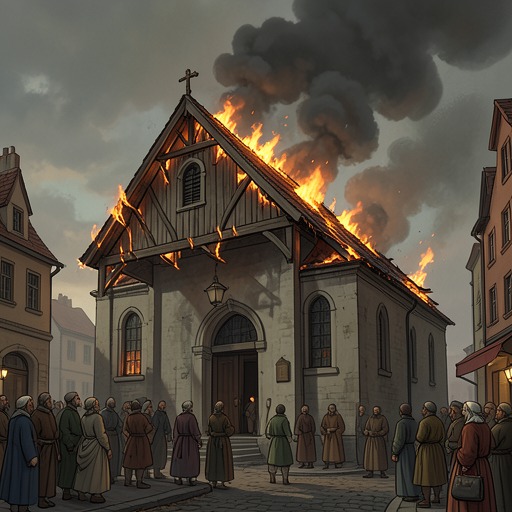
Norwegian Black Metal church arsons
Lords of ChaosThe Norwegian Black Metal church arsons were attacks on religious buildings that made the scene’s rhetoric of evil and resistance materially consequential. The fires were presented by some participants as retaliation against Christianity and as a way to revive pre-Christian identity; they also became a source of notoriety, fear, and imitation. The book does not reduce the arsons to a musical cause: it places them within a shifting subculture where beliefs, appearance, status, media representation, and criminal action reinforced one another without forming a single, settled doctrine.
Background: a scene organized around extremity
Norwegian Black Metal was defined as much by belief and outlook as by sound. There was room for sonic experimentation, but musicians were expected to display recognizable attitudes; no fixed rulebook governed the genre, and its ideological boundaries changed over time. The scene’s direction was closely tied to its prominent personalities. Mayhem, associated with founder Øystein Aarseth, stood near its center, while Aarseth’s record shop became a gathering place and a point of reference for emerging bands. By mid-1991, Darkthrone, Burzum, Immortal, Thorns, Enslaved, Arcturus, and later Emperor were in contact with him, and he intended to release much of their work through Deathlike Silence Productions.
Access to the shop and acceptance by its older participants helped establish an internal hierarchy. Ihsahn recalled an atmosphere in which newcomers had to be trusted and recognized as serious in their views. People sought acceptance and showed deference to Aarseth and other established figures. Corpse paint and black clothing made those distinctions visible, although the appearance could also be adopted in settings where it looked conspicuous or out of place. The arsons emerged from a culture in which style and commitment were already being used to mark insiders, reject ordinary respectability, and compete over who represented the scene most intensely.
That culture was not ideologically uniform. Young participants might describe themselves as Satanists, Nazis, Odinists, or simply as evil, and the book stresses that the scene’s outlook shifted over time. Music, clothing, and provocative claims could establish an identity, but they did not mean that every band or listener shared the same beliefs or supported the same crimes. The movement from staged or symbolic extremity to attacks on buildings was therefore not a simple, universal progression from music to violence.
Fires as retaliation and performance
The arsonists’ stated reasoning often cast attacks on churches as justified retaliation against Christianity. A review of Scandinavian cases in the book compares this account with revenge-motivated arson: the fires were not merely gestures, but were intended to cause destruction. The perpetrators’ viewpoint made religious buildings stand for a broader Christian order, so the target acquired meaning beyond its physical structure. This rationale described the actors’ own interpretation; it did not make the attacks representative of a shared Black Metal creed.
Varg Vikernes gave the fires an additional heathen meaning. He described Burzum as a resurrection of primordial forces and presented the crimes as a means of awakening an inherited Norse identity. In his account, showing people Odin would cause that presence to burn within them. He also described the Norse figures not as conventional gods but as archetypes of the Northern race, connecting heathenism to ancestry and nature. The book notes that no central Ásatrú authority could prevent him from presenting this interpretation, while emphasizing how extreme and bloody it was. Contemporary revivalists had not set out to restore lawlessness or uncontrolled violence.
The fires also belonged to a deliberately cultivated image. Aarseth’s stated ambition to spread evil made a sinister public identity part of Mayhem’s project, and the band’s rare live performances were where its appearance most closely matched its reputation. When church burnings entered the scene’s public story, criminal action could function as a claim to authenticity and a means of gaining status. That connection is visible in the later use of the smoldering ruins of Fantoft Stave Church on promotional lighters for Burzum’s Aske album. A representative of Voices of Wonder later said that the lighter had been intended as a comment on the attention Vikernes received, not as approval of a real church arson; in retrospect, he regretted producing it. The object joined a recorded image of destruction to the promotion of music, even as its maker later distanced himself from that association.
Escalation, publicity, and competing accounts
The book situates the church attacks within a wider period of crimes and public alarm. In 1993, Asbjørn Dyrendal described a shift in headlines: stories about alleged Satanic ritual abuse had receded, and Black Metal had become a more visible subject. His account identifies young people, mostly teenagers, who tried on identities associated with evil and sometimes attacked people or property. During 1991–1993, several people were beaten, some were stabbed, and two people were murdered. These details place the arsons within a broader pattern of criminal activity, but do not establish that the church attacks alone caused that violence or that all participants were involved in it.
Dyrendal later revised his view of the media’s role. He concluded that publicity had been valuable to Vikernes in building a near-mythical public image and that intense coverage could sharpen the internal contest to become the scene’s dominant personality. In his account, media attention did not create the subculture’s internal dynamics, but it may have amplified them more than usual. He also described young people imitating images of Satanism they had encountered through media and Christian sources. Some participants appeared to perform the expected role in interviews, cultivating the implication of hidden crimes while withholding a clear admission. This helps explain how sensational coverage and self-presentation could feed each other without proving that reporting directly caused any particular fire.
The fires provoked fear and defensive action among congregations and police. Dyrendal records churches being watched at night, sometimes with little success; some buildings were later burned when watchfulness had lapsed. The public response was not uniform, and neither was the assessment within the music scene. Ihsahn could see that church burnings provoked religious communities to reconsider their beliefs, yet he also thought the attacks strengthened the Norwegian Church and regarded that consequence as a reason to condemn them. The arsons could thus be framed by participants as revolt while producing solidarity among the people and institutions they meant to challenge.
Aftermath and continuing force
Hendrik Möbus recalled hearing about the fires after Vikernes burned Fantoft Stave Church near Bergen on June 6, 1992, and described the subsequent wave across Scandinavia as electrifying. He said his circle already supported actions that weakened what it regarded as a Judeo-Christian order, and argued that artists who believed in their work should turn art into action. Möbus estimated that, from the first incidents to the time of his account, more than one hundred churches had been burned or damaged. That figure is his claim, not a verified total supplied by the book. He also said his group had made plans to become active before its members were incarcerated, but had achieved no concrete results.
The distinction between artistic expression and action became one of the episode’s central arguments. For some participants, a fire was a psychological attack: even if a damaged church could be rebuilt, the threat was intended to extend beyond the individual building. For others, the damage and the solidarity it generated made the tactic self-defeating. The book presents these as competing assessments rather than resolving them into a single measure of the fires’ effects.
Nor did rejection of arson by some early participants end the practice. The book observes that many people associated with the first wave later considered church burning futile or saw more effective ways to spread anti-Christian beliefs without going to prison. Yet later fans continued to commit acts of terror. In that account, Black Metal’s representation as a violent attack on society had acquired a life beyond the intentions of some of its early proponents. The arsons’ significance consequently lies not only in the buildings attacked, but in the passage from subcultural signs to criminal acts, and in the way notoriety could keep that passage available for imitation.