Norwegian Church Arson Wave
Lords of ChaosThe Norwegian Church Arson Wave was a succession of church fires and attempted attacks that, beginning in 1992, made Norwegian Black Metal a national focus of fear and controversy. Its significance lies not only in the damage to churches, but in the collision between a real series of crimes, participants’ claims that they were retaliating against Christianity, and media accounts that often presented the events as a unified Satanic assault. The evidence supports neither treating every church fire as a Black Metal crime nor reducing the wave to a media invention: the connections were substantial, but incomplete, and the competing explanations became part of the story.
The First Fires and Their Spread
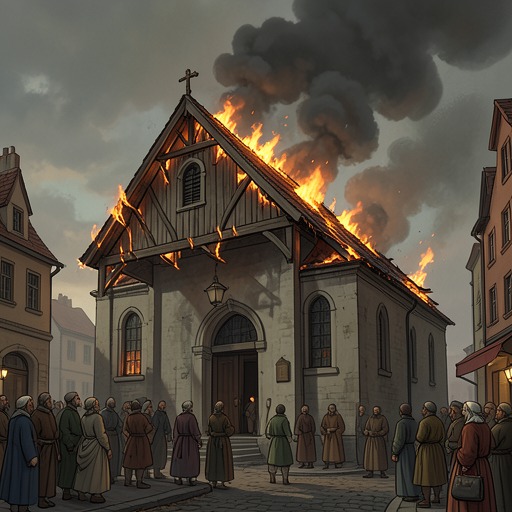
The destruction of Fantoft Stave Church near Bergen in the early morning of June 6, 1992, gave the wave its defining opening image. The church, a wooden cultural landmark on a wooded hill, was difficult to see from some vantage points until a visitor was close to it. Its construction made it vulnerable to fire, and the concealed setting made the arson easier to carry out. Varg Vikernes was strongly suspected of starting the blaze, but he was never convicted of that crime. A photograph said to have been taken by Vikernes shortly after the fire added to the later association between him and the destruction.
The fires soon appeared at other sites. Revheim Church in southern Norway was torched on August 1, 1992; twenty days later, Holmenkollen Chapel in Oslo burned. Ormøya Church caught fire on September 1, followed by Skjold Church on September 13. Hauketo Church burned in October. After a pause of several months, Åsane Church in Bergen was consumed by fire, and Sarpsborg Church was destroyed two days later. A firefighter died while tackling the Sarpsborg blaze. Some later attributed his death to Svarte Sirkel, but the evidence presents this as an attribution made by others, not an established finding.
The sequence was preceded by a small, ineffectual fire at Storetveit Church in the month before the Fantoft blaze. Looking across the wider record, the book estimates at least forty-five to sixty church fires, near-fires, and attempted arson attacks in Norway. According to Sjur Helseth, head of the Technical Department of the Directorate for Cultural Heritage, roughly one-third had a documented connection to the Black Metal scene. That distinction matters: the scale of the overall arson record was greater than the portion demonstrably linked to the subculture, and authorities were reluctant to publicize details for fear of encouraging further attacks.
Motives and Responsibility
The book places the Norwegian attacks alongside the category of revenge-motivated arson, while emphasizing that the parallel is limited. Vikernes and others convicted of burning churches presented their crimes as retaliation against Christianity. Vikernes argued that the Christian church had destroyed what he regarded as Norway’s beautiful, heathen culture. He described the arson wave as an instinctive uprising against Christianity and understood his music project, Burzum, as a means of encouraging such acts. These are his stated political and cultural interpretations; they do not establish a single motive for every fire or every person involved.
The suggested retaliatory motive also differs from a blanket explanation based on Satanic ritual or a clinical label such as pyromania. The book notes that churches had burned in Norway before the wave—typically one or two each year—and that lightning and faulty wiring accounted for many earlier fires. Against that background, a series of deliberate attacks was distinctive, but the existence of ordinary accidental fires makes it especially important not to count every blaze as part of the same campaign. The evidence instead presents a mixture of confirmed scene connections, suspected responsibility, and incidents whose causes were not established.
The pattern also crossed national borders in its influence, if not as a single coordinated operation. In an interview, Hendrik Möbus said that the fires had electrified his group and that they supported actions intended to weaken Christianity. He described the arsons as psychological warfare and said that plans for similar activity had been made before the group’s incarceration, though they had produced no concrete results. His account records an expressed response to the Norwegian events; it does not demonstrate that the Norwegian fires were directed by, or organized together with, groups elsewhere.
Publicity and the Satanic Frame
News of Fantoft’s destruction made national headlines, and the subsequent fires brought growing attention to Black Metal. On January 20, 1993, Bergens Tidende published a cover story featuring Vikernes and presenting him as a central figure in the crimes. The article helped establish the scene’s public image through Vikernes’s own theatrical self-presentation, as well as through claims about its aims. A prominent feature in the British magazine Kerrang! followed on March 27. Its dramatic cover and five-page report carried the Norwegian story to an international metal readership, while basing much of its account on alleged comments from Vikernes and Øystein Aarseth.
That publicity did more than report on the arsons. It circulated the image of Black Metal as a national menace and helped Vikernes build a near-mythic reputation within youth subcultures, according to an interviewee who later reconsidered the media’s role. The same analysis describes attention as intensifying internal competition for dominance in the scene. The book also warns against treating the effect as one-way: media focus could amplify the stakes and prestige attached to transgression, but the subculture had its own internal dynamics and crimes had already occurred.
Coverage often framed the fires as evidence of a broad Satanic conspiracy. A later account by Asbjørn Dyrendal describes how the emergence of Black Metal in the headlines replaced earlier Norwegian stories about Satanic ritual abuse. The public image centered on teenagers who variously adopted Satanist, Nazi, or Odinist identities, or rejected established labels in favor of an identity built around evil. Some attacked people; more commonly, they attacked property, including churches and graveyards. This account connects the climate of alarm to actual violence while distinguishing it from the impression that every young Black Metal adherent belonged to an organized Satanic campaign.
The resulting fear prompted concrete responses. Police and congregations kept watch over churches, sometimes with little success; some churches were later burned when vigilance had slackened. Dyrendal’s account describes one Oslo priest keeping night watch in a sacristy with an axe. The tabloids’ Satanic framing and calls to act against the threat reflected a broader struggle over what the attacks meant: religious conspiracy, youth crime, political retaliation, or a subculture’s deliberate performance of evil. The 1998 police report, Church Fires and Satanically Motivated Criminal Damage, later reviewed the scene’s organization, the investigations, and methods for police facing similar cases. Its retrospective approach brought the crimes into an official account without dissolving the contradictions and uncertainties surrounding the scene.
Decline and Legacy
The book describes the Norwegian wave as reaching a low ebb after the police crackdown sent many of its most active members to prison. With leading figures dead or older, the arson activity diminished, though sporadic attacks continued. That decline did not end Black Metal’s wider appeal. The Norwegian fires became a reference point for scenes and young people elsewhere, while the genre grew internationally; the book likens the spread to embers from a forest fire emerging far from their original source. This influence should not be mistaken for proof of a common organization: the account presents the fires as a catalyst and example, not as a centrally managed international campaign.
The wave’s lasting significance is therefore double-edged. The attacks were real, and some were demonstrably connected to Black Metal participants who cast them as anti-Christian retaliation. Yet the documented connection covered only a portion of a larger record of fires and attempted fires, and sensational coverage often blurred that distinction. In the book’s account, publicity helped convert crimes into both a national scare and a source of subcultural reputation. The churches that burned remained physical evidence of deliberate attacks; the explanations attached to them—ritual, revenge, performance, or political resistance—continued to compete.