Samoth
Lords of ChaosSamoth, the guitarist of Emperor, was both a participant in the Norwegian black metal scene and one of its later witnesses. His account follows the scene from the intense, selective atmosphere around Øystein Aarseth’s Helvete record shop into church arson, police investigations, and prison sentences. It also records a personal change: the younger Samoth used extreme appearance and outspoken views to mark himself as different, while the older Samoth said he no longer needed other people’s reactions to establish who he was.
Identity and Place in the Scene
Emperor emerged from the Telemark countryside as Norwegian black metal was taking shape. The scene was not governed by a fixed rulebook: its boundaries and expectations shifted, and influential musicians helped define what counted as belonging. By mid-1991, Emperor was among the groups in contact with Aarseth, who planned to release much of the music through Deathlike Silence Productions. The scene’s authority was personal as well as musical, concentrated around the people and places that could confer recognition.
Samoth describes Helvete as a demanding environment rather than merely a record shop or meeting place. Visitors had to be trusted and accepted; they were expected to demonstrate that their views were serious. People came in corpse paint, sometimes even during the day, and showed deference to Aarseth and the older members of the scene. Samoth remembered the atmosphere as powerful and difficult, with acceptance something people wanted and had to earn. The shop’s influence rested partly on this informal discipline: it made belonging feel consequential even without formal rules or organization.
Helvete, Mayhem, and Musical Connections
At one point, Samoth lived in the basement of Helvete with Varg Vikernes, who had come from Bergen to Oslo. The room was described as barren, and the arrangement placed the two musicians inside the scene’s central gathering place as well as its social network. The musical boundaries between bands were porous. Samoth played bass on Aske, the second Burzum release, the sole exception to Vikernes’s practice of making Burzum entirely by himself.
Samoth also played as a stand-in bassist for Mayhem and performed on the band’s debut full-length album, De Mysteriis Dom Sathanas, which the group was still trying to complete. In an interview from this period, Vikernes praised Mayhem’s then-current lineup, naming Hellhammer as an outstanding drummer and Euronymous as a musical genius. He also said Hellhammer would play drums for Burzum, though that plan never came to pass. These connections show how closely the projects and personnel overlapped: Samoth’s role in the scene was not limited to Emperor, and the same musicians could move between bands while their albums were being developed.
Church Arson and Samoth’s Retrospective
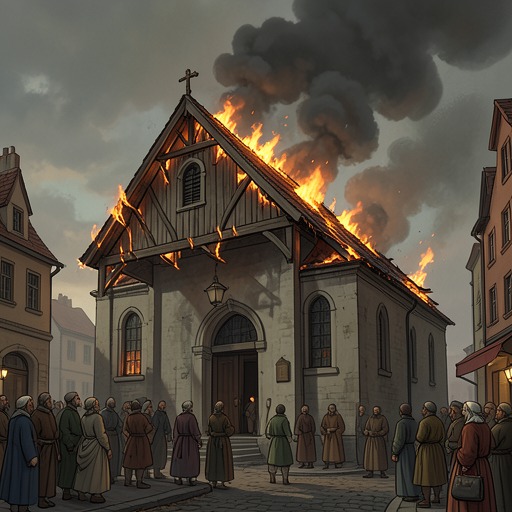
Samoth traced his awareness of the idea of burning churches to a hint in a letter from Vikernes in 1992. Later, someone showed him photographs of church ruins at Helvete. He said he joined the arsons because participation felt right to him, although the acts happened spontaneously and the thought had been present for some time. His account does not describe a structured campaign directed through formal meetings. He characterized many actions in the scene as decisions to act that night; for a brief period, participants shared a sense of unity and strong ideas, but that unity soon weakened, and too many people knew what was happening.
In retrospect, Samoth treated the fires as symbolic opposition to Christianity and as extreme acts directed against the church and society. He said they strengthened his own feelings and marked a step away from ordinary daily life. At the same time, he judged their consequences negatively for the scene: the fires brought media hysteria and intensified public prejudice, while the resulting black metal attention was driven by sensational coverage. He believed the acts had made the existence of anti-Christian forces visible, but suggested that serious, intelligent propaganda might be a more effective way to reach people. His reflection therefore holds together attraction to the act’s extremity and a recognition that its public effects did not match its intended point.
Murder, Investigation, and Confession
Samoth said Aarseth’s murder did not initially come as a shock, though he hoped Vikernes was not responsible because he expected the consequences would be severe. Vikernes was arrested soon afterward, and police began a large investigation of the scene in Norway and Sweden. Samoth said Aarseth’s death affected him little personally, but that the murder brought the scene’s collapse: people were arrested and imprisoned. He had been on good terms with both Aarseth and Vikernes, had heard each speak critically of the other, and had not wanted to take sides. After the confessions and trials, relations among some of those involved became strained. He later rejected the idea that Aarseth should be treated as the scene’s king, stressing his own independence from that hierarchy.
Samoth’s own encounters with the police unfolded over several stages. He was questioned after Vikernes publicly attributed the church fires to the Black Circle and claimed to know something about the Olympic Park Murder. Samoth said he disclosed nothing relevant then. After Aarseth’s murder, he was questioned again in connection with Bård Eithun’s murder and the church arsons, but still did not provide relevant information. He was arrested in September 1993, after others had been arrested and Eithun had confessed. Three people from the scene had made statements against him; while he later considered those statements weak, he said that at the time he did not understand the law or the process.
In custody, Samoth first tried to explain his way out of the case, which he later considered a mistake. When a stronger statement against him emerged, he decided to confess. He thought he would be convicted regardless and believed Vikernes was already so deeply implicated that his own confession would make little difference. He described the decision as partly a surrender and partly a choice to put himself first. The account presents his confession not as a single isolated decision but as the end of a progression through questioning, legal advice, fear of the process, and a changed assessment of his chances.
Sentencing and Change
Samoth was among the participants in church arson who confessed and received a sentence of two to three years, to be served in a minimum-security institution. The penalties varied widely: Vikernes received twenty-one years, Bård Eithun fourteen, and Snorre Westvold Ruch eight. The cases also brought substantial financial claims against people involved in the fires, intended to cover damage and reconstruction. Samoth’s sentence placed him within the broader aftermath in which the scene’s loose network gave way to investigation, convictions, imprisonment, and lasting conflict among former associates.
Looking back on his youth, Samoth said he had once dressed and behaved more extremely to show people around him that he was different and held strong views. The response mattered because it helped confirm his identity. As he grew older, he developed more rational views and became comfortable with his beliefs; he no longer felt a need to prove that he held them or to present himself as a Satanist in order to provoke a reaction. That change gives his recollections a distinctive arc. The same person who remembered the force of the scene’s image and its appetite for extremity later described a less performative relation to belief, while remaining clear about the consequences of actions in which he had taken part.