Vikernes Church Arson Compensation Judgment
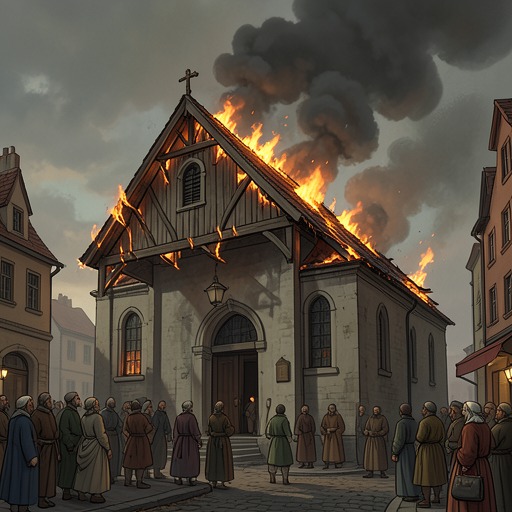
Lords of ChaosThe Vikernes Church Arson Compensation Judgment turned the destruction of churches associated with the Norwegian Black Metal scene into a substantial civil liability for Varg Vikernes. Although claims initially sought nearly 40 million Kroner for rebuilding costs, the court ordered him in December 1997 to pay 8 million Kroner, with interest accruing from the summer of 1996. The proceedings connected the scene’s rhetoric of anti-Christian defiance to a concrete financial consequence, while leaving a marked gap between the amount claimed and the judgment imposed.
Claims and the scale of the damage
The City of Oslo sued Vikernes over the burning of Holmenkollen Chapel. The insurance company Gjensidige separately pursued claims relating to Skjold Church and Åsane Church in Bergen. The original demand was that Vikernes compensate the full cost of rebuilding the churches, a sum described as nearly 40 million Kroner, or about 5 million dollars.
That demand was later reduced to exclude the costs of consecrating rebuilt churches and holding cake parties afterward. Even with those expenses removed, around 37 million Kroner remained at issue. Vikernes rejected the charges, setting up another passage through the courts after his criminal convictions.
The figures belonged to a wider pattern of loss. The Norwegian Directorate for Cultural Heritage estimated that fully reconstructing a destroyed church could cost between 15 and 30 million Kroner; the rebuilding of totally damaged churches alone could therefore reach 300 million Kroner. Those estimates excluded damage to partially harmed churches and the cost of artistic decoration. Fantoft Stave Church, a church museum and tourist attraction near Bergen, had become a central symbol of the burnings. Its owner intended a faithful reconstruction, but kept the project’s exact cost confidential.
The courtroom and the ruling
At the hearing, Vikernes appeared in green fatigues and leered, presenting himself in the courtroom as a public enemy. Security reinforced the exceptional atmosphere: everyone admitted was searched with metal detectors, an unusual measure in Norway. His defense attorney argued that Vikernes had been wrongly convicted of the church burnings, that the charges were outdated, and that he had no money to pay. The defense sought acquittal on all counts.
The court rejected those arguments. In December 1997 it ordered Vikernes to pay 8 million Kroner in damages. The judgment was far below the roughly 37 million Kroner still being claimed, but it carried a further cost: a 12% interest rate calculated from the summer of 1996. By the time of the trial, the interest alone had already reached nearly one million Kroner.
The scene behind the claims
The lawsuits unfolded against a scene with no fixed ideological rulebook. Its beliefs and outlook mattered as much as the music, and its boundaries shifted over time, often under the influence of its most prominent figures. By mid-1991, Darkthrone, Burzum, Immortal, Thorns, Enslaved, Arcturus, and later Emperor were in contact with Øystein Aarseth, who planned to release most of them through Deathlike Silence Productions. Aarseth called the circle of friends and acquaintances around these bands the Norwegian Black Circle when speaking to the press about the church burnings that were to begin before the end of the year.
Ihsahn recalled the record shop as a tightly controlled social environment: visitors had to be trusted and accepted, and people deferred to Euronymous and older figures in the scene. Corpse paint appeared even during daytime visits, making the scene’s visual identity conspicuous beyond performances. The close-knit atmosphere helped establish belonging and status, but the book also stresses that the scene’s attitudes were not static. Ihsahn, describing his own earlier involvement, said that extreme dress and strongly expressed views had once helped him provoke a reaction and prove his identity; with age, he became more comfortable with his beliefs and less interested in demonstrating them to others.
Accounts of the arsons convey how destruction could become a shared badge of defiance. One participant recalled first hearing about the fires on the news, then encountering Vikernes, who said he had burned a church and showed photographs. The participant described the act as impressive and evil, and remembered that others were inspired to do something similar. The fires came to feel personal, as an us-against-everyone cause; the speaker compared the group’s attachment to its destructive acts with the shared investment musicians feel in something they create, and described the resulting mood as a kind of war. Other explanations in the same account varied: some burned churches as a symbol against Christianity, some to prove themselves to respected figures, and some simply for the transgression itself.
Vikernes’s account and the judgment’s significance
In an interview, Vikernes denied that the activities had been organized in the way the public imagined and refused to say that he had burned churches. He nevertheless described one person as having started the sequence and identified the fire at Fantoft Stave Church as what triggered the wider events. He said that people linked the fire’s date, June 6, to Satanism because of the repeated sixes, while arguing that they overlooked the date’s association with the Viking raid on Lindisfarne in 793 and with Hordaland, his home county. These were his retrospective claims, distinct from the court’s findings and the compensation ruling.
The social reach of the scene extended beyond the record shop. Pubs in Oslo had served as meeting places for Black Metal musicians and other subcultures, including right-wing extremists, allowing movement between groups. One observer described a hierarchy in which musicians and senior figures occupied the top positions, and argued that the pursuit of recognition could become intense enough to contribute to extreme acts. In that context, the judgment supplied a different measure of consequence from reputation or status: the costs of reconstruction, a court’s rejection of Vikernes’s defense, and a continuing debt accruing interest.