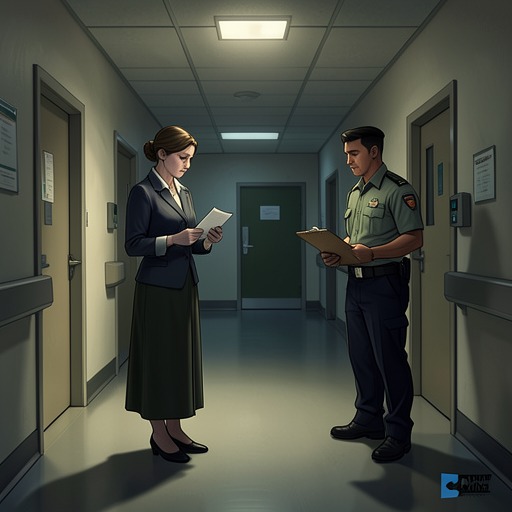
«El cepo»
Los renglones torcidos de Dios«El cepo» is the chapter heading and governing image for Alice Gould’s discovery that her admission to the psychiatric hospital was not voluntary. She understands that the supposed murder investigation drew her there, while the formalities filed in her name made departure difficult. The trap is at once legal and narrative: the investigation served as bait, and Alice’s own professional confidence helped lead her into it.
The expression and its discovery
The phrase means a trap or snare, and the chapter makes that meaning concrete through Alice’s reasoning. Alone on a ledge beside the hospital walls, and avoiding the part of the grounds where The Gnomo attacked her, she turns over the word motive. Someone, she reasons, must benefit from keeping her cut off from the world. She considers two broad possibilities: a positive benefit, such as interest or revenge, or a negative one, in which her detention prevents her from reaching a particular goal.
That distinction redirects her attention from possible enemies in her past to the investigation that brought her into the hospital. As a professional detective, she has dealt with blackmailers and swindlers, so revenge remains possible in her analysis. But the thought that someone might be preventing her from uncovering a crime grips her more strongly. Her question is no longer simply who wants her confined, but what discovery her confinement might obstruct. The trap image gives that change in reasoning a shape: she is not merely caught in an unpleasant place; she suspects that the circumstances of her arrival were arranged to stop her from doing something.
How the admission becomes a trap
The legal distinction Alice reconstructs explains why she cannot simply leave. A voluntary patient could depart with relative ease. An involuntary admission, made on the basis of a medical report and a family request, did not offer the same freedom; Alice compares the restriction to a prisoner’s inability to leave at will. The paperwork in her file follows the second route, not the straightforward process that would have applied had she chosen treatment herself.
The director spells out the mismatch during their confrontation. A voluntary admission would have required Alice’s own signed declaration and a certificate from Teodoro Ruipérez, the doctor who received her. Instead, her file contains a medical certificate from E. Donadío in Madrid, attesting to illness and the need for confinement, alongside a request from her husband, Heliodoro Almenara, as her relative. These are not interchangeable formalities: together they make the institution’s version of her admission one from which she cannot simply withdraw.
Alice therefore reads the procedure itself as evidence of purpose. Although the involuntary route involved greater complications, she concludes that it was used precisely because it would prevent her from leaving. In her understanding, Raimundo García del Olmo arranged the actual abduction with Samuel Alvar’s complicity, while she herself had unwittingly cooperated. The text presents her conclusion about their roles, but leaves her far from understanding their reasons. The trap is recognized before its full design is known.
Bait, capture, and self-reproach
Alice identifies the criminal investigation as the lure: the alleged crime she was recruited to investigate did not exist. The image of cheese offered to a laboratory rat expresses how she now sees her own participation. The metaphor is sharply self-accusing. She had entered as a detective pursuing a case, and only afterward interprets that professional purpose as the bait that made confinement possible. Her anger turns inward as she realizes that the role she trusted—the investigator capable of finding what others missed—was also the means by which she was drawn in.
The chapter’s preceding episode makes the language of admission resonate in a smaller, physical gesture. When Montserrat Castell says Alice is not yet a resident, Alice insists that her admission has just been issued, bends to retrieve a lighter from the floor, and hands it over with a trembling hand. The scene does not explain the later conspiracy, but it shows how quickly the hospital’s designation of her status becomes concrete. A word in an administrative process changes what she is called; the later discovery is that the process also changes what she is permitted to do.
The hospital’s open spaces and the hidden restraint
The trap is especially pointed against the hospital’s open-regime setting. Montserrat Castell explains that residents can move relatively freely through the building and grounds, spend time in the bar or workshops, join activities, and, in some circumstances, travel by bus to nearby towns. That apparent mobility does not erase the exceptions, nor does it change the legal conditions attached to Alice’s admission. The grounds may be open to movement while the route out remains controlled by her file.
Her search for a place apart from the other residents brings that contrast into view. She walks toward the boundary walls, avoiding the location of The Gnomo’s attack, and sits alone to examine the motive for her detention. Elsewhere, César Arellano defends the reformist argument for removing bars as a constructive change to old hospital systems, while cautioning that such changes require the necessary infrastructure. Read alongside Alice’s discovery, this distinction matters: a less visibly confining environment is not the same as freedom to leave. The chapter’s trap is not simply a locked door or a set of bars. It is the binding effect of an admission procedure that appears to have been built around her without her understanding what it would mean.
Narrative significance
«El cepo» marks a reversal in Alice’s understanding of her circumstances. She arrived believing she was investigating a crime; now she suspects the investigation was fabricated to secure her detention. Yet recognition is incomplete: she has inferred the mechanism and named the people she believes involved, but she does not know their reasons. The title holds both states together, the clarity of seeing the snare and the uncertainty of not knowing who benefits from it.
The image also binds the institution’s formal authority to Alice’s own mistaken confidence. Her admission paperwork constrains her from the outside, while the false investigative lead brought her to the institution in the first place. By calling herself the rat that took the bait, she makes her professional judgment part of the trap’s account without making it the sole cause. «El cepo» thus names not only confinement, but the painful recognition that an apparent opportunity to pursue the truth may itself have been arranged to keep the truth out of reach.