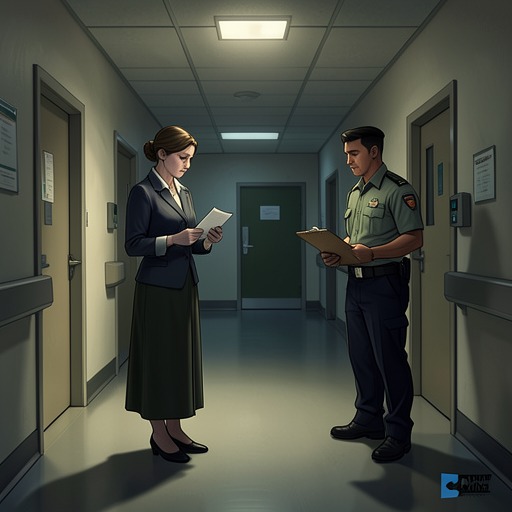
Alice Gould's Involuntary Admission Documents
Los renglones torcidos de DiosAlice Gould's Involuntary Admission Documents are the medical and family papers that make Alice Gould's confinement involuntary in the hospital's records, despite her insistence that she entered by choice as a professional detective. Their importance lies not only in what they say but in what their classification does: it places her admission under a procedure that, as she later recognizes, makes departure far harder than entry. The documents become the hinge between her account of herself and the institution's authority to treat her as a patient who cannot simply decide to leave.
The papers and the procedure
When Alice challenges the basis of her confinement, the director distinguishes two routes into the hospital. Voluntary admission, he explains, would require a declaration signed by Alice expressing her wish to be treated there, together with a certificate from Teodoro Ruipérez, the doctor who received her, confirming admission. That is not what the file contains. Instead, it records the steps for an involuntary case: a medical certificate from E. Donadío, a physician registered in Madrid, attesting to illness and the need for internment, and a request from Alice's husband, Heliodoro Almenara, as her nearest relative, addressed directly to the director for authorization.
The director's account makes the file more than a record of diagnosis. It is also the institutional chain of authorization: a doctor certifies a need for confinement, a close relative requests it, and the director approves it. A further signature, that of the deputy medical inspector in Madrid, is raised as the legal authentication of E. Donadío's signature. The director also points to a commitment by Heliodoro to pay the hospital expenses, since Alice is recorded as a paying patient. These elements are presented as features of the admission record; the exchange does not establish that every signature or document was forged.
Alice's account of their provenance
Alice does not deny that her husband's request bears his signature. She says she drafted the request herself and obtained his signature without his understanding what he was signing. She separately insists that E. Donadío's medical report is forged. Her account therefore disputes the truthfulness and authority of the paperwork without claiming that every mark on it is counterfeit. The distinction matters: a genuine signature, secured without an informed understanding of the document, can still serve a purpose its signer did not knowingly authorize.
She also rejects the record's implication that Heliodoro brought her to the hospital. Alice says that he did not accompany her on the day she was admitted; her client, Raimundo García del Olmo, did. She recalls that the director himself was absent and that a substitute was in charge, a circumstance she says made her investigation more difficult without the director's help. Her explanation preserves her original identity as an investigator even as the file identifies her as a patient admitted at her husband's request. In the confrontation, the papers and the competing accounts of her arrival cannot be separated: each proposes a different answer to who brought Alice there, why she came, and whose decision her confinement represents.
What the classification changes
After reflecting on the dispute, Alice identifies a practical difference between voluntary and involuntary admission. A voluntary patient, she reasons, can leave almost as easily as she entered. When admission follows a relative's request and a doctor's recommendation, departure is no longer at the patient's discretion; she compares it to a prisoner being unable to leave before completing a sentence. The analogy expresses her predicament, not a claim that the hospital has formally sentenced her. The crucial consequence is procedural: once her file places her in the involuntary category, her own account of having chosen to enter does not by itself release her.
The hospital's later language confirms the force of that classification. Samuel Alvar tells Alice that she entered as a paranoid person who had tried three times to poison her husband, and that her admission followed Heliodoro's request on a doctor's recommendation. He treats her claims about the admission as separate from the hospital's stated commitment to try to cure her. The records thus connect a contested family request and medical assessment to a clinical identity that the institution can continue to invoke, even while Alice disputes the premises on which it rests.
Institutional consequences and significance
The paperwork also raises the question of what Heliodoro might gain from being treated as the responsible relative. In a later discussion, José Muescas asks why Heliodoro, if he believed Alice had tried to poison him three times, did not report her to a judge, who could decide whether prison or the hospital was appropriate. Muescas suggests that a legal finding might instead have made Heliodoro his wife's guardian and administrator of her property, which he says could have served Heliodoro's interests. This is a question and an interpretation offered in discussion, not proof that the admission documents were created for that purpose; it nevertheless shows why the relationship between medical authority, family power, and financial responsibility remains under scrutiny.
The contested file gives administrative procedure a direct role in Alice's loss of control over her own movements. Her admission is not represented simply as an encounter between a patient and a doctor: it is routed through a certificate, a relative's request, the director's authorization, and a financial undertaking. Alice's own account complicates the apparent certainty of those papers, while the hospital's reliance on their classification determines the practical terms of her confinement. The documents therefore embody the novel's central tension between the story a person gives about herself and the version an institution can make operative.