Alice Gould’s undercover admission and investigation
Los renglones torcidos de DiosAlice Gould’s undercover admission turns the psychiatric hospital into both the setting of her investigation and the disguise that protects it: the staff and residents see a patient, while she is there to pursue a crime. The strategy gives her room to ask questions, observe, and take notes without immediately exposing her purpose, but it demands that she perform illness amid suffering she finds deeply distressing.
Mission and Cover
After a meeting with the acting director, Alice watches the door close, lights a cigarette with a white-gold lighter, and considers the encounter a success. Her answers and manner have gone as planned. More importantly, the hospital’s belief that she is not a detective works in her favor: if anyone notices her probing or recording details, they can attribute it to her supposed delusions rather than to an investigation. The cover is useful precisely because it makes the truth seem implausible.
The work nevertheless exacts an emotional cost. Alice is not at ease in the presence of other people’s suffering, and she recognizes that the patients around her bear injuries of the mind rather than visible wounds. She regards this assignment as more painful than her previous investigations because it requires her to enter a world of profound human distress, not merely observe it from a distance.
Her performance is also visible in small acts of compliance. When a resident insists that she has already been admitted and orders her to retrieve the lighter, Alice bends down with a trembling hand and returns it. The moment places her, however briefly, in the position of a new patient expected to obey; the same lighter that marks her composure outside the encounter becomes an object through which she enacts her assigned role.
The investigation has two linked targets: Alice means to discover who wrote a set of letters and, probably, who committed a murder. She understands that the culprit might be the murderer, the person who prompted the crime, or both. The scale of the task is immediately clear to her: the residents occupy different wards, and the person responsible may be concealed within that population. Her disguise lets her search among them, but it also immerses her in the institution whose suffering she had hoped to approach as an investigator rather than as a patient.
Alvar’s Guidance and the Discipline of the Cover
Alice’s plan depends on a partnership that remains invisible to the hospital. Samuel Alvar is her accomplice and the only person who knows for certain that she is entirely well; he advised her to feign paranoia. He is also an intimate friend of her client, Raimundo García del Olmo, and has agreed to provide whatever information she needs about the suspects. Alice repeatedly turns over Alvar’s name as she weighs her situation, aware that her access to the case depends on the same secret that makes her appear to the staff as a patient.
The choice of paranoia is practical as well as deceptive. Alice reasons that people with paranoid delusions may remain intelligent, capable reasoners and continue to perform the duties of their ordinary professions. Their outward behavior therefore gives her a plausible way to question, observe, and investigate without having to imitate the more conspicuous symptoms associated with other conditions. Her role is not simply to claim illness: she must sustain a form of illness compatible with the alertness her inquiry requires.
To keep the two purposes of her admission in view, Alice resolves to examine her conscience each day and review both objectives: feigning psychosis and identifying the author of the letters, who may also have been involved in a murder. Until Alvar arrives, she expects not to be medicated; the treatment she anticipates is repetition of an unspecified kind. The daily review makes her undercover work a deliberate act of self-surveillance: she must track not only the clues but also the consistency of her own performance.
That performance calls for restraint in ordinary encounters. Alvar has warned her to follow the rules as strictly as possible and avoid distinguishing herself from the other patients, even while offering, as he did with the sherry, to bend a rule for her when an opportunity arises. When he asks whether she wants him to stay while she gets into bed, Alice nods. His offer briefly supplies personal reassurance within a relationship otherwise organized around secrecy and the demands of the investigation.
The Hospital as Terrain of Inquiry
Montserrat Castell explains that the hospital’s open regime allows residents to move with relative freedom through the buildings and park. Patients may gather in the bar for dominoes, brisca, or parchís, walk in the garden, explore the extensive grounds, attend occupational therapy, or work in workshops that function as small industries. The objects they make are sold, and workers receive variable wages according to their abilities and output. Some residents can even leave the hospital by bus for nearby village festivals, though many exceptions limit this general freedom. For Alice, the arrangement creates a broad field of observation: residents circulate through shared spaces, but their movements and opportunities remain shaped by the institution’s rules.
That apparent freedom coexists with intensive dependence on others. Rómulo accompanies Niña Oscilante and Hombre Elefante, while nurses and patients alike help care for residents unable to move independently. At the Dementia Ward Known as the Lion Cage, some residents require help with dressing, eating, and getting into bed; staff must also manage toileting and clean patients who cannot care for themselves. This daily care places Alice’s inquiry amid forms of vulnerability that cannot be reduced to clues or suspect lists. The hospital is both a population to investigate and a system of labor, supervision, and dependence.
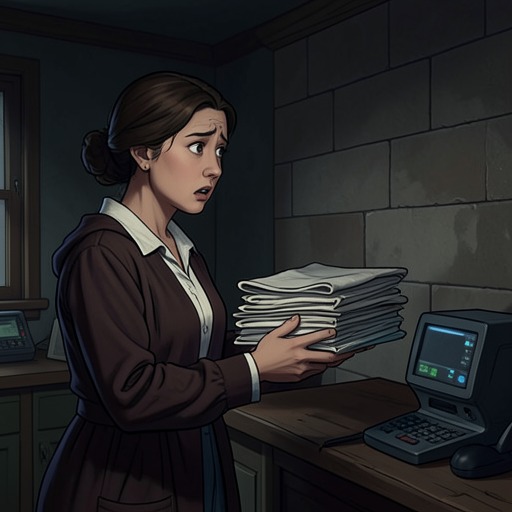
Alice’s investigation proceeds by turning institutional records and physical details into tests of competing explanations. She asks the director for access to selected patient files because she needs to identify who had permission to leave the hospital on the dates when Raimundo García del Olmo’s father was murdered. She gets the opportunity to inspect only one relevant file, and that happens when the commissioner has requested it for the office. The restriction makes the records useful but incomplete: her inquiry depends on access controlled by the same institution in which she is undercover.
In reconstructing the killings of two men, Alice distinguishes the evidence of the wounds from assumptions about who could have inflicted them. The victims’ throats were cut, and she concludes that Ignacio Urquieta could not have committed those murders. Her account identifies a different assailant: someone who spoke Basque, intercepted the men, and offered to guide them through the basement labyrinth by way of a supposed passage left by the former monks. He told them to wait while he fetched a lantern, but returned with a knife. In a separate line of reasoning, the moment Alice recognizes the dead man as Remo leads her to suspect the killer; she later describes how Hombre Elefante could crush him under his 160-kilogram weight. Together, these reconstructions show the method of her undercover work: observation, access to records, and close attention to what a body and a crime scene permit—or rule out.
The Cover Becomes Confinement
The undercover arrangement is finally exposed as more than a disguise when the director examines Alice’s admission papers. Alice maintains that she entered by choice and as a professional detective, but he distinguishes the documents for a voluntary stay—a declaration signed by Alice and an admission certificate from Teodoro Ruipérez—from what actually appears in her file. Her admission followed the procedure for involuntary confinement: a medical certificate from E. Donadío stating that she was ill and needed to be hospitalized, together with a request from her husband, Heliodoro Almenara, as her next of kin. The revelation makes the hospital’s version of Alice legally consequential, not merely a cover she can manage through careful acting.
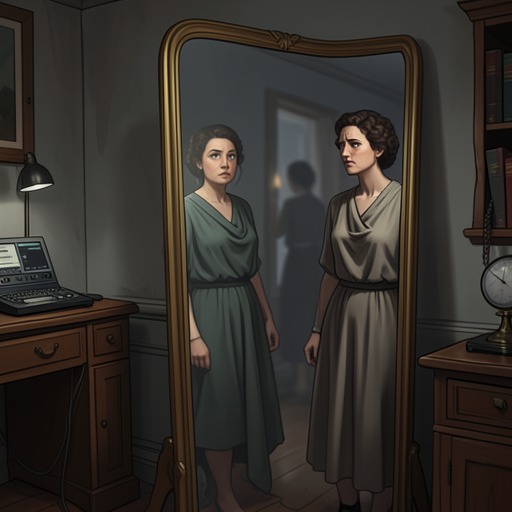
That reversal sharpens the danger built into the investigation. Alice entered believing that feigned illness would conceal her professional purpose; the paperwork instead gives the institution grounds to treat her as a patient against her stated account of herself. Her inquiry therefore unfolds under a double constraint: she must preserve the appearance that lets her investigate, while the admission record threatens to make that appearance authoritative. The disguise that grants her access can no longer be separated from the confinement it enables.