César Arellano
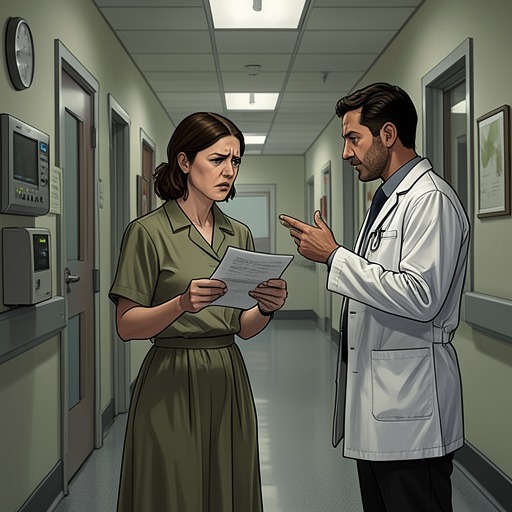
Los renglones torcidos de DiosCésar Arellano is a physician at the psychiatric hospital and one of Alice Gould’s earliest clinical contacts. His importance rests not on a single decisive intervention but on a changing relation to Alice: he first encounters her as a patient under observation, yet comes to occupy the more intimate place she later names as that of her first protector. His scenes connect the hospital’s work of gathering clinical information with the personal attention that can make a patient feel seen beyond a diagnosis.
Identity and Clinical Position
Arellano is introduced in the medical setting as Dr. César Arellano, and the narrative places him among the physicians involved in Alice’s assessment. In the early arrangement for her care, the stated task is to keep her under observation, collect data, and make that information available so that a doctor can decide on appropriate medication. The emphasis on observation and accumulated information marks a clinical process still in progress rather than a settled account of Alice’s condition.
Arellano’s questions bring the accusations surrounding Alice directly into the consultation. He asks why she tried to poison her husband, putting the charge at the center of the clinical encounter rather than leaving it as background to her admission. The question is pointed, but the portrait that follows is not reducible to suspicion: after listening to her, he falls silent and watches her with an expression described as combining compassion and admiration. He recognizes her as singular, intelligent, sensitive, and refined, while acknowledging that she has an illness not yet diagnosed. That unresolved combination—qualities he can perceive alongside a condition he cannot yet name—defines the tension in his early clinical role.
The narrative also associates him with explanations of mental illness. Later, he is shown explaining that many mental disorders have particular characteristics, though the available scene does not supply the rest of his account. The detail establishes him as a physician who interprets illness, but it does not reduce his characterization to medical exposition: the attention he gives Alice remains part of the same portrait.
Alice’s Assessment and His Personal Attention
Arellano’s early contact with Alice includes an offer that reaches beyond the formal exchange of questions. He asks whether she would like him to stay for a while as she lies down. The offer is modest and specific: remaining nearby during a vulnerable, ordinary moment, rather than making a grand claim about what he can do for her. In a hospital organized around observation and care, the gesture shows how clinical attention can also take the form of simple presence.
That distinction matters because Alice is being assessed amid serious allegations. At a later point, the director explains that her admission followed a request from her husband and a doctor’s recommendation, and describes her as a paranoid patient who has tried three times to poison him. Arellano’s earlier response to her does not erase those charges or establish that they are false. Instead, his compassionate and admiring observation holds open a space between the institutional account of Alice as a dangerous patient and recognition of her as a person with intelligence and sensitivity. The narrative sustains that uncertainty rather than making the physician’s sympathy into a verdict on the case.
Arellano also asks Alice for her view during a discussion among the doctors. In another scene, after Montserrat Castell takes her leave, he turns to Alice with a question. These brief moments place him in conversations where she is not merely the object of medical scrutiny: he addresses her and invites a response. The surviving details do not disclose the full content of those exchanges, but they show a recurring pattern of contact across both formal discussion and quieter encounters.
Protection, Trust, and Alice’s Account
Alice’s later conduct gives their relationship its clearest description. After a day that has left many impressions crowded in her mind, she visits the people she wants to speak with; Arellano is the last. She talks at length, telling him everything that has affected her. No dialogue is possible: the encounter becomes a monologue. Alice’s choice of listener and the narrative’s description of him as her first protector make the scene more than a routine consultation. She brings him an accumulated account, and his established place in her life is expressed through the trust implicit in that act of telling.
The contrast between this later monologue and the early clinical questions is significant. At first, Arellano asks Alice about the alleged poisoning; later, she pours out her own impressions without an exchange of questions and answers. The direction of speech has changed, as has the function of the encounter. The evidence does not specify what Arellano says in response, and the scene makes his silence or listening, rather than advice, the defining feature. His role as protector is therefore conveyed through Alice’s confidence and his availability as an audience, not through a documented power to resolve her situation.
Other moments suggest that Arellano remains a recognizable point of contact for Alice. She urges Montserrat Castell to locate him, while a later report relays that César has just telephoned. The fragments do not establish the purpose of either the search or the call. They do, however, place his name within the practical network through which people seek him out and pass on news. His importance to Alice is personal, but he is also part of the hospital’s working relationships.
Institutional Role and Narrative Significance
Arellano appears at several points where Alice’s case is considered by doctors. In one discussion, another physician asks what he thinks of Alice’s statements; elsewhere, the floor is given to a doctor before a medical conclusion is recorded. Near the final deliberations, Arellano is described among the notably silent participants, while José Muescas and Teodoro Ruipérez handle questions and clarifications. In the exchange that follows, Arellano is directly addressed, and a hesitant conclusion states that Alice can be released without danger to herself or others and may return home. The available passage does not establish every step of the deliberation, but it places his voice within the clinical judgment about her freedom.
The narrative also locates him amid events that test how doctors interpret evidence. When Alice argues that the continuous water at the old friars’ washhouses makes Ignacio Urquieta an impossible suspect, three doctors are convinced by her reasoning. The passage does not identify those physicians individually, so it does not warrant assigning Arellano a particular reaction. Its relevance to his character is contextual: the medical group around him is sometimes required to reconsider a patient’s account in light of concrete evidence, not merely repeat an initial suspicion.
A striking image shows Arellano standing several meters from an entrance with his arms spread in a cross-like pose. Alice later calls for him to be found. The episode’s fragment does not explain the gesture, and its significance should not be filled in with an invented motive. What it does contribute is an unusually vivid physical image amid a character otherwise defined largely through questions, consultation, and attentive listening.
Arellano’s narrative function lies in this combination of roles. He belongs to an institution that observes, classifies, and judges Alice, but he is also the physician she remembers as her first protector and the person to whom she entrusts an uninterrupted account. His compassion does not by itself settle the truth of her illness, and his presence does not abolish the hospital’s authority over her. Instead, the contrast between clinical scrutiny and personal trust gives his character weight: he stands where diagnosis meets relationship, and where a patient’s right to be heard remains distinct from the question of what the institution will decide.