Chemari Goñi
Los renglones torcidos de DiosChemari Goñi is the older boy whose brief childhood alliance with Ignacio Urquieta ends in a drowning that Ignacio cannot consciously remember for decades. A dare, a fall into water, and a pair of skates become the fragments around which Ignacio’s adult memory reconstructs a possible responsibility for Chemari’s death—without ever settling whether that responsibility is real.
Identity and Background
The episode takes place thirty years before the events being recounted. Chemari is seven, two years older than Ignacio, who is five; the boys attend different classes at the same school. They meet by the stop for a long, noisy school tram serving the Jesuit school in Bilbao. The incidental encounter will become consequential for both boys, though its meaning is invisible to them at the time.
Chemari is described as the kind of child bourgeois parents classified as bad company. The label has specific grounds: boys like him taught others vulgar words, broke streetlamps with stones, and skipped school, sometimes persuading classmates to do the same. Chemari’s influence on Ignacio begins with just such an invitation. His character is introduced less through an account of his home life or inner thoughts than through the mischief he initiates and the confidence with which he leads the younger boy into it.
The Skating Excursion
Chemari proposes that they miss school and spend the morning skating at Club Loreto, which has an outdoor skating rink and an indoor swimming pool. The boys’ abilities are sharply mismatched. Ignacio is an excellent swimmer but has never skated; Chemari swims badly, yet is an accomplished roller skater. The excursion puts Chemari in his element and leaves Ignacio struggling to keep up.
Ignacio’s shoes slip free of the skates, and he repeatedly falls. Chemari, meanwhile, skates forward, backward, and sideways, turns at will, and can stop suddenly. After Ignacio finally manages to move forward, he discovers that he cannot stop and throws himself backward to avoid hitting a wall. From the ground, he admires Chemari’s skill. Chemari responds to the praise by showing off further, taking a run-up and cleanly jumping over a folding chair. The exhibition establishes the older boy’s pleasure in being admired as well as his physical advantage over Ignacio on land.
The balance changes at the pool. Chemari pushes Ignacio into the water while taunting him for being presumptuous. Ignacio’s first instinct is to remove the skates, but he cannot manage it underwater. He gets his shoes off instead, leaving the footwear and its metal skate attachments on the pool bottom, and reaches the surface. Chemari laughs at what he regards as a heavy-handed joke. Ignacio conceals his anger, displays his swimming skill, and waits for a chance to retaliate. He offers Chemari a hand from the pool’s edge and then pulls him in. The boys’ joking contest has become an actual struggle in the water, but the available recollection does not establish exactly what happened during Ignacio’s underwater revenge or whether it caused Chemari’s later death.
Disappearance and Death
After the pool incident, the boys separate. Chemari leaves without saying goodbye. Ignacio runs home in his raincoat and socks, frightened and crying, and gives his mother a false account: he says he slipped from a mossy platform into the water near the harbor while watching children fish. The invented explanation conceals the outing and the pool, but the episode records no immediate confession or accusation between the boys.
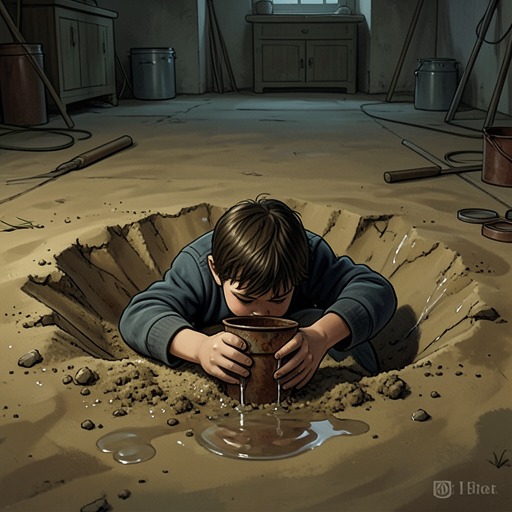
Ignacio avoids the school tram the next day in case he meets Chemari. The precaution proves unnecessary: Chemari also misses school. He is absent again when the first-term marks are issued and the Christmas holidays begin. When Ignacio returns after the break, he learns that Chemari has drowned. Employees discovered his body at the bottom of Club Loreto’s pool as they were preparing to empty it, with the skates still on his feet.
The news horrifies Ignacio, though he does not feel much grief because he did not like Chemari. A terrible doubt briefly comes to him, and he rejects it. He reasons that Chemari probably returned to the club to skate during the days he had missed school before the holidays. This explanation leaves the pool encounter and the death close together in the story while allowing Ignacio, at the time, to avoid joining them as cause and consequence.
The Buried Memory Returns
For thirty years Ignacio does not think about the incident. The past returns when, as an adult patient at the Nuestra Señora de la Fuentecilla Psychiatric Hospital, he is thrown into water fully clothed. The sudden dizziness feels identical to a sensation from childhood. For a short time, his present surroundings and identity give way to the earlier scene: the hospital pool becomes the pool at Club Loreto in Bilbao, he is a small boy again, and the person who pushed him seems to be Chemari rather than the adult associated with the hospital incident, Carolo Bocanegra.
As he swims, Ignacio remembers that he was already planning how to pull his attacker under. The impulse to take revenge feels not merely similar to the childhood feeling but continuous with it. Another image follows: the mute patient drowned at the bottom of the pool, burdened by heavy skates. That image brings back Chemari, whose body was found with skates on. The adult event thus unlocks the memory through a bodily sensation and a repeated arrangement of water, a push, and the possibility of retaliation; Ignacio’s explanation comes after the sensation has already carried him into the past.
Ignacio’s account remains uncertain even as his conviction strengthens. He wonders whether he had been told that Chemari drowned wearing his skates and refused to take it in, or whether that detail was missing from what he knew at the time. He identifies Chemari by name and tells the doctors that he is sure he himself killed him. The statement reveals the force of his recovered belief, not independent proof of how Chemari died. The remembered prank, the later discovery of the body, and Ignacio’s revenge remain linked, but the gap in his memory is not filled with a witnessed account of the fatal moment.
Narrative Role
Chemari’s brief appearance connects a childhood prank to Ignacio’s later crisis and recovery. His skating prowess first marks him as the confident instigator, while the pool reverses their positions: Ignacio, helpless on skates, becomes the capable swimmer and retaliates in the element he knows. The reversal gives the adult memory its shape, but it does not resolve its central ambiguity. Ignacio’s old anger and his adult guilt can be understood through the same remembered act without proving that his act killed Chemari.
When Ignacio later repeats his account to Alice Gould over a large jug of water at Pepe el Tuerto’s Roast Grill, the water is a quiet witness to a memory now spoken aloud. He and Alice have received their declarations of health that day and are celebrating together. Chemari, absent from the adult scenes except through recollection, therefore remains central to the meaning of Ignacio’s return to health: the forgotten past has surfaced, yet the certainty Ignacio attaches to it is still his own conclusion rather than a settled account of the drowning.