E. Donadío
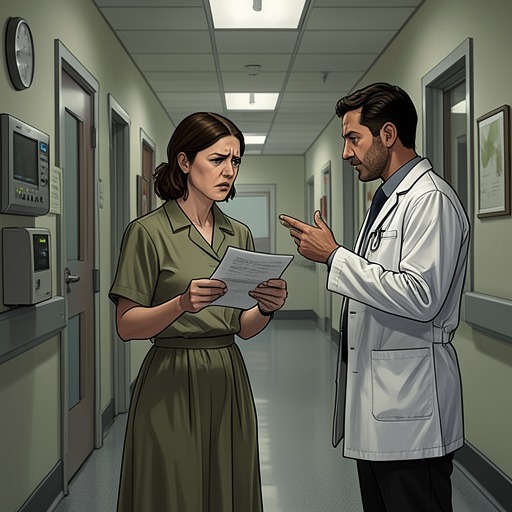
Los renglones torcidos de DiosE. Donadío is a physician whose authority enters the story through Alice Gould’s admission papers and a private letter to the asylum director, Samuel Alvar. His assessment helps place Alice in the institution involuntarily, while his written description of her becomes one of the first clinical accounts against which she must defend herself. The novel gives no extended scene of Donadío examining her: his character is assembled through documents and Alice’s rebuttal, leaving the reader to weigh professional judgment against a patient’s contested testimony.
Identity and Documentary Role
Donadío is identified as a physician registered in Madrid. His medical certificate, included in Alice’s admission file, records that she is ill and requires hospitalization. The paperwork follows the procedure for an involuntary admission rather than the simpler arrangement that would have applied had Alice chosen treatment herself. Her husband, Heliodoro Almenara, appears in the file as the relative who requested the admission; Donadío’s certificate supplies the medical authorization for it.
The distinction matters because Alice insists that she entered the hospital voluntarily as a professional detective investigating a case. When Samuel Alvar explains that her file records an involuntary admission, the paperwork contradicts her understanding of her own status. Donadío is therefore not merely a doctor mentioned in the background: his certificate helps give institutional force to a version of events Alice rejects.
The Letter to Samuel Alvar
While Alvar is away on vacation, Teodoro Ruipérez opens a personal letter Donadío addressed to the director, considering himself authorized to do so. In it, Donadío describes Alice as having a pronounced need to answer every question, even if doing so requires lying. He portrays her as unusually able to lie and as capable of contradicting things she has said previously. The report turns conversational habits and inconsistencies into evidence about her character, shaping how another doctor encounters her before the account can be tested against her own explanation.
The letter’s form also defines the limits of what can be known about Donadío. The reader receives his assessment through a private document opened by someone other than its addressee, not through a direct account of the consultation that produced it. Its confident portrait of Alice thus stands beside the circumstances of its circulation: it is an official-seeming clinical judgment, but also a written interpretation being passed between doctors while its subject has no part in presenting it.
Alice’s Dispute with His Judgment
Alice rejects the suggestion that she confessed to attempting to poison her husband. She tells Ruipérez that the accusation was made by an incompetent doctor, not established in court, and says she never admitted to Donadío that she had done what she was accused of doing. Her response draws a sharp boundary between an allegation, a medical conclusion, and a judicial finding—categories that the admission documents risk making appear settled.
She also gives her own account of Donadío’s reasoning. According to Alice, she persuaded him that she had lacked a motive to poison her husband; although she had not lacked the opportunity, he concluded that she was insane because, in his view, a person without a motive for an act must be mad. This explanation is Alice’s report of their exchange, not an independently narrated account from Donadío. Its significance lies partly in the way it exposes the interpretive gap between them: the same absence of motive that Alice presents as evidence against the accusation becomes, in her telling, a reason for the doctor to diagnose her.
Narrative Significance
Donadío remains largely offstage, yet his documents establish a consequential imbalance. His certificate and letter can travel through the institution as evidence; Alice’s denials must be heard from within the identity of a patient whose credibility the letter has already called into question. The contrast does not by itself prove either account correct. Instead, it makes the authority to classify Alice part of the story’s central uncertainty: whether her contradictions indicate deception, whether the accusation has been misrepresented, and whether a clinical interpretation has mistaken the absence of a motive for proof of illness.
His role is therefore defined less by a developed personal history than by the reach of his professional words. The certificate helps make Alice’s confinement involuntary, and the letter supplies Ruipérez with a suspicious portrait of her; Alice, in turn, disputes both the alleged confession and the logic she attributes to Donadío. The resulting conflict leaves his assessment present even when he is absent, as one of the documents through which the institution’s version of Alice competes with her own.