Guardia Civil
Los renglones torcidos de DiosThe Guardia Civil is a law-enforcement presence in the novel whose brief appearances connect public authority with the asylum’s institutional world. It intervenes directly in Pecas’s rescue and referral to the courts, then becomes the focus of a comic but revealing encounter when officers meet a procession of patients and staff on an outing. The contrast is between action taken in response to a grave case and the patients’ fearful, exaggerated reading of an everyday meeting with authority.
Rescue and judicial referral
The Guardia Civil becomes involved after Pecas is found in appalling condition: naked, severely malnourished, and terrified by noise, voices, and light. Those who discover him report what they have seen at the first Guardia Civil post they reach. The officers then rescue him with assistance from another man and report the case to the court. The account thus presents the organization not merely as a recipient of information but as an agency that takes part in bringing a vulnerable person out of immediate danger and placing the case before judicial authority.
The intervention has consequences beyond the rescue. The judge orders proceedings against Pecas’s parents and directs that Pecas be admitted to the asylum’s Emergency Department, which is headed by José Muescas. His path from discovery to institutional care therefore passes through both law enforcement and the courts. The episode also shows how protection and confinement meet in the same sequence: Pecas is removed from the conditions in which he was found, but the judicial response also results in his commitment to the hospital.
The officers and the asylum outing
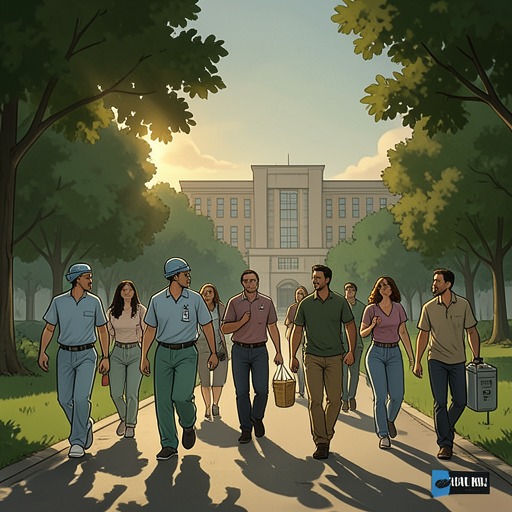
A later encounter takes place during a country outing involving more than two hundred people, patients and staff together. Two Guardia Civil officers meet the procession and ask the nurses at its head where it is going and why so many people are abroad. The sheer size of the group makes the outing look less like an ordinary excursion than a mass escape, giving the officers’ practical questions an immediate context without suggesting that the officers themselves treat it as a criminal flight.
The patients interpret the officers’ presence through their own fears. When Rómulo sees a nurse shake hands with one of them, he follows suit, believing that the gesture is required when greeting the authorities and that refusing it might lead to pursuit or imprisonment. The misunderstanding spreads into a queue: the officers have to shake roughly three hundred hands, as some patients return two, three, or even five times, while others stop to talk at length. The scene turns a routine encounter into a measure of how institutional authority shapes the patients’ expectations, even outside the hospital.
Narrative role
These appearances give the Guardia Civil a limited but distinct function in the story. In Pecas’s case, its action helps carry a report of severe mistreatment into the judicial system; on the outing, the officers serve as a real-world authority onto which the patients project the possibility of arrest. The first episode is consequential and procedural, while the second is largely comic. Read together, they distinguish what the officers do from what the patients fear they might do, and place law enforcement at the boundary between the asylum and the wider society.