Hospital Medical Committee
Los renglones torcidos de DiosThe Hospital Medical Committee becomes the institutional body whose unanimous decision frees Alice Gould, even though its members know she is still ill. Its handling of her case brings clinical judgment into direct conflict with the consequences of involuntary admission: a declaration of sanity can secure her liberty without resolving whether she is well.
Institutional remit and the stakes of admission
The Committee’s decisive role emerges against the distinction between voluntary and involuntary admission. The director explains to Alice that she did not enter under the simpler voluntary procedure: her file records a medical certificate by E. Donadío and a request by her husband, Heliodoro Almenara. That difference matters beyond the original paperwork. Alice reasons that a voluntary patient can leave almost as readily as she entered, whereas a patient confined on a relative’s request and a doctor’s recommendation cannot simply choose to go. The Committee’s later decision therefore concerns more than a clinical label; it determines whether the hospital will continue to hold her under the circumstances of her admission.
The Committee’s work also sits within a wider institutional practice of certifying people as sane. At the meeting, Dolores Bernardos notes that the doctors have signed eight or ten declarations of sanity in recent days and suggests that some may need reconsideration. Alice’s case has caused particular unease. The procedure is not presented as an abstract review: the doctors must listen to information that may alter how they understand the patient, her confinement, and the documents on which it rests.
The hearing on Alice Gould
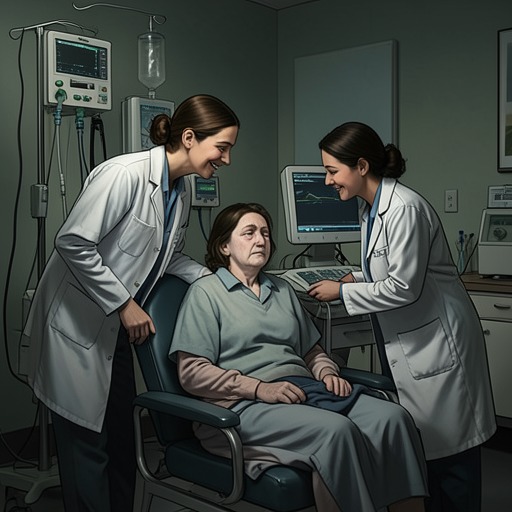
Dolores Bernardos moves the exceptional meeting to her office because it is unusual to have someone outside the hospital’s psychiatric staff present. That outsider is María Luisa Fernández, whom Alice had asked to investigate the obscure circumstances surrounding her case. Dolores invites her to explain her findings to the doctors. The setting makes the Committee a forum where clinical authority has to reckon with testimony from beyond its own ranks.
María Luisa reports that Heliodoro Almenara forged his wife’s signature and, while she was confined in the hospital, appropriated an inheritance that belonged to her. He has since fled Spain. The account is painful for those listening, and it changes the meaning of Alice’s confinement: the hospital admission is entangled with a deception that enabled her husband to take her property. Earlier that same day, Alice carried a duplicate of her declaration of sanity as she visited the hospital’s units to say goodbye. Patients embraced her, wished her happiness in her new life, and promised to visit. The Committee’s review thus takes place as her departure already seems imminent to the people around her.
The doctors do not respond as a single, uncomplicated voice. José Muescas asks why Heliodoro, if Alice had tried three times to poison him, did not bring the matter before a judge. In his view, a judge could have decided whether prison or a hospital was appropriate; a legal guardianship might also have placed Alice’s property under her husband’s administration. His question makes the financial consequences of the case part of the Committee’s deliberation, rather than allowing the accusation of poisoning to settle the issue by itself. César Arellano remains among the silent doctors, while José, Teodoro Ruipérez, and Salvador Sobrino ask questions and seek clarifications. Dolores steers the inquiry toward a reasonable conclusion.
Unanimity, judgment, and release
Dolores says she does not want to influence the others, while acknowledging that she has always trusted Arellano’s prognosis. After hearing María Luisa’s account, however, a majority is not enough: Dolores requires unanimity. She describes the struggle between Alice, an intelligent patient with paranoia, and the hospital director as one in which Alice has defeated the doctor and driven him to resign. Her framing registers both Alice’s formidable force in the dispute and the institutional upheaval it has produced.
The final exchange turns on a single vote that is initially misunderstood. A doctor protests that there is only one no; the voter clarifies that the no means not to withdraw the document already given to Alice, and to leave her free. The Committee’s decision is unanimous: it declares the mental health of a resident whom every member, whether openly or not, knows to be ill. The result does not erase the doctors’ awareness of her condition. Instead, it sets that knowledge beside the decision not to revoke her declaration or keep her confined.
Significance
The Committee’s importance lies in the gap between diagnosis and institutional action. Its members do not arrive at a simple finding that Alice has recovered; the narrative explicitly preserves their knowledge that she remains sick. Yet their unanimous vote releases her, after testimony has exposed the forged signature and the seizure of her inheritance. The decision makes the Committee’s authority consequential precisely because it cannot be reduced to a medical verdict: it has to decide what that verdict will mean for a person whose involuntary admission has also served another person’s interests.