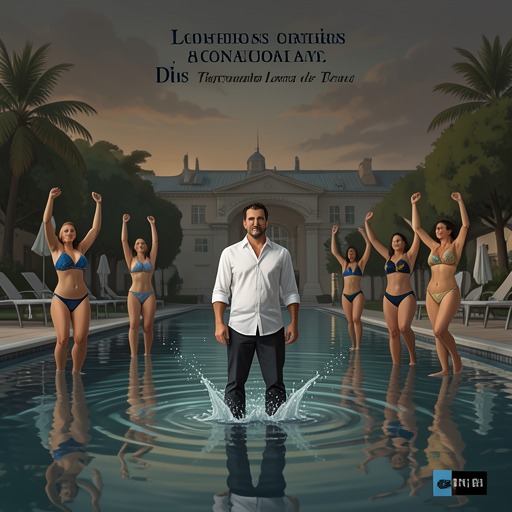
Ignacio Urquieta’s Pool Attack and Recovery from Hydrophobia
Los renglones torcidos de DiosIgnacio Urquieta’s pool attack turns an act of cruelty into a sudden recovery. When fellow patients carry him to the water and throw him in, his terror first appears to confirm the severity of his hydrophobia; then his body begins swimming, and the plunge unlocks a buried childhood memory. The episode resolves the immediate fear while exposing a more painful truth: Ignacio connects his schoolmate Chemari Goñi’s drowning to his own actions and has not been able to face that connection until the pool makes the past present again.
The Attack and Its Setting
The assault begins when a group of patients form a conspiracy against a man they regard as another patient pretending not to be mad. Six of them seize Ignacio from beside Alice Gould and carry him toward the pool, intending to throw him into the water. Alice cries out to two nurses for help and runs toward the sports area, while Ignacio struggles in their arms with his eyes closed so he will not have to see the water. The scene makes clear that this is not a planned treatment: the patients’ action is cruel, and Alice tries to stop it.
Alice arrives in time to see them throw Ignacio, still dressed, into the pool. His cry is described as a howl of panic; the image makes the water seem to him like a place of imminent death. Two nurses remove their shoes and coats to rescue him, and Alice prepares to follow them. Before anyone can reach him, however, the body that had been thrashing in the water takes off its shoes, which sink to the bottom, and begins to swim slowly and rhythmically. His response changes the scene in an instant: the anticipated rescue becomes a stunned observation of a capacity he had believed fear made impossible.
From Panic to Recognition
Ignacio reaches the opposite edge, turns, pushes off, and swims the length of the pool three times, then climbs out by the ladder. Alice and the nurses hurry to him. He does not answer Alice’s first question about whether he is all right; shortly afterward, he exclaims that he is cured, his voice carrying both astonishment and happiness. The recovery is therefore registered first as bodily action, before Ignacio can explain it. The calm, repeated lengths of the pool stand in sharp contrast to his helpless struggle moments earlier.
He describes the change as a sudden flash of understanding. Being thrown into the water while dressed produces a faint spell that feels identical to one he experienced as a child. In the instant of the fall, he imagines that the present has become the past: the asylum pool is the pool at Club Loreto in Bilbao, he is five rather than thirty-six, and the person who pushed him is his schoolmate Chemari rather than Carolo Bocanegra. The episode links the adult phobia to a specific remembered scene, not merely to water in the abstract.
The Memory of Chemari Goñi
The recollection gathers around the figure Ignacio calls the Mutist and the image of a drowned boy weighted by large roller skates. Thinking of the Mutist drowned at the bottom of the pool leads Ignacio back to the memory of his dead classmate. He cannot establish whether anyone told him that Chemari drowned with the skates on, or whether he heard and refused to take it in. That uncertainty remains part of the account; what becomes newly certain to him is Chemari’s name and Ignacio’s own responsibility. He insists that the schoolmate was Chemari Goñi and that he himself killed him.
The restored memory does not arrive as a detached explanation delivered before the crisis. It erupts through the physical repetition of the childhood scene: a fall into water, a remembered shove, and the return of the boy’s death. Ignacio’s mind initially replaces the present assailant with the schoolmate, then connects that remembered push to the drowned child and to his own guilt. The episode gives the hydrophobia a history while preserving the disturbance of recognition: Ignacio can name what he believes happened, but his uncertainty about what he was told shows that the memory had been inaccessible or resisted.
Aftermath and Significance
Ignacio later recounts the experience to the doctors and repeats it to Alice Gould over a large jug of water at Pepe el Tuerto’s Roast Grill. The jug serves as a silent witness to the recovery: water, which had organized his fear, is now present at the meal where he can tell the story. He and Alice have both received declarations of health on the same day and decide to celebrate together; their later lunch gives the private breakthrough a shared aftermath without diminishing its unsettling content.
The episode’s reversal is both physical and psychological. The patients intend to use the pool as an instrument of humiliation, and Alice initially sees a man in mortal danger; instead, Ignacio swims, and the assault breaks open the memory concealed behind his fear. His declaration of cure marks a decisive change, but the recalled death prevents the scene from becoming a simple triumph over a symptom. The water restores his ability to act while forcing him to confront the loss and responsibility he associates with Chemari Goñi’s drowning.