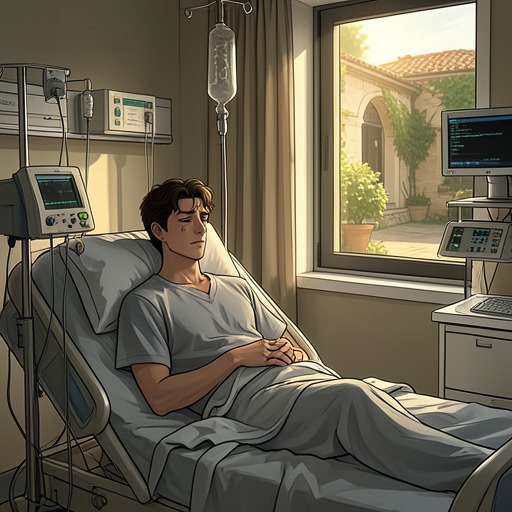
José Muescas
Los renglones torcidos de DiosJosé Muescas is an asylum physician who directs the Emergency Department and takes an active, often challenging role in clinical discussions. His importance in Alice Gould’s story lies in his resistance to treating a psychiatric label as a complete explanation: while other doctors debate her paranoia and possible deception, he argues that she may instead be the victim of a fraud. At the final decision about her freedom, a misunderstood vote briefly makes his position appear more punitive than it is; he explains that he supports leaving her at liberty.
Identity and Medical Work
Muescas is identified as the physician in charge of the Emergency Department, where patients brought into the hospital under urgent circumstances are received. The arrival of El Pecas, rescued after being found in an appalling state of neglect, is connected to that department: the Civil Guard brings him to the hospital on the same day Alice has a disastrous interview with Samuel Alvar, and he is admitted under Muescas’s service. When colleagues ask about El Pecas’s condition, Muescas is among the physicians discussing it, establishing his involvement in evaluating patients whose needs extend beyond routine consultation.
His position places him within the hospital’s medical structure, but the narrative does not reduce his role to administration. He takes part in the doctors’ deliberations, asks pointed questions, and offers interpretations that challenge the assumptions governing a patient’s treatment. A description of the medical staff presents him as pale and particularly restless: under emotional pressure, he changes posture more than anyone else in the room. That visible agitation contrasts with the director’s customary calm and gives Muescas a physical presence in the tense institutional meetings, without making his arguments any less direct.
Treatment and Clinical Judgment
Muescas’s approach to treatment is significant in the dispute over Alice’s care. When she is told that insulin treatment is about to begin, she reacts with alarm; in a later conversation, she specifically recalls that Muescas had been prepared to treat her with insulin. The evidence establishes his readiness to use that treatment, but does not specify its clinical rationale or show that it was administered. The episode nonetheless places him on the side of active medical intervention at a moment when Alice is emotionally withdrawn and the prospect of treatment jolts her into fear.
His clinical judgment is not simply an endorsement of the diagnosis that brought Alice into the hospital. He questions whether the supposed paranoia is convincing and proposes an alternative account: Alice may have been caught in a swindle. This distinction matters because the diagnosis is tied to her involuntary admission, while the possibility of fraud shifts attention toward what may have happened to her outside the hospital and toward the interests involved in keeping her confined. Muescas’s intervention does not establish the fraud as a medical finding; it demonstrates that, within the doctors’ discussion, he refuses to treat the original interpretation as beyond scrutiny.
Alice Gould and the Doctors’ Deliberations
At a meeting about Alice, Muescas becomes one of the clearest challengers to the account that her husband, Heliodoro Almenara, has acted as a straightforward victim. He asks why Heliodoro, if Alice had tried to poison him three times, did not report her to a judge. In Muescas’s reasoning, a legal complaint would have left the decision between prison and hospital to the court. He adds that a husband declared his wife’s guardian could administer her assets, and suggests that control of her property might have been what Heliodoro wanted. These are questions and suspicions voiced in debate, not independent proof of Heliodoro’s motive; their force is that they expose the financial consequences hidden inside the family’s version of events.
Muescas also distinguishes Alice’s apparent psychiatric condition from the institutional circumstances of her admission. The doctors hear a recording of her first account of herself at the hospital, and the meeting proceeds through competing interpretations of her behavior and history. Muescas’s suspicion of fraud puts pressure on the assumption that the reported attempts to poison Heliodoro settle what kind of patient she is. His contribution makes the dispute not only about symptoms but also about who benefits from treating Alice as ill and who has authority over her life and property.
His manner in these discussions is direct. When the commission examines Alice, he insists that the group hear what she saw and inferred, inviting her to dictate her account after the discussion turns to her conclusions about the dead. Elsewhere, he takes charge of questioning and pressing for clarification during the inquiry into Alice’s history. The narrative thus associates him with scrutiny: rather than simply repeat a settled diagnosis, he asks for reasons, tests the consistency of other people’s accounts, and gives Alice’s own deductions a place in the examination.
Disagreement, Vote, and Narrative Role
Muescas’s views diverge from Alvar’s interpretation of other patients as well. In a discussion of diagnoses, Alvar’s readings of Norberto Machimbarrena and Maruja Maqueira are contrasted with Muescas’s different interpretation. The disagreement places Muescas within a wider debate about whether unusual beliefs and histories should be understood through a psychiatric framework, and how much confidence physicians should place in their own explanations. The available account does not supply the full details of Muescas’s alternative reading, so its significance rests on the fact of disagreement rather than on an unstated diagnosis.
The sharpest consequence of his position comes in the doctors’ decision about Alice’s discharge. When the votes are taken, his negative response is initially heard as opposition to her release. Muescas, visibly upset by the misunderstanding, clarifies that his no was directed at withdrawing the document Alice had already received, not at keeping her confined; he wants her to remain free. The distinction reverses the apparent meaning of his vote. In a hospital where paperwork and diagnostic categories can determine whether a person is allowed to leave, his correction shows how a procedural gesture can obscure a doctor’s actual position—and how urgently that ambiguity must be resolved.
Muescas is therefore neither a simple defender of the hospital’s initial judgment nor an opponent of medical care. His readiness to use insulin coexists with his willingness to question Alice’s diagnosis, investigate the financial logic of her admission, and support her liberty. That tension is central to his role: he represents a physician working inside the institution’s authority who nevertheless insists that clinical conclusions be tested against the circumstances and interests surrounding the patient.