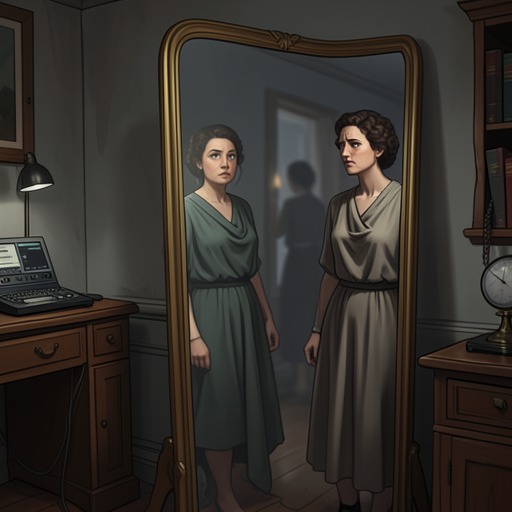
La ambigüedad sobre la cordura de Alice Gould
Los renglones torcidos de DiosThe uncertainty surrounding Alice Gould’s sanity is central to how her story is understood: she appears both to be a healthy investigator playing a patient and to be a woman whose intelligence and orderly reasoning give a delusion the convincing shape of a case. The tension is not simply between what Alice says and what doctors say. It lies in the fact that her performance can be read as deliberate strategy while the very qualities that make it effective also resemble the clinical pattern described by her doctors.
Two accounts of Alice
At her admission, Alice is presented as believing that she is a private investigator leading a team of detectives through complicated cases. A letter from her personal doctor supplies a sharply different account: that she is driven by a paranoid obsession with killing her husband, Heliodoro Almenara. The contrast establishes the problem before the reader can decide which version to trust. Alice’s investigative story could be a delusion; equally, the medical account could misread a capable woman whose reasons for entering the sanatorium are concealed.
The initial uncertainty is intensified by Alice’s intelligence and apparently normal manner. These qualities unsettle rather than reassure the doctors, since a convincing, coherent presentation does not rule out paranoia. Dr. Teodoro Ruipérez observes that Alice handles simulation with unusual skill, yet he also sees her words as confirming the paranoid symptoms diagnosed by E. Donadío. Thus the same speech carries two possible meanings: evidence of a calculated performance and evidence of a disorder expressed through articulate reasoning.
The investigator’s performance
The narrative gives readers access to Alice’s private understanding of her situation, complicating the diagnosis that others make. After her exchange with the acting director, she takes white-gold cigarettes and a lighter from her handbag, lights a cigarette, and considers her answers and conduct to have followed the plan agreed beforehand. She understands herself to be on a professional mission to investigate a crime. Being taken for a detective only in the grip of delusion, she reasons, may protect her: questions, notes, or searches can be dismissed as symptoms rather than recognized as investigative work.
That private account does not make the role effortless. Alice is distressed by the setting in which she must carry it out and acknowledges that she cannot bear the sight of human suffering. Her case will require her to move among people whose wounds are mental rather than bodily. The discrepancy between her controlled planning and her admitted vulnerability adds texture to the uncertainty: the performance is deliberate, but the conditions of the performance are painful to her.
The small incident with her lighter shows how readily the institution’s interpretation can absorb ordinary actions. When a resident insists that Alice has been admitted and orders her to pick up the lighter, Alice bends with a trembling hand and returns it. The gesture does not settle her diagnosis; instead, it places her inside a world where even a mundane object can become part of the routines and assumptions governing patients. Her outward conduct is visible to others, while its meaning depends on knowledge they may not possess.
Why the deception resembles illness
Alice’s chosen role is specifically paranoid, not a performance of conspicuous or generalized disturbance. The narrative explains that paranoid delusions can form a coherent, systematically defended account, and that greater natural intelligence may make such reasoning more elaborate. Alice is portrayed as lucid and convinced of her intellectual superiority to those around her. Her fluency, therefore, is not a simple test of sanity: it can make a delusion more persuasive, but it can also make a feigned delusion easier to sustain.
Samuel Alvar is identified in Alice’s private account as her accomplice and the one person who knows with certainty that she is entirely healthy. He advised her to feign paranoia. Alice also recalls that he is an intimate friend of her client, Raimundo García del Olmo, and that he could provide information about the suspects. This disclosure makes her detective identity more than a claim made to the doctors: within her own account, it belongs to a coordinated investigation. At the same time, the reader receives that account from a narrative moving through Alice’s perspective, while clinicians interpret the same person from the outside. The difference in access creates the central epistemic problem rather than eliminating it.
The strategy is presented as practical. Alice believes paranoia will suit her better than imitating mania, depression, schizophrenia, or dementia, because she need only enact the symptoms associated with a particular delusion rather than a broader set of behaviors. Her capacity to reason is consequently both an instrument of deception and the feature that makes the doctors’ suspicions plausible. A well-constructed performance and a well-systematized delusion can look remarkably alike from the outside.
Institutional evidence and its limits
The question of Alice’s sanity is entangled with the question of how she came to be confined. When she insists that she entered voluntarily and is a professional detective, the director distinguishes her claim from the paperwork in her file. Voluntary admission, he explains, would require Alice’s own signed declaration and a certificate from Dr. Teodoro Ruipérez. Instead, her admission followed involuntary procedures: a medical certificate from E. Donadío recording illness and the need for confinement, together with a request from her husband, Heliodoro Almenara, as a relative. The institutional record therefore contradicts Alice’s stated account of her admission, but its procedural authority does not by itself demonstrate that its medical judgment is correct.
The sanatorium’s open regime offers another contrast between institutional ideals and lived conditions. Patients can move with relative freedom around the building and grounds, join games, attend occupational therapy, work in workshops for wages, and sometimes travel by bus to nearby towns. Yet exceptions remain, and patients in the Dementia Ward Known as the Lion Cage may require assistance with dressing, eating, and basic bodily care. These different forms of treatment show an institution that accommodates a wide range of needs and restrictions; they do not provide a single, simple measure by which Alice’s condition can be judged.
César Arellano’s defense of antipsychiatric reform further cautions against treating physical confinement as a self-evident clinical answer. He acknowledges the value of removing bars to lessen the oppressive sense of imprisonment, while arguing that such reforms depend on first creating the infrastructure needed to support them. The novel’s uncertainty about Alice therefore sits within a broader tension between diagnosis, institutional power, and reform: what appears to be evidence of illness is interpreted through procedures and spaces that also shape patients’ lives. In Alice’s case, the evidence remains divided between a coherent account of deliberate concealment and a clinical reading that finds disorder in the very coherence of her speech.