La teoría de los nueve universos
Los renglones torcidos de DiosLa teoría de los nueve universos is both the title of a supposed discovery and the organizing idea behind one patient's identity at the asylum. Its significance lies less in any scientific account—the novel supplies none—than in the way the man describes his work as unfinished, appropriated by powerful outsiders, and still capable of advancing inside confinement. The theory remains an assertion rather than a demonstrated fact, while the patient's tenacity gives that assertion a concrete life within the institution.
The name and the patient
Alice Gould encounters a community whose members are known through distinctive behaviors, appearances, and nicknames. One man is called the Author of the Theory of the Nine Universes; he also goes by the Astrologer, the Lover of Galaxies, or simply the Galactic. These shifting names make the theory more than a proposition he once put forward: it has become a social identity, recognizable to other residents and repeated as a shorthand for him.
The account situates that identity among the asylum's striking variety of visible conditions, which Alice reads through different faces, postures, and attitudes. Yet the narrative does not offer the man's diagnosis or independently establish what he believes about the universe. It shows how an extraordinary claim marks him within the community, without turning the claim itself into proof of either illness or discovery.
The claim of discovery and arrest
When Alice asks why a man like him is confined, he gives a direct explanation. He says that after discovering the theory, he sent a communication to NASA, which, through the CIA, had him arrested. In his account, the agencies had reached the same discovery but lacked the final calculations and proofs; he believes they wanted to prevent him from getting ahead of them. He predicts that they will release him after taking credit for the work, but insists they will not succeed because he intends to finish it first.
Those allegations belong to the man's account, not to an independently verified explanation of his confinement. The distinction matters: the novel gives the conspiracy a particular structure—discovery, institutional interception, unfinished proof—while withholding evidence that would settle whether the account describes an actual scheme or a conviction shaped by illness. His confidence is clear; the truth of its object is not.
Calculations under confinement
The man's present task, as he describes it, is to complete the calculations. He tells Alice that the work had already been finished when he contacted NASA, then explains that after his admission he had to begin again. The narrative does not clarify exactly what happened to the earlier results. Instead, the claimed setback makes the asylum part of the theory's own story: confinement interrupts the work, while the patient represents himself as returning to it.
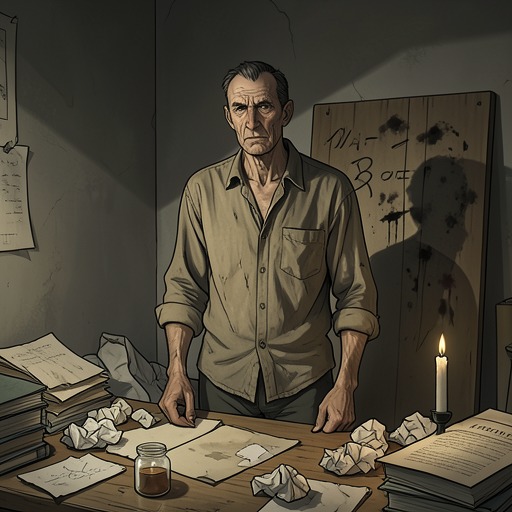
He produces a small notebook from his pocket and opens it for Alice. Its tiny, multicolored handwriting gives visible form to calculations otherwise described only in conversation. The notebook is evidence that he records work, but not that the theory is correct; the novel neither reproduces its calculations nor explains how they would prove his claim. Its narrative force is narrower and more intimate: Alice can see the material trace of the project he says he is pursuing.
A fragile continuity of work
The patient says that he collapses almost every day, apparently dead, but that his brain continues to function. When he recovers, he believes his calculations have advanced substantially. He also fears that sleep therapy would destroy this progress and force him to start again. His insistence that he is tenacious connects these episodes to his larger account: bodily interruption does not, in his telling, end the intellectual labor.
La teoría de los nueve universos therefore remains deliberately incomplete as a scientific object. The reader is given no formula, account of the nine universes, or final proof, only the patient's explanation, his recurring work, and the notebook he shows Alice. That limit preserves the tension between an asserted achievement and an unconfirmed belief. The theory is compelling in the story not because the novel validates its cosmology, but because it shows how completely the claim organizes this man's sense of purpose and his interpretation of confinement.