Luis Ortiz
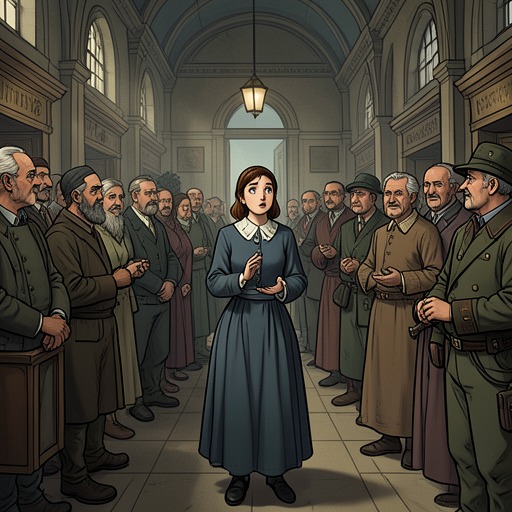
Los renglones torcidos de DiosLuis Ortiz first appears as a tall, thin resident with long limbs, a sunken chest, and a nearly bald head, weeping silently in the hospital. His sorrow reaches beyond him: residents nearby begin to cry as they watch. Later scenes reveal the guilt and delusional family story beneath that grief, making him one of the novel’s most affecting portraits of suffering held in check only briefly by companionship.
Identity and First Presentation
When Alice Gould first notices Luis, his crying is quiet and unbroken. He neither looks at anyone nor calls out; the narrator compares the steady tears to fine rain. His bearing and clothes give him the appearance of a gentleman, but it is the gravity of his sadness that marks him out. The grief seems to pass from face to face among the residents sitting near him, and Alice is moved by its apparent sincerity.
Ignacio Urquieta approaches Luis with the familiarity of a friend, placing his hands on Luis’s shoulders and asking how his troubles are. Luis answers that they are very bad. Ignacio urges him to think of happier things, and Luis looks up with gratitude; for a moment, he smiles and stops crying. The relief is fragile. When Ignacio introduces him to Alice as Luis Ortiz, a new resident’s friend, Luis turns the exchange into an accusation against himself: he says that Alice should not be contaminated by him and that, if justice existed, his hands would have been cut off long ago. He cannot hold back the tears again. His remorse is plain, although its cause and the family delusion bound up with it only become clearer later.
Work, Family, and the Shape of His Guilt
Luis’s place in the hospital’s working routine is as precise as his grief is overwhelming. In the workshop, residents form a production chain for umbrellas: Rómulo quickly threads a nut onto a metal rod, Luis tightens it with a wrench, and then passes the rod to Carolo Bocanegra, who fits it into a hollow-fingered frame. Ignacio Urquieta adds the stick farther along the line. The umbrella fabric is attached later at a commercial factory, while the hospital’s piecework gives patients tasks and wages according to their abilities and output. Luis’s hands, which he believes deserve punishment, are thus shown performing a useful, careful part in shared work.
The family visit makes the source of his anguish more legible without making his accusations true. Alice sees Luis walking with a young man, a woman, and a girl of about ten: his son, daughter-in-law, and granddaughter. In his delusion, he believes he has wronged his son by seducing the latter’s wife and that the child is his own. Yet the family appears to Alice like a modest, healthy household, and the daughter-in-law’s restrained manner seems far removed from the betrayal Luis attributes to her. The contrast places his imagined guilt beside the ordinary people who have come to see him, without diminishing the pain he feels.
At the gate, Luis holds the child’s hand while the family says goodbye. He remains standing after they leave and does not move until their car has disappeared; only then does he turn back toward the hospital, weeping so intensely that Alice considers calling a member of staff. He condemns himself as a miserable father beside the son he regards as an angel, and begs Alice to leave him alone, insisting that his presence would soil her. His remorse therefore persists even when the scene offers no confirmation of the crimes he imagines. The family’s departure restores the silence of his solitary grief, while the workshop’s measured cooperation offers a stark counter-image: within the hospital, he can still take part in work shared with others.
Narrative Role and Characterization
Luis’s recurring epithet, the weeping gentleman, turns his visible manner into a social identity before Alice learns the family story that gives his anguish its shape. Yet the label does not explain him: his distress is private and quiet, then briefly eased by Ignacio Urquieta’s familiar touch and attention, and finally intensified in the presence of his family. These changes make his suffering legible through relationships rather than through a clinical account. The brief exchange with Alice is especially revealing. Even when introduced to a newcomer, Luis cannot regard himself as an ordinary fellow resident; he casts himself as a contaminating danger and imagines bodily punishment as the only just response. The force of that remorse belongs to him, whether or not its imagined grounds are real.
The family visit also establishes a distinction between what Luis believes and what Alice can observe. She recognizes the visitors as his son, daughter-in-law, and granddaughter, and reads their composed, ordinary appearance against his imagined account of betrayal. The narration gives no independent testimony from the family about the history behind his delusion; instead, the contrast is filtered through Alice’s attention to their behavior and the way Luis watches them leave. His devastation is unmistakable, but his accusation is not presented as fact. That separation prevents his guilt from becoming proof of wrongdoing: the reader encounters a man sincerely suffering for acts the story identifies as delusional. His careful contribution to the umbrella-making chain sharpens the same tension. The hands he believes deserve amputation are shown doing useful, coordinated work, so the character’s self-condemnation stands against evidence of his continuing capacity to participate in the shared life of the ward.
The Name Attached to His Delusion
In the workshop scene, the narrator identifies Luis both as the weeping gentleman and as the man who believes himself to have violated his daughter-in-law. The two designations place his visible sorrow beside the imagined offense that gives it meaning, even as he performs a precise task in the production line. His delusion is thus not confined to his private confession to Alice: it also becomes a shorthand by which the narrative locates him among the residents, binding his public identity to the guilt he cannot escape.