Ovejas
Los renglones torcidos de DiosOvejas are the flock encountered by the hospital group on an outing, and their arrival transforms a routine pastoral scene into a collective panic. The sheep do not set out to attack anyone: the uproar begins when lambs are released to feed. Yet dust, bells, and converging animals overwhelm the patients’ ability to make sense of what is happening. In a reversal of the familiar story of a lone madman scattering a flock, these animals put more than two hundred frightened people to flight.
The flock and its markings
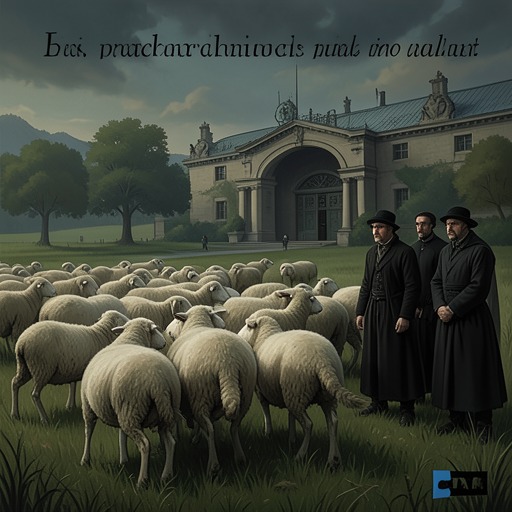
The flock includes sheep with large black patches around their eyes, contrasted with white sheep. The dark-marked animals are described as resembling wearers of carnival masks; the markings give the flock a visually distinctive presence before its movement becomes the scene’s central event. This detail also helps preserve the animals as a particular group, not merely an indistinguishable mass appearing to serve the patients’ panic.
The sheep arrive with the ordinary sounds and activity of pastoral life: their bleating and bells accompany a great cloud of dust. To the shepherds, the flock’s passage and feeding are familiar routines. For the hospital patients, however, the sudden appearance of so many animals is difficult to interpret. The same scene is at once a commonplace episode of animal care and an alarming spectacle, depending on who is watching.
A routine feeding becomes a rush
The immediate cause of the commotion is the release of the young lambs from their pens. Hungry at the customary feeding hour, they race toward their mothers—or, more precisely, toward the ewes’ udders. The lambs’ movement meets the adult sheep’s answering calls, and the flock divides into two rushing currents: larger ewes and small lambs converge around the patients, who find themselves caught between them.
The scene’s apparent violence arises from motion and perspective rather than a deliberate attack. Lambs hurry to feed, mothers call to their young, and the flock presses through the space; from within that convergence, the patients mistake a feeding rush for a threat. Their alarm escalates into panicked interpretations that the lambs are consuming the larger sheep and will next turn on the people. The story thus makes a basic difference in understanding decisive: what the shepherds recognize as feeding, the patients experience as an inexplicable danger.
Panic among the patients
The nurses order the group to stop and shout to the shepherds to change direction, because the flock is coming toward them and the patients’ reactions cannot be predicted. The order does not prevent the wider panic. Some patients run in terror; others run because they see the rest running; some attempt to stop the flight. The mass response spreads without anyone having a clear account of what is happening.
The scale makes the episode more than an individual fright: more than two hundred patients are scattered by the peaceful, pastoral family of sheep. The people most able to understand the event are the shepherds and their dogs, while the patients caught in the middle cannot agree on what they are seeing. The narrative locates the danger less in the animals themselves than in the contagious movement of fear, which turns an ordinary flock’s passage into a disorderly retreat.
Reversal and narrative significance
The episode deliberately reverses the well-known account of the Manchegan knight who attacked and dispersed what he imagined to be an enemy army. In that story, a single deluded man scatters a flock; here, the flock disperses a crowd of more than two hundred people. The comparison is comic in its inversion, but it also keeps the sheep’s ordinary behavior distinct from the patients’ frightening explanations of it.
Ovejas therefore matter not because they are shown as aggressors, but because their independent routines set the scene in motion. The lambs are hungry at feeding time, the mothers call, and the flock converges; none of these actions is directed at the hospital group. The contrast between animal purpose and human interpretation gives the episode its force. What appears to the patients to be a chaotic assault is, to the shepherds, a familiar feeding event—and the calm order of the animals is precisely what makes the human panic so striking.