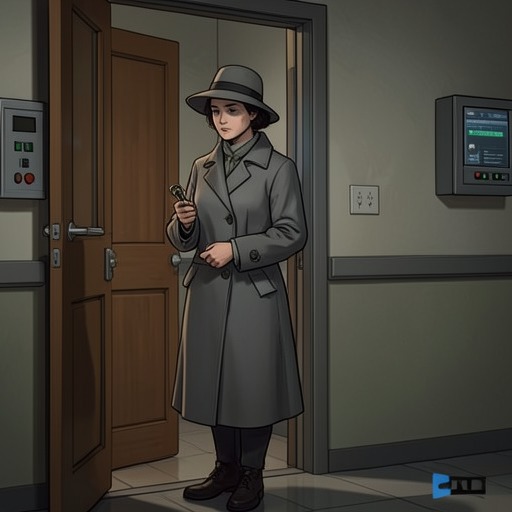
Rómulo
Los renglones torcidos de DiosRómulo, called the Mimetic Boy, is a resident of the asylum whose story repeatedly turns on mistaken or denied kinship. Though he appears young, the narration stresses that he is not a child in years; his childlike presentation and mental age shape the way other residents and Alice Gould understand him. He is first introduced as a boy who imitates everyone, and as one half of a supposed pair of twins with the quieter Remo. Yet Rómulo denies that relationship—and, at moments, even denies that Remo exists. His part in the story remains modest, but the contradictions surrounding him make him a vivid instance of the novel’s unstable borders between resemblance, identity, and family.
Identity and the Denied Twin
Rómulo is presented alongside Remo as a pair of boys whom Alice Gould initially takes for identical twins. The account of their background complicates that first impression: their parents are described as intellectually disabled, and the two boys deny being twins or pretend not to know that they are related. The narrative later sharpens the contradiction. Rómulo does not merely reject the kinship; he denies the reality of the twin who resembles him so closely that the other seems like his photographic duplicate. The text leaves open whether this is a sincere failure of recognition or a deliberate refusal to acknowledge Remo. It offers no settled explanation, making the uncertainty itself part of Rómulo’s characterization.
The label Mimetic Boy points toward imitation as a defining feature, but his behavior does not reduce to simple copying. In one striking scene he stops caressing the forehead and head of the girl he believes to be his sister, rises onto his knees, raises his arms like claws, bares his teeth, and growls. His short advances make him resemble a young leopard preparing to attack, though he never completes the lunge. The sudden performance gives physical form to the contrast between his childlike appearance and the unsettling force of his gestures. Once he returns to stroking the girl, he seeks a nurse in a white coat and reports that his sister has soiled herself. The shift from animal imitation to plain, practical concern is characteristic of the scene’s abrupt changes of register.
Remo’s Death and the Investigation
Rómulo becomes a witness to the killing of Remo. When called to give an account, he has blood beneath his fingernails and says that he fled because he was frightened after seeing the Elephant Man kill a child. His statement does not make him the killer; instead, it places him at the scene as a frightened witness whose flight helps explain his absence. The physical detail of the blood remains beside his account, a clue for investigators rather than a complete explanation of his actions.
Alice Gould’s reconstruction gives Rómulo a place in the circumstances of the crime. Describing a drawing she made during a psychological test, she says it contains three figures: Remo’s killer, Rómulo, and the woman who is the motive for the crime. The drawing helps the investigators understand the relationships among those involved. When the Elephant Man is questioned, he has blood and other bodily matter on the back of his trousers; believing he is speaking to his superiors in Naval Intelligence, he recounts events in a way that matches Alice’s reconstruction. Rómulo’s frightened testimony and Alice’s interpretation thus contribute to resolving the case, while leaving his own contradictory relation to Remo intact.
Work and Everyday Conduct
Outside the murder investigation, Rómulo appears as part of the asylum’s working life. In the hospital workshop, patients assemble components for umbrellas made under a commercial work contract. Rómulo’s task is precise and repetitive: he takes a nut from a basket at his right, threads it onto a metal rod, and passes the rod to a basket on his left. The narration notes his speed and accuracy. The task places his imitative identity beside a concrete competence: whatever uncertainties surround his understanding of family, he can carry out this small operation with admirable precision.
His conduct toward the girl he regards as his sister also has a quieter, caretaking aspect. He strokes her head and seeks a nurse when he thinks she needs help. Later, Rómulo walks hand in hand with the young Alice, who sways slightly as she walks. The narration identifies both as residents whose mental ages are younger than their years. These gestures do not resolve the question of his biological relationship to the girl, but they show that the imagined tie has an everyday emotional and practical presence for him.
Recognition and Alice Gould
Rómulo’s encounter with Alice Gould brings the novel’s recurring confusions of names and family resemblance into a brief, intimate scene. He visits with Niña Oscilante, and Alice asks how he recognized something about her. He explains his recognition through two details: she has the same small bump on her ear as he does, and she has the same name. The explanation rests on visible likeness and shared naming rather than on any established family history. It should not be read as proof that Alice Gould is related to him; its significance lies in how readily recognition, resemblance, and kinship become linked in his account.
The scene also makes clear why Alice’s concern for Rómulo extends beyond the investigation. In a later discussion of what should happen if her own delusions remain, she imagines teaching him elementary arithmetic, walking hand in hand with the woman who believes herself to be self-punished, and helping with ornamental designs for the embroidery work directed by Teresiña Carballeira. Rómulo appears in this imagined future not as a mystery to solve, but as someone Alice could continue to teach and care for. The proposal gives his presence a place within her everyday commitments, whether she remains in the asylum or leaves it.
Narrative Significance
Rómulo’s identity is built from paired images that never settle into a single account: the apparent twin who denies his twin, the imitator capable of precise work, and the supposed brother whose ties to others are sustained through belief and recognition. The narrative does not explain away his denial of Remo or confirm a biological bond with the girl he calls his sister. Instead, it places his assertions beside observable resemblance, frightened testimony, and acts of care. His brief appearances therefore echo one of the story’s central uncertainties: a relationship may be emotionally real without being factually established, while the evidence of likeness does not guarantee that someone will acknowledge what it seems to show.