Sergio Zapatero
Los renglones torcidos de DiosSergio Zapatero is a psychiatric patient known for an unfinished theory of nine universes, eighty-six notebooks of calculations, and a recurring prediction that everything would happen on a Saturday. His story places an ambitious, intricate intellectual project beside the visible progression of illness: the same calculations that give him purpose also become something he is afraid to complete. His eventual death during a panic crisis makes the prediction ominous without establishing that he understood what would happen.
Identity and Introduction
When Alice Gould first takes stock of the patients, she gives Sergio the provisional nickname Don Quixote. She then adjusts it to match the names already circulating in the community: he is known as the author of the theory of nine universes, the Astrologer, the Lover of the Galaxies, or simply the Galactic. These titles frame him through his cosmological preoccupation, but they are also part of the social vocabulary by which patients recognize one another. Sergio is not introduced only through a diagnosis; he arrives in Alice’s view as one distinct person among a striking variety of conditions, appearances, postures, and habits.
His movement contributes to that public image. The narrative places him among patients with psychomotor disturbances and describes his movements as grotesque, almost comic, in comparison with the more brutal movements of a blind patient Alice observes. Sergio walks as if dancing an old-fashioned dance. The contrast registers how bodily difference is seen and classified by observers, while also marking a physical feature that recurs alongside his intellectual self-presentation.
The Theory and Its Notebooks
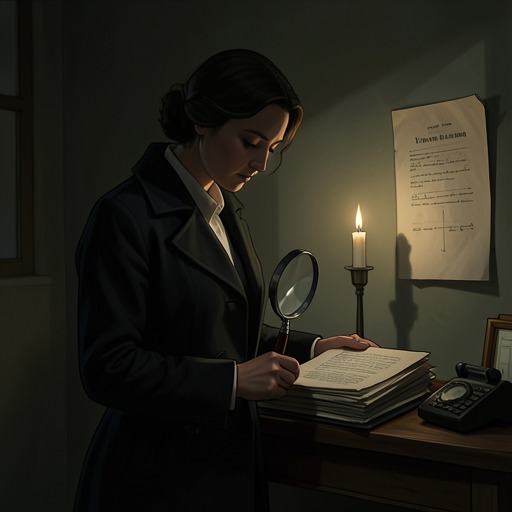
Sergio explains to Alice why he believes he has been confined: after discovering his theory, he sent a communication to NASA, and the CIA, acting through it, had him arrested. This is his account of the events, not an independently verified explanation of his admission. In the conversation, the grand scale of the theory is paired with the intensely private labor of keeping it on paper. He secretly produces a small notebook for Alice to see, its minute writing spread across pages with drawings, labels, equations, calculations, symbols, and Greek letters.
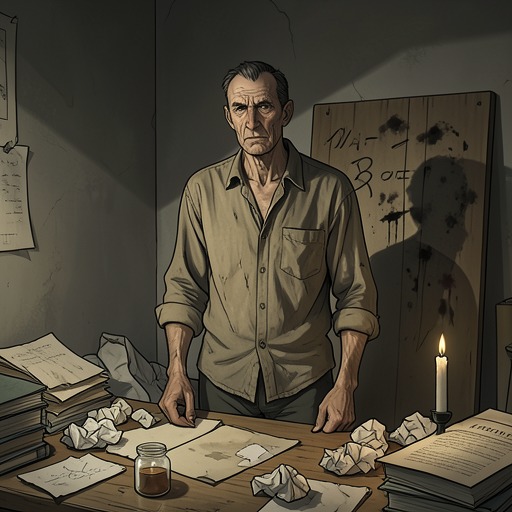
The work is not presented as a completed system. Sergio says that he nearly collapses every day, as if dead, but that his brain continues working and his calculations advance substantially when he recovers. He is proud of the progress and of Alice’s astonishment. The notebooks make that progress tangible: rather than one definitive manuscript, the theory exists as a growing series of records, each carrying further work while leaving the conclusion out of reach.
The delay is more than a practical obstacle. Sergio says that only one line remains, yet he both longs to finish and fears demonstrating what he already believes he knows. In response to that uncertainty, he starts another notebook. He tells Alice that the total has reached eighty-six, a number that turns his hesitation into a visible accumulation. The notebooks thus hold both ambition and avoidance: each extends the project, but also postpones the moment when its final claim would have to be set down.
Deterioration and Clinical Assessment
Later, Salvador Sobrino presents Sergio’s case to the hospital’s doctors as delicate and worsening, with no solution yet in sight. Sobrino explains that he has left him without medication for two days so the committee can form an opinion. Sergio enters supported under the arms by two attendants. His gaze is vacant, his face sweaty, and his hair disheveled; he speaks through groans and pleading gestures in an unintelligible jargon from which isolated English words emerge. The scene sharply contrasts this condition with the earlier conversation in which he showed Alice his work and described its progress.
César Arellano understands what is moving through Sergio’s disordered mind and interrupts the presentation. The doctors’ judgment identifies an acute delirious episode in a chronically ill patient. The distinction matters to the account of Sergio: the notebook-bearing theorist and the patient whose speech has become difficult to understand are not presented as unrelated identities, but as different circumstances in the course of the same illness. The record does not supply a recovery from this deterioration.
Alice’s Last Encounter and Death
On a later occasion, Alice asks who the patient bent over and muttering about Saturday is. She is told it is Sergio, now again identified by his reputation as the author of the theory of nine universes. His lips repeat that everything will happen on Saturday. Alice tries to comfort him by advising him to resume his calculations and saying that she is sure he will reach a more optimistic conclusion. He neither understands nor attends to her; the Saturday refrain continues in place of a conversation.
The following Saturday, Sergio dies during a panic crisis. The sequence gives his repeated prediction a terrible retrospective force, but the narration does not explain it as foreknowledge or say that his theory caused his death. Alice keeps vigil beside his body. Her prayer that he be granted millions of oilcloth notebooks, so that he can count the duration of eternal bliss, returns to the object that had defined his earthly work and transforms it into an image of an afterlife measured through endless writing.
Narrative Significance
Sergio’s arc is built from a contrast between what his mind claims to encompass and what his life can sustain. His theory reaches toward multiple universes; its surviving evidence is a pocket notebook, dense with signs, and a succession of eighty-six volumes that still cannot complete the final line. The scale of the idea and the smallness of its material record remain together, without the narrative resolving whether the theory has validity beyond Sergio’s conviction.
His death also changes the meaning of the Saturday refrain. First it is a repeated utterance that Alice cannot penetrate; after his death, its timing makes it sound like a warning, although the event itself remains a death during illness rather than proof of prophecy. Alice’s vigil offers the final response: not an explanation of the theory, but an act of mourning that carries Sergio’s notebooks into an imagined eternity. The name by which the hospital community remembers him and the unfinished work he leaves behind therefore become inseparable from the tragedy of his decline.