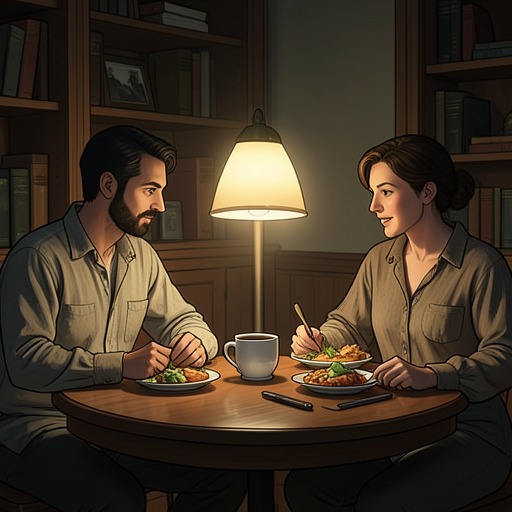
Bethany’s parents’ house
Lost and FoundBethany’s parents’ house is the first major setting for Bethany and Ransom’s fake relationship, transforming a transaction made in the Greenleaf Diner into an arrangement that looks, from the outside and increasingly feels from within, like domestic life. The house is vacant because Bethany’s parents are spending the winter in Italy, but their orderly presence remains visible in its maintenance, furnishings, supplies, and carefully managed temperature. That combination of absence and preparation makes the house both safe enough for the deception and intimate enough to expose how quickly two strangers can begin inhabiting a shared routine.
Setting and Physical Character
Bethany reaches the house after stopping at the Greenleaf Diner, where she has arranged for Ransom to pretend to be her boyfriend during her high-school reunion. She has the keys because her parents entrusted the property to her for the visit, and the house is therefore available without the questions or supervision that might have accompanied an occupied family home. Its emptiness is practical rather than neglected: the heat has been programmed to come on before Bethany arrives, and the interior is substantially warmer than the winter darkness outside. The exterior presents a carefully managed suburban ideal. It is a white house with dark trim, a low, rambling porch, and a huge front window. Fresh-looking concrete renews the driveway, while brick pavers and low path lights lead toward the entrance. Pruned trees, well-maintained grass, and gardens covered in mulch suggest that Bethany’s parents expect to restore the beds with color and flowers when spring arrives. The scene gives Ransom an immediate impression of a family that values order and appearance, an impression reinforced by the neat interior. Inside, the house is clean, warm, and arranged for distinction between private family life and formal hospitality. The kitchen contains a fully stocked refrigerator and an organized pantry. Separate sets of dishes, glasses, and silverware divide “company” use from everyday family use, with the latter showing small signs of wear. The downstairs guest room has a made bed, matching duvet and thermal quilt, coordinated pillow covers, and the mingled smells of carpet cleaner and wood cleaner. It is feminine without being overly decorative, polished without becoming impersonal.
Refuge for the Fake Relationship
Bethany invites Ransom to stay at the house rather than share her hotel room or require him to find separate accommodation. The guest bedroom is downstairs beside the stairs, with its own bathroom access and greater privacy; Bethany explains that her parents designed it to make guests comfortable. She retreats upstairs to change from work clothes into pajamas while telling Ransom to make himself at home, an ordinary domestic gesture that sits uneasily beside the fact that they have only just met. The arrangement begins under explicit conditions. Ransom has offered to pose as Bethany’s boyfriend in exchange for secure access to files connected with the agency where she works, and he even suggests that he would pretend to be her husband if that would secure the deal. At the house, the financial and professional bargain is placed inside a family environment that makes the performance more convincing. Bethany plans to use Ransom as the flashy partner who will complete the image of success she wants former classmates to see, while retaining the option of paying him in cash instead of granting access if he proves untrustworthy. The house consequently functions as a controlled opportunity structure. Bethany’s parents are absent, Ransom has a guest room, and Bethany possesses authority over the keys, the property, and the confidential material at stake. Yet the same privacy that makes the deception possible also lowers the barriers between the participants. Ransom can move through the kitchen, observe the household’s organization, and imagine what Bethany’s life looks like when no reunion audience is present. Bethany, meanwhile, has allowed a stranger into a family property and has to confront the consequences of that choice without the protection of a public setting.
Domestic Routine and Growing Ambiguity
The house quickly becomes the place where the performance acquires everyday texture. Ransom examines the stocked refrigerator and considers how the available food and drink might help break the ice between them. After he leaves to handle an errand, Bethany cleans the breakfast dishes and recognizes that the two strangers have already fallen into an odd habitual routine. She immediately insists to herself that the arrangement is fake and that, once the reunion is over and Ransom receives the information he wants, they may never speak again. Even so, the prospect of losing the routine makes her sad. This tension is intensified by the ordinary logistics of the property. The warm rooms, the downstairs guest bedroom, the kitchen, and the separation between upstairs and downstairs give Bethany and Ransom a structure resembling shared domestic life while preserving the nominal boundaries of strangers. The physical arrangement allows closeness without requiring either person to declare that closeness meaningful. It is a temporary household built from a commercial agreement, and its normality becomes precisely what threatens to blur the agreement’s limits. Ransom’s behavior also shifts as he becomes familiar with the house. Before leaving, he jokes that he will not snoop in Bethany’s underwear drawer; once outside in the cold, he admits that he may look around her room to learn more about her. The house is therefore not merely shelter. It is an archive of Bethany’s private identity, and its rooms invite investigation even as their apparent ordinariness produces intimacy. The boundary between respectful hospitality and unwanted access remains present throughout the arrangement.
Connection to Ransom’s Identity Search
The house’s most consequential function is to enable Ransom’s search for his origins. Ransom knows that his adoptive parents obtained a child through the agency where Bethany works, but he has never known the child’s identity or the names of the birth parents. Because the adoption was closed, ordinary public-record searches cannot provide the information, and older paperwork may have been destroyed or retained only by the agency. His need for answers is the motive behind the bargain that brought him into Bethany’s family home. Bethany ultimately gives him authorized access through her laptop rather than a hotel computer. From the house, Ransom opens the agency’s “Children Served by Us” database and searches for the name he stopped using years earlier, Patrick Nolan. The search first appears empty, then produces a single result: a photograph of a three-year-old child and a record naming Janice and Raymond Nolan as the adoptive parents. Ransom recognizes them as his own parents and reads that he entered the agency at age two after being surrendered by his birth parents. The file records above-average intelligence and minor behavioral issues described as consistent with unstable attachment to birth parents. The first database also reveals the name that had been concealed by adoption. Ransom was not originally Patrick Nolan but Patrick Cartwright. He then uses the second database, reserved for parents who gave up children, and finds Genevieve Cartwright and Alexander Cartwright attached to his birth name. The house thus becomes the physical setting from which a blocked family history is reopened. Its domestic order surrounds an act of profound biographical disruption: within an ordinary family home, Ransom discovers that the identity he has lived under is only one layer of his history.
Narrative Significance
Bethany’s parents’ house embodies the contrast between performed success and hidden need. Bethany intends to display a polished romantic life at the reunion, yet the display begins in a quiet house occupied by no audience, where her work addiction and social isolation are harder to conceal. Ransom enters as a paid accessory to that public image, but the house gives him access to the private records that explain why he is willing to accept such an arrangement. The location also reverses the usual meaning of a family home. It is not the place where Bethany’s parents receive or protect their daughter; they are away, leaving behind a house prepared for her arrival but not participating in her life. For Ransom, however, the house becomes the gateway to the family he has been trying to locate. Its rooms contain the material signs of one established family while the databases accessed there reveal another, absent family linked through a changed name and a closed adoption. By the time Ransom leaves the house’s immediate domestic orbit and the reunion arrangements move toward hotel accommodation, the location has already accomplished its central work. It has sheltered the fake-boyfriend agreement, made intimacy look routine, exposed the risks of confidential access, and served as the launch point for Ransom’s discovery of Patrick Cartwright, Genevieve Cartwright, and Alexander Cartwright. The house is therefore both a temporary refuge and a threshold: a carefully ordered family space through which two people cross from formal deception into consequences neither can fully control.