Eve’s accidental collision with Joshua’s truck
Lost and FoundEve Waters’s accidental collision with Joshua Jackson’s truck is a near-accident that becomes an unexpected first encounter. A distracted moment with her phone brings the vehicles together, but the scene’s larger turn is emotional: Eve moves from fearing that she has killed someone to confronting an attraction she thought her marriage had extinguished. Joshua, meanwhile, responds to the damage by checking on her rather than demanding money, making concern—not blame—the encounter’s final note.
Causes and Approach
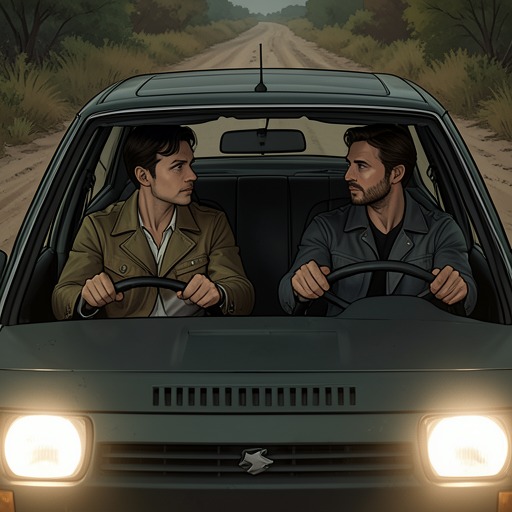
Eve is driving her beat-up truck along a dirt road when her attention shifts from the road to her phone. A woman’s voice from the phone interrupts her protest, and Eve looks down at the map to check her next turn. The glance is brief, but the danger lies in its timing: when she looks up, she sees a man close enough that she has only an instant to react.
The scene gives the lapse a specific, ordinary cause rather than treating the collision as an unexplained mishap. Eve has been trying to follow directions, and her attention has already been divided; the phone’s voice and map draw her eyes away just as Joshua is beside his truck. The contrast between the tiny act of checking a route and the sudden physical threat gives the mistake its force. A familiar aid to navigation becomes, for a moment, the reason she fails to see what is directly ahead.
Collision and Immediate Danger
Eve yanks the wheel left and slams on the brakes, but her truck still swipes the rear bumper of Joshua’s truck. It comes to a stop about forty feet away. The impact throws up a cloud of dust and grit, temporarily obscuring the road and leaving Eve unable to tell what has happened to the man she saw dive aside. Her first response is fear that he may be dead; she watches the rearview mirror, then gets out and walks back toward the truck, calling out to him as she goes.
Joshua emerges from behind the vehicle alive. He is wearing tight, dusty jeans, with a flannel shirt tied around his waist, and he confronts Eve with irritation, asking whether this is her first day driving. The question registers the obvious danger of her mistake, but the physical outcome is less severe than Eve feared: Joshua was paying attention and got out of the way. Her relief comes before any argument about responsibility. She thanks him for being alive, while he asks whether she is all right and looks over the damaged bumper.
Apology, Blame, and Attraction
Eve starts to explain that she looked down for a second. Joshua suggests that she was playing on her phone, perhaps because of a text from a boyfriend. She rejects that explanation and says she was checking directions because she thought she was lost. Her account does not erase her mistake, but the exchange makes visible how quickly the encounter moves between practical questions and personal assumptions: the phone explains the distraction, while Joshua’s question introduces the possibility of a boyfriend that Eve immediately denies.
She apologizes and offers to pay for the damage. Joshua’s truck is parked in the middle of the road, a fact Eve raises as she tries to explain what happened, yet she cannot make herself turn that into a convincing accusation against him. Instead, she admits that she has only just got a job and may need time to save enough to repay him. The financial offer gives the moment a concrete stake: Eve is worried not only about having caused damage but about what making it right might cost her.
Joshua says he does not care about the money. He explains that his first concern was whether Eve was okay, and then tells her to slow down and pay attention. His response does not deny the collision or absolve her of responsibility; it changes the terms of the encounter from a dispute over payment to a warning paired with concern. Eve’s heartbeat, which had thudded as she approached him through the gravel, and the gradual fading of her fear register how strongly the scene affects her before she can settle on a single emotion. When she reaches him, she finds him much more attractive up close, and the thought unsettles her because she had sworn off men.
Significance in Eve’s Story
The collision brings Joshua into Eve’s life through a mistake, not a planned introduction. Its immediate sequence is sharply reversible: the man she fears she may have killed appears to be alive, and the stranger she is ready to blame becomes someone whose concern she notices. That reversal does not make the damage disappear, but it shifts the encounter from potential catastrophe toward conversation and attraction.
The moment also places Eve’s new response against the emotional aftermath of her marriage to Bryan. She thinks that her ex-husband has wiped her desire for romance off the table, then questions whether she knows how to care for someone—or even who she is. Those thoughts make her attraction to Joshua more than a passing assessment of his appearance: it contradicts the position she has adopted about men and forces her to recognize that her sense of herself remains unsettled. The collision therefore initiates a relationship possibility without resolving Eve’s doubts. It ends with a practical admonition to drive more carefully and an opening she had not intended to find.