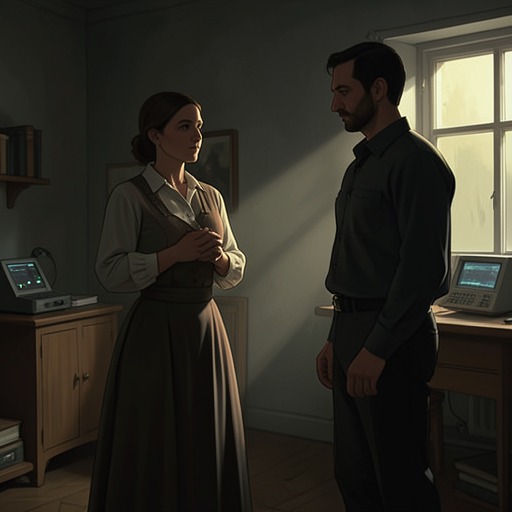
Greenleaf Diner
Lost and FoundGreenleaf Diner is the roadside setting where Bethany and Ransom first meet, and its decisive narrative function is to turn an accidental stop for food into the foundation of their fake-boyfriend arrangement. Arriving late at night in search of coffee and a meal, Bethany finds in the diner not merely shelter from the cold but the stranger who can supply the dramatic partner she wants for her high-school reunion. Ransom, meanwhile, recognizes that the well-dressed customer may possess precisely the confidential access he needs for his private search. The diner therefore operates as a threshold: a modest, familiar public place becomes the point at which performance, opportunism, romance, and identity investigation enter the same plot.\n\n## Setting and Atmosphere\nBethany notices the sign for Greenleaf Diner while driving toward her hometown and turns off the highway because she needs a break, something in her stomach, and enough rest to complete the journey. She is already fighting the anxious feeling that she might be late, even though no actual deadline governs her arrival. The stop follows weeks or months of planning for her return and for the impression she intends to make at the reunion, so the diner receives her at a moment when ordinary fatigue is colliding with elaborate social preparation.\n\nThe diner’s physical details establish a sharp contrast with Bethany’s isolated destination. Its door creaks open onto hot air carrying the smells of cooking meat, hot oil, and frying starch, a welcome warmer than the abandoned house where her parents have left her the keys while they spend the winter in Italy. Inside are old classic photographs and knickknacks, several nearly empty tables, a few waitresses, and a cook working behind the counter. The late hour and the cold outside—thirty-five degrees according to Bethany’s Prius, with temperatures expected to fall below freezing—give the room a temporary refuge quality. It is neither glamorous nor private, but its homely activity makes it the first place on the journey to offer Bethany immediate human contact.\n\n## The First Encounter\nRansom is sitting several seats away at the counter, hunched over his phone, with dark hair slicked into a strange 1950s style, heavy jeans, a dark green hoodie, worn boots, and a leather jacket hanging over his chair. Bethany initially cannot reconcile the waitresses’ teasing reference to a “Casanova” with his appearance, especially when she sees him first from behind and then in profile. The mismatch between the diner’s joking social reputation and Bethany’s skeptical first impression prepares the story’s recurring concern with surfaces and concealed identities.\n\nRansom sees Bethany differently. He has been preparing to leave, but her thousand-dollar shoes—conspicuous in a small, sleepy diner—arouse his curiosity and persuade him to remain. He notices her brown hair and hazel eyes and reads her as jumpy, while she studies him for possible danger and asks whether he is connected to the mob. The exchange makes the diner a site of reciprocal assessment: each character is trying to determine what the other might conceal, and each is already forming a practical judgment before either understands the other’s circumstances.\n\n## From Conversation to Bargain\nBethany’s stop becomes consequential when she admits that she may have a job Ransom could help with, although she wants to know him better before making an offer. The proposal is not initially presented as romance but as a calculated solution to the social problem of appearing successful and desired at the reunion. Ransom’s response reveals the second pressure operating in the diner: he is willing to trade an affectionate public performance for secure access to files connected with the agency where Bethany works. He says he would pretend to be her boyfriend, or even her husband, if she would provide the access he needs.\n\nThe arrangement joins two forms of performance. Bethany wants to create a spectacular homecoming and display a convincing image of a fulfilled life to former classmates; Ransom wants to use charm and an invented romantic role to reach information unavailable to him elsewhere. The diner’s public setting makes the bargain feel both risky and oddly plausible. They can negotiate while surrounded by waitresses and other customers, yet the late hour and limited crowd give the conversation enough privacy for an ethically serious exchange. Confidential agency files, professional consequences, money, and the credibility of a fake relationship are all placed on the table alongside the diner’s ordinary checks and coffee.\n\nBethany recognizes the danger after agreeing to leave with him. She has paid both meals, tipped generously, and is suddenly forced to confront the concrete reality of allowing a stranger to stay with her at her parents’ house, pretending to be her boyfriend, and potentially giving him access to confidential information from her job. Her fallback plan is to pay him the money reserved for the arrangement rather than grant file access if he proves untrustworthy, and she tells herself that the police remain an option. Even so, she concludes that the risk may be worth taking because Ransom completes the picture she wants her former classmates to see.\n\n## Departure and Continuing Function\nThe diner’s role as a threshold ends physically when Bethany and Ransom leave together. A colder gust meets Bethany outside, and she hurries toward her Prius while Ransom follows to a nondescript black car that is slightly sporty but not a proper sports car. She starts toward the highway and watches to see whether he will actually follow; he does. The brief movement from counter to parking lot transforms a verbal experiment into an active partnership, with the road toward Bethany’s hometown becoming the next stage of the arrangement.\n\nRansom’s later reflection confirms how improbable and useful the meeting seems from his perspective. He regards it as a twist of fate that the exact person capable of helping his private mission has appeared in a dingy old diner outside a tiny town. He expects Bethany to delay granting access because the material is sensitive and could cost her job, but he has already imagined a way to obtain the information without exposing her. The scene thus retrospectively deepens the diner’s importance: what looked like chance hospitality is also an opportunity window for Ransom’s investigation.\n\nThe location remains associated with the practical mechanics of trust and access even after the pair moves on. At the diner, Bethany pays both checks and chooses to trust Ransom provisionally; later, she gives him use of her laptop and authorized credentials so he can reach the adoption databases, where he searches under the name Patrick Nolan and finds one result. The contrast is significant. A casual meal in an ordinary roadside room leads first to a fabricated romance and then to the discovery that Ransom was born Patrick Cartwright. Greenleaf Diner is therefore the story’s point of origin for both the public relationship plot and the hidden birth-identity investigation.\n\n## Narrative Significance\nGreenleaf Diner compresses the novel’s central tensions into a single transitional space. It is warm but surrounded by freezing weather, familiar but populated by strangers, public yet capable of sheltering confidential negotiations, and mundane while producing consequences that reach into careers, family history, and romantic commitment. Bethany enters seeking food and a controlled route home; she leaves committed to an uncontrolled experiment in intimacy. Ransom enters intending to depart; he stays because curiosity identifies a possible route to his origins.\n\nThe diner also introduces the story’s pattern of mistaken appearances and staged social meaning. The waitresses call Ransom a Casanova, Bethany initially doubts the description, and Ransom recognizes that Bethany’s expensive appearance may conceal emotional and social vulnerability. Later, the couple presents him to reunion guests as arm candy, a chef and caterer, and eventually a prospective husband, while the truth of his identity remains hidden. The first performance is born in the diner’s banter, and the location’s ordinary joking atmosphere becomes the seedbed for a relationship that gradually acquires consequences beyond the roles either character originally intended to play.