Heather’s Forge
Lost and FoundHeather’s Forge is the nearby town Joshua and Eve enter while transporting Billy the Kid, the goat whose bleating and smell turn an apparently simple drive into an awkward, comic roadside mission. Reached from Hope Creek in about thirty minutes, the town becomes more than a destination: its church, streets, trucks, and gossiping residents establish a close-knit community whose welcome carries both warmth and pressure.
Setting and Arrival
Heather’s Forge lies close enough to Hope Creek for Joshua to assure Eve that the drive will take only thirty minutes. The route is hot, with heat pouring through the truck’s cab, while the open window carries away Billy’s odor and admits the contrasting scents of grass, dirt, and an unfamiliar floral note. Eve points out the town sign as they arrive and jokes about the surrounding places bearing women’s names, prompting Joshua to suggest that the names may preserve the presence of female settlers.
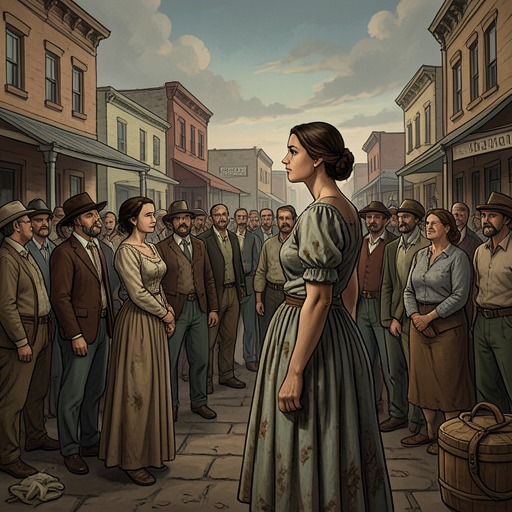
The town’s entrance is presented through ordinary, tangible details rather than formal description. Eve identifies Heather’s Forge from behind the steering wheel, and the truck proceeds toward Church Street, where the church stands behind a stone wall. A dusty black Nissan is parked in front, and George waits against its grille with his cap pulled low. This church-centered meeting place gives the town a recognizable public core and makes the transfer of Billy a visible local transaction rather than a private exchange.
The Goat-Delivery Encounter
Billy the Kid is the immediate reason for the visit. Joshua carries the struggling goat in his lap while Eve drives, and Billy’s bleat approves the decision to continue toward Heather’s Forge. Joshua’s concern that the animal might soil his leg and Eve’s remark that the goat may be cute enough to offset its smell keep the journey grounded in physical discomfort and practical improvisation.
Joshua tells Eve that the goat’s owner will be met in front of the church, down Church Street. The destination is therefore precise and functional: Heather’s Forge is where an animal changes hands, with George positioned beside the waiting truck to receive or manage the exchange. The town’s setting turns the errand into a small public scene, and Billy’s noise makes concealment impossible even before the local residents begin to notice the travelers.
Local Memory and Social Surveillance
Heather’s Forge is also a place of recognition. An elderly resident, Mrs. Beaumont, spots Joshua from across the street, waves a massive handbag, and hurries over to question him because he has not been in town for an age. Joshua explains that he has been out on the ranch and that business will not take care of itself, while privately recognizing her as the town’s biggest gossip, whose information spreads into Hope Creek as well.
Mrs. Beaumont’s attention quickly shifts from Joshua’s absence to Eve’s presence. After asking who Eve is, she focuses on the unfamiliar woman with the same avid curiosity she has brought to Joshua’s return. The exchange reveals Heather’s Forge as a community where personal movements are noticed, absences invite explanation, and a new companion becomes immediate social information. Its intimacy is therefore double-edged: the town offers the familiarity of being known, but that familiarity also makes privacy difficult.
Narrative Function
The visit gives physical shape to Joshua’s connection with the region. He has moved back to Hope Creek after time spent among Ivy League schools, business, and parties, and his return to Heather’s Forge places him within the older, more personal network that links nearby towns. His explanation that he has been occupied with ranch business presents him as rooted in work and local responsibility, even as Mrs. Beaumont’s questioning exposes how conspicuous his absence has been.
For Eve, Heather’s Forge is an immediate introduction to the social world surrounding Joshua. She drives him and Billy into town, follows his directions to the church, and witnesses the rapid transition from a practical errand to an encounter with local gossip. The town consequently functions as a threshold between the privacy of the truck and the communal visibility of small-town life. Its significance lies less in a catalog of landmarks than in the way arrival activates memory, recognition, and scrutiny: Heather’s Forge is a place where a road trip becomes a public introduction.