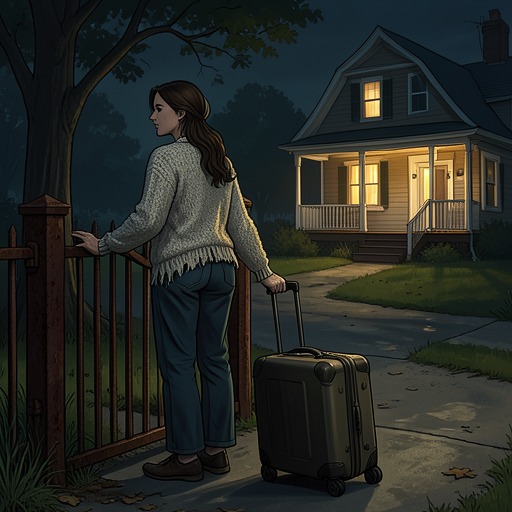
Post-Divorce Reinvention
Lost and FoundPost-divorce reinvention is the unsettled process through which Eve Waters tries to reclaim a life shaped for years around Bryan. Rather than returning immediately to her former professional standing or embracing a new romance, she retreats to Hope Creek, takes a job she considers beneath her qualifications, and protects her solitude. The story makes this reinvention deliberately incomplete: Eve has escaped the marriage, but she has not yet recovered the parts of herself she feels she lost within it.
A Life After Bryan
The opening account finds Eve one month into life in a tiny, one-stoplight town. She has kept to herself and taken work for which she is overqualified because distance from her past matters more than professional advancement. Hope Creek offers a slower pace and people who seem genuine, but Eve also values that they do not press to know every detail of her life. The town’s relative quiet provides space to withdraw, not proof that she has already settled into a new identity.
Eve describes the marriage as a long period of catering to Bryan, her college sweetheart, before discovering that he was cheating. She had lost herself in the relationship, and the loss reached into her work: she had lost the will to cook, a particularly painful change for a professional chef. Leaving was therefore more than a change of address. It was an attempt to stop organizing her life around a husband and to recover the desire and capacity that had once defined her professionally.
The Cost of Leaving
The separation brings practical as well as emotional consequences. Eve had no prenuptial agreement, and Bryan took half of what she had. Her cash is low, so the freedom to begin again does not arrive with financial security or the means to restore her former life at once. When she reflects that she did not want to fight over what he wanted, she frames surrendering the dispute as a way to remove him from her life permanently. That choice costs her materially, but it also marks a boundary: she would rather accept a diminished share than prolong her connection to him through a fight.
Her battered pickup and the Beyoncé CD she has played repeatedly since the divorce give the passage a concrete register for that strain. The CD skips, and Eve bangs on the dashboard before imagining that her whole life, not merely the truck, needs an upgrade. The thought catches the gap between wanting a clean break and possessing the resources to make one. Her life is not repaired simply because she has left; even basic movement forward takes place in a vehicle and a financial situation that bear the marks of what came before.
Hope Creek as Retreat
Eve calls her move an escape and links it to an effort to make lemonade from a bad situation. She takes a job at a hole-in-the-wall restaurant in Hope Creek, deliberately choosing a slower and less prestigious setting than her professional qualifications might suggest. This is not evidence that she has abandoned cooking forever: rather, the contrast between being a professional chef and having lost the will to cook makes the job part of a tentative attempt to live differently while she regains her footing.
The small-town setting does not instantly dissolve her isolation. Eve finds the locals’ wholesome manner harder to get used to than loneliness, and she remains wary of trusting people she barely knows. A trip to Heather’s Forge offers a limited excursion beyond the town, with getting a cat among her reasons for going. The detail suggests a wish for companionship, but one that does not require the risk of a romantic attachment. Her return to the country roads and her repeated listening to the same CD keep the new life in tension with the habits and emotional residue she has carried from the marriage.
New Boundaries, Unsettled Feelings
Joshua becomes an early test of the distance Eve is trying to maintain. After agreeing to stay overnight at his place, she questions the decision: he is attractive but a stranger, and she suspects guilt may be the reason she agreed. She considers signaling him with her truck’s high beams, then stalls. Her hesitation is not a declaration of attraction’s triumph; it shows the pull between an impulse to retreat and her recognition that Joshua seems sweet and down-to-earth. Mrs. Beaumont’s challenge has also encouraged her not to back down, complicating a choice that Eve would prefer to treat as simple.
Before dinner, Eve explicitly resists turning the encounter into a promise of intimacy. She does not want to become involved with anyone, cannot imagine feeling emotion for a man after Bryan, and has not yet worked out who she is or what she wants. She tells herself that the evening is only dinner and that the guest room is simply where she will sleep afterward. These qualifications expose how much effort it takes to hold a boundary while facing the possibility of connection. The evidence establishes her ambivalence, not a completed romantic recovery or a settled new relationship.
An Incomplete Reinvention
The narrative defines Eve’s fresh start through small, uneven decisions rather than a single triumphant reversal: leaving Bryan without contesting what he wanted, accepting reduced finances, relocating to Hope Creek, and living privately while she tries to recover her appetite for work and life. Each choice offers some freedom while leaving a visible cost. Even her attempt to get away for a day and find a cat sits beside her continuing loneliness and distrust.
Eve’s movement toward Joshua therefore matters less as proof that the divorce is behind her than as a pressure placed on the identity she is still rebuilding. She has made a decisive break with the marriage, but she remains unsure whether she can trust a new man or what she would want from one. Post-divorce reinvention, as presented through her, is not a polished transformation into a finished self. It is the harder interval after departure, when she has enough distance to begin asking what she wants but has not yet found the answer.