Post-divorce singlehood
Lost and FoundPost-divorce singlehood is a state of deliberate retreat and unfinished reinvention for Eve: after leaving Bryan, she moves to Hope Creek and tries to recover a self diminished by years of marriage, even as attraction to Joshua tests her resolve to remain unattached.
A life rebuilt at a distance
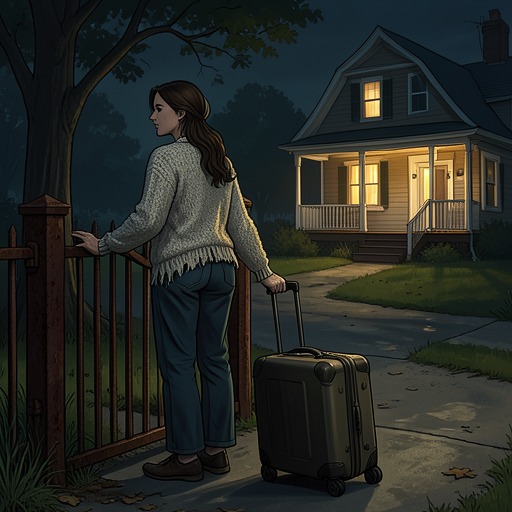
A month after arriving in a small, one-stoplight town, Eve has managed not to drive herself crazy. She describes the place as slower-paced and its people as more genuine, while valuing that they do not press her to disclose every part of her life. That privacy matters because she wants to forget at least some of what came before. Her move is not presented as a triumphant new beginning so much as an attempt to find enough quiet to live with the aftermath.
Eve has kept to herself and taken work for which she is markedly overqualified. She has chosen a job in a small, hole-in-the-wall restaurant in Hope Creek, an abrupt change in scale from the professional life she once had as a chef. The work offers an escape from her past, but the change also measures how far the divorce has unsettled her: she has lost not only a marriage but, for a time, the desire to cook. For someone whose profession depended on that desire, its disappearance signals a personal rupture as well as a career retreat.
The marriage she left
Bryan was Eve’s college sweetheart. She recalls having been fooled into marrying him, spending years catering to him, and eventually discovering that he had cheated. The account links the end of the marriage to a longer loss of self: by the time she left, she felt she had lost herself and her will to cook. Her new life therefore begins with more than separation from a spouse; it begins with the task of recovering interests and identity that had receded during the relationship.
The divorce has also left Eve with less money. Without a prenuptial agreement, Bryan took half of what she had, and the loss makes even a basic upgrade to her battered truck feel unaffordable. Yet she did not want to fight him over the division. She gave him what he wanted because removing him from her life mattered more to her than contesting the outcome. The choice carries a cost, but it also shows the firmness of her decision to end the marriage: she accepts financial damage as the price of severing that tie.
A private soundtrack and a chosen escape
On the drive through the countryside, Eve hums along to a Beyoncé CD that has been playing repeatedly since the divorce. When the disc skips, she thinks of her life as a series of the singer’s songs; the music gives her a framework for narrating the marriage, the betrayal, and the departure. Its recurrence does not erase the loss. Instead, the familiar soundtrack makes the recent past audible in the ordinary mechanics of the drive, even as Eve tries to move beyond it.
Her truck is beat-up, cash is scarce, and the road is rough, but she calls the move to Hope Creek an escape and a way to make lemonade from what has happened. She has chosen a slower town and less prestigious work because she needs distance from Bryan and from the life she had built around him. At the same time, her wish to visit Heather’s Forge to get a cat offers a small, concrete glimpse of the life she is assembling: not a declaration that she is healed, but an interest beyond the marriage and its aftermath.
Attraction and resistance
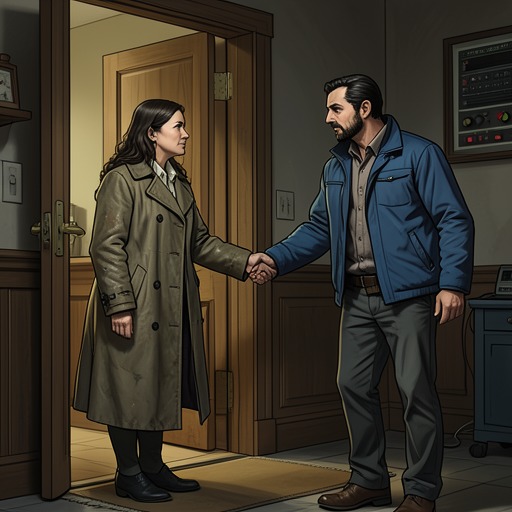
That distance becomes harder to maintain when Eve accepts Joshua’s invitation to stay at his place. She questions the decision, recognizes that he is attractive but still a stranger, and wonders whether guilt is the reason she agreed. On the drive, she repeatedly considers flashing her high beams to signal him, then hesitates. Her wavering makes the invitation a test of the new single life: she is not merely deciding whether to spend a night under his roof, but confronting what it means to move toward someone while her previous relationship still shapes her expectations.
Eve explicitly says she does not want to become involved with anyone. After Bryan, she cannot imagine feeling emotion for another man, and she has not yet worked out who she is or what she wants. She tries to contain the situation by telling herself that it is only dinner, followed by a night in the guest room. The reasoning draws a boundary around the encounter, but her attention to Joshua’s attractiveness and her repeated hesitation show that the boundary is under pressure. Her post-divorce singlehood is thus neither simple independence nor immediate readiness for romance: it is a fragile interval in which she is rebuilding a life while guarding against a new attachment before she feels able to choose one freely.