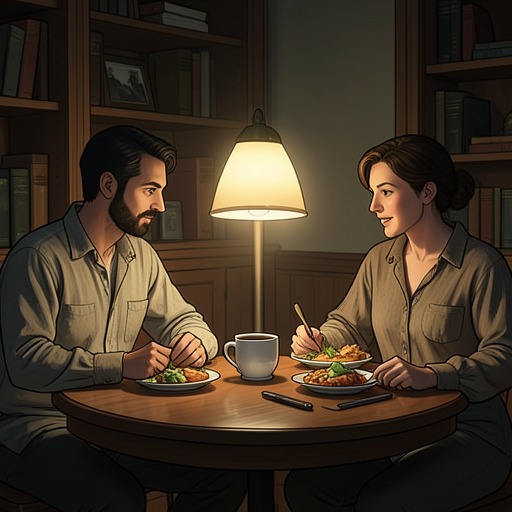
Ransom's stay at Bethany's parents' house
Lost and FoundRansom's stay at Bethany's parents' house is the first concrete extension of Bethany and Ransom's fake-boyfriend agreement into shared private space. What begins as a solution to the questions their reunion audience might ask places Ransom inside Bethany's family setting, gives him unusual proximity to her life and possessions, and helps transform a paid performance into a relationship whose emotional consequences exceed the original plan.
Causes and Arrangement
The stay is negotiated at the Green Leaf Diner after Bethany and Ransom have already identified the central problem in their cover story: appearing to be a couple for a long weekend requires more than simply arriving together. When Ransom suggests getting a room at Bethany's hotel, she rejects the idea because it would create further questions. The plan becomes more convincing, she reasons, if he stays where she is staying rather than maintaining a separate room.
Bethany therefore invites Ransom to her parents' house, explaining that there is a guest bedroom and that she does not expect to have anyone over. The arrangement is presented as a way to make their story look ordinary and to avoid scrutiny, not as an expression of established trust. Yet its very practicality makes the invitation startling: Bethany is allowing a stranger to stay in her parents' house with her while agreeing to present him as her boyfriend.
The domestic arrangement is tied directly to the unusual bargain that created it. Ransom offers to pretend to be Bethany's boyfriend, or even her husband, in exchange for secure access to files connected with the agency where she works. Bethany recognizes that he wants confidential information for his own purposes, but he refuses to explain those purposes, calling them his business. She retains a fallback plan: if he proves untrustworthy or causes trouble, she can pay him the cash she had set aside instead of granting access and can call the police if necessary. Her decision thus combines calculated risk, professional ethics, and a desire to make a spectacular entrance at her high-school reunion.
The Stay and Its Immediate Logic
After Bethany pays both restaurant checks and tips Lucy generously, Ransom tells her that he will follow her to Bethany's parents' house. The departure gives the agreement a physical beginning. Outside the Green Leaf Diner, the temperature is falling sharply, and Bethany watches Ransom approach a nondescript black car that is sporty without being an actual sports car. The ordinary appearance of the vehicle fits the cover story's need for plausibility while leaving Bethany aware that she has accepted a stranger into an arrangement she herself considers potentially irrational.
The stay also establishes a pattern of practical care that makes the performance more persuasive. During the reunion's worsening cold, Ransom gives Bethany his jacket when she shivers, and she remains huddled in it until they reach her car. The gesture is useful as public boyfriend behavior, but it also carries an intimacy that is not reducible to the contract. Later, when Ransom returns to the car after leaving Bethany in the hotel room, he realizes that he has lent her his coat and wishes he had taken it with him. The object becomes a small emblem of the arrangement: a borrowed layer of warmth that is both staged evidence of closeness and a real inconvenience for the person who provides it.
Although the supplied scenes do not narrate every domestic exchange at Bethany's parents' house, they establish why the residence matters as a narrative threshold. It is the first place where the two must occupy adjoining personal space without the protective distance of a restaurant or public reunion venue. Ransom even describes the situation as strangely domestic, imagining the guest room and the possibility of sleeping on chairs as something almost like real couplehood despite the fact that the two barely know each other.
From Private Shelter to Reunion Performance
The household stay is soon overtaken by the snowstorm that threatens to trap the reunion attendees. Madison announces that the airport may be snowed in, roads out of town may be blocked, and the group may have to remain for an extra day or two, although streets within town can be cleared. Bethany is not initially alarmed because she drove into town and can work from home, but the weather changes the practical value of staying near the reunion's center.
Bethany and Ransom decide to relocate to the Clairmont Hotel. Bethany argues that the severe cold makes running back and forth undesirable and that remaining at the center of events will strengthen their public presentation. Ransom confirms that he is willing to proceed only if she is completely certain, while Bethany accepts the pressure of being seen together by classmates. The original stay at Bethany's parents' house therefore becomes a stepping stone rather than the final arrangement: it solves the first logistical problem, then gives way to hotel-room proximity when the storm turns the reunion into a temporary enclosed community.
At the hotel and reunion venues, Ransom takes an active role in staging the couple's success. He signs Bethany and himself up for the weekend's activities, including events she protests she cannot perform, and deliberately increases their interaction with former classmates. At the school fun fair, his stated objective is to ensure that his fake girlfriend has genuine fun. The phrase captures the arrangement's developing contradiction: the relationship remains explicitly false, yet Ransom begins to measure its success partly by Bethany's actual pleasure rather than by appearances alone.
The same performance reaches its most public form at the Clairmont Hotel ballroom dance. Bethany and Ransom work the room, greet classmates, take photographs, and dance amid early-2000s music and openly served alcohol. Their shared presence produces the surprised reactions Bethany wanted, making the fake relationship socially legible as a successful life. The private shelter that began at Bethany's parents' house has thus become a public spectacle.
Confidential Access and Ransom's Hidden Objective
The stay is inseparable from Ransom's undisclosed reason for accepting the arrangement. He has learned that Bethany's agency may hold records concerning an adoption made by his parents roughly twenty years earlier. Public-record searches have failed because the adoption was closed, the relevant paperwork was likely held by the agency, and Ransom did not initially know which name to search. His purpose is not casual curiosity: he believes the agency's files may identify the child adopted by his parents and, ultimately, that child's birth parents.
Bethany eventually grants him restricted access. She explains that one login reaches the adopted-children database and another reaches records for parents who gave up children, warning him not to use either credential elsewhere because misuse could lock her out and force her to explain herself. She tells him to use Bethany's laptop because the agency recognizes it as authorized. The arrangement that began with a request for secure access therefore becomes an opportunity created by trust, private proximity, an authorized device, and a password.
Ransom uses the laptop and reaches the page titled Children Served by Us. He searches for Patrick Nolan, a name he had stopped using about five years earlier, and initially sees no result before the system returns one record. The file contains a photograph of a three-year-old child and identifies Janice and Raymond Nolan as the adoptive parents. Ransom recognizes them as his parents and learns that he was placed with the agency at age two after being given up by his birth parents. The file records above-average intelligence and minor behavioral issues associated with an unstable attachment to his birth parents, but it does not list those birth parents.
The record nevertheless supplies the decisive missing link. Ransom discovers that his name before adoption was Patrick Cartwright, giving him a name with which to search the birth-parents database. The stay at Bethany's parents' house thus sits beside a second, concealed movement: Ransom is entering Bethany's domestic world while using the relationship to recover his own obscured family history. His physical arrival and his archival investigation proceed together, each making the other possible.
Consequences and Emotional Reversal
The snowstorm initially appears to prolong the reunion and intensify the usefulness of the cover story. At the dance, however, an announcement reveals that the roads have been cleared and the airfield is operating, so everyone can leave on schedule the next day. The news is welcomed by the crowd, but it makes Bethany sadder. The extended stay had turned the arrangement into a temporary world in which the performance could continue; its ending restores the ordinary separation that the original plan had assumed.
Bethany displays the engagement ring and tries to prolong the dance, even while recognizing that the reunion is nearly over. She understands that she and Ransom live in different places and may have little in common beyond the weekend, and she expects their contact to end when they return to their separate lives. Yet the shared domestic and hotel experience has made that prospect painful. She wants to continue living the pretend life because, in a short period, it has supplied pleasure and intimacy that no longer feel entirely pretend.
The event's decisive value shift is therefore from controlled convenience to emotional exposure. Bethany's parents' house is chosen to prevent questions; the hotel move is chosen to survive the storm and maximize the show; the reunion dance confirms the public fiction. But the same chain of arrangements gives Ransom access to the records that reveal Patrick Cartwright and gives Bethany a reason to fear the end of their time together. The stay matters not because it is a settled domestic life, but because it creates the private conditions under which an invented couple begins to acquire real stakes.