Reunion art party
Lost and FoundThe Reunion art party is an indoor activity held in the events room at the Helmston Lodge during the snowbound high-school reunion. Its decisive significance lies in the way an apparently light recreational diversion becomes a pressure chamber for Bethany and Ransom’s fake relationship: surrounded by classmates, they continue performing as a couple, yet the relaxed setting also makes Bethany recognize how intensely she wants him when the audience falls away.
Origins and Setting
The art party is arranged after the reunion’s outdoor fun-fair activities, when the weather has made movement between venues uncomfortable. Ransom—using the public identity of James—has signed himself and Bethany up for the event at the other hotel near the high school. Bethany arrives with the top of her shirt still damp from bobbing for an apple, while the wind and falling temperature make the short drive from the first hotel unpleasant. The party therefore belongs to the wider snowbound extension of the reunion, in which ordinary plans are repeatedly moved indoors and the participants remain concentrated in temporary hotel spaces.
Bethany initially resists the activity because she does not consider herself artistic and fears that an ugly result will invite ridicule. Ransom counters that many attendees will make terrible things and laugh at their own failures, encouraging her to treat the event as play rather than a test. He also admits that his own artistic ability amounts to line maps and stick figures, which keeps the activity from becoming another arena in which he appears effortlessly accomplished.
Activities and Public Performance
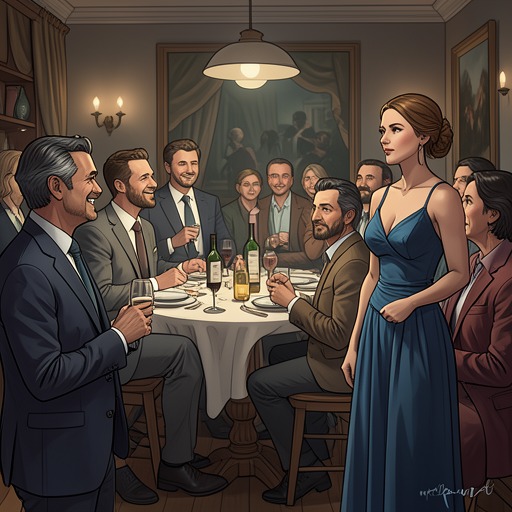
At the Helmston Lodge, Jess is already working at the modeling-clay station on an odd-looking animal figure. Ransom takes a place at a painting station, while Bethany settles beside him to draw a still life. The presence of wine served as pitchers of sangria quickly loosens the atmosphere. Bethany’s fear of being judged gradually subsides, and the party’s social energy makes the classmates’ attention feel less threatening than she had expected.
The activity continues the reunion’s playful testing of Bethany and Ransom as a supposed couple. Bethany jokes that Ransom could persuade her to pose nude only in private, while he responds with evident interest, and she treats the exchange as teasing even as it exposes the sexual charge between them. When she finally displays her poor still life, the other guests laugh, but sympathetically; their own bad attempts make the laughter communal rather than cruel. The moment allows Bethany to participate without maintaining the polished competence that normally protects her.
The couple’s public image remains part of the event’s social machinery. Earlier, Bethany had presented James as a chef and caterer and as her attractive “arm candy,” while their joking suggestion that he receives midnight feasts in exchange for accompanying her made the fake relationship sound casually established. At the art party, that performance becomes easier because their banter no longer feels entirely manufactured. Their classmates may read the flirtation as evidence of a convincing romance, but Bethany increasingly experiences it as an expression of something real.
Bethany’s Sexual Awakening
The sangria and the informal atmosphere repeatedly return Bethany’s thoughts to the night before. She recalls that Ransom had taken time to relax her and had studied her reactions rather than treating sex as a mechanical act. His patience brought her closer to orgasm than any previous sexual experience, leaving her uncertain whether she had actually climaxed or had merely reached an unprecedented intensity. The uncertainty does not lessen the importance of the encounter; it establishes a new bodily threshold against which her earlier, mediocre experiences are measured.
At the art party, attraction becomes continuous rather than confined to a private encounter. Bethany notices heat building between her legs while she banters with Ransom, Jess, and the other guests, describing her whole body as poised at the edge of boiling. She tells herself that the arrangement will end in only a few days and that she will never see or hear from him again, but the prediction only sharpens the desire she is trying to suppress. Her wish expands from repeating the previous intimacy to discovering what actual sex with Ransom would be like.
This is the event’s central reversal. Bethany entered the party worried about artistic embarrassment and tired of pretending to be Ransom’s girlfriend, yet she leaves having enjoyed herself and having understood that the performance itself can generate pleasure. She still wants privacy and feels relieved that Ransom does not suggest attending the large group dinner, but her resistance is no longer directed simply at him or at the reunion. It is directed at the consequences of acknowledging how much she wants the relationship to continue beyond its assigned weekend.
Consequences and Narrative Function
When someone asks whether Bethany and Ransom will attend dinner, Bethany silently hopes he will refuse because prolonged contact with classmates has become exhausting. Ransom answers that they will eat on their own, while recalling that they are due at another activity before dinner. His response protects Bethany from the social pressure of the reunion while preserving their shared movement through the snowbound schedule. The art party thus ends not with a public declaration but with a private withdrawal from the group, an outwardly ordinary choice carrying a new emotional charge.
The event also prepares later escalations in the relationship. Their joking intimacy becomes visible enough to support the public image Ransom eventually intensifies through a proposal at the dance, while the couple’s private encounters become vulnerable to discovery when Nadine and Katherine catch them fooling around. At the same time, the reunion’s role-playing intersects with Ransom’s hidden purpose: Bethany has offered secure access to the Hannah Wells Organization’s adoption databases in exchange for his posing as her boyfriend, and he later uses Bethany’s laptop to search Children Served by Us under the name Patrick Nolan. The art party therefore sits between two kinds of performance—romantic display for classmates and investigative concealment—while helping the first move toward sincerity and the second toward disclosure.
In structural terms, the art party is a threshold scene. The classmates’ laughter, the unfinished still life, the shared drinks, and the damp cold outside temporarily suspend the disciplined identities Bethany and Ransom brought to the reunion. Bethany cannot yet call the relationship genuine, and Ransom has not yet revealed that he was born Patrick Cartwright before becoming Patrick Nolan, but the event makes the eventual truth emotionally plausible. What begins as an indoor craft activity becomes the point at which Bethany’s body and judgment cease cooperating with the limits of the fake-boyfriend arrangement.