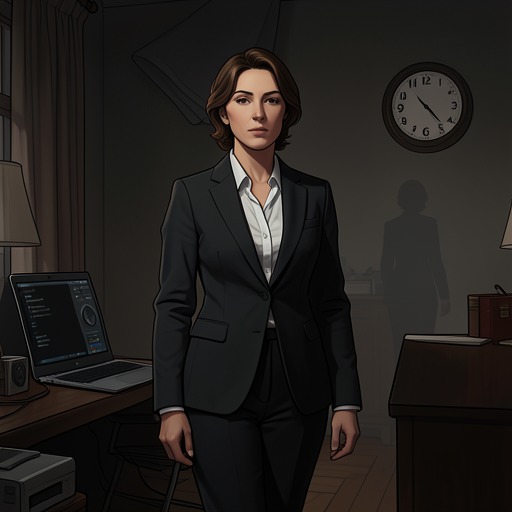
Reunion opening dinner
Lost and FoundReunion opening dinner is the first public trial of Bethany and Ransom’s fake-boyfriend arrangement. Staged at Bethany’s former school, it turns a private bargain involving confidential agency access into a visible social performance: the pair must persuade classmates that they are an established couple while improvising around gaps in their invented history. The dinner therefore changes the arrangement from a convenient plan into a shared identity under scrutiny, while exposing how easily appearance, desire, professional success, and personal secrecy can become entangled.
Causes and Preparation
The dinner follows Bethany’s decision to secure a striking companion for her high-school reunion and Ransom’s offer to play that role in exchange for secure access to files at the agency where she works. Rather than paying him the five thousand dollars she had set aside, Bethany considers trading access to confidential information for his performance as her boyfriend. She recognizes the danger of letting a stranger into her parents’ house, allowing him access to sensitive work material, and relying on him throughout a long weekend, yet she also believes that his appearance and presence will complete the impressive life she wants former classmates to see.
Because the two barely know one another, Ransom insists that they learn as much as possible about each other and that Bethany master his cover story. Their preparation resembles studying for a test: it is designed to prevent contradictions, but it cannot anticipate every question or emotional complication. Bethany’s account of Sarah’s suicide, shortly before graduation, gives the preparation an unexpected gravity. Sarah had reconnected with her birth parents and found them as harmful as before; Bethany believes that a genuinely caring family might have helped her survive. That history links Bethany’s professional commitment to adoption work with a personal wound that Ransom is not initially meant to investigate.
The Dinner as a Public Performance
At the school, Bethany and Ransom enter holding hands, with Ransom deliberately allowing her to lead their interactions. The setting is a decorated cafeteria transformed by bunting, hand-painted posters, school-colored votive holders, round tables, and comparatively expensive catering. The formal clothing, name tags, and awkward search for old friends establish the reunion as a ritual in which former students display revised versions of themselves while pretending that the encounter is casual.
Alicia’s greeting immediately tests the couple’s presentation. Bethany compliments Alicia’s appearance and remarks on her recovery after having a baby, while Ransom observes the careful social politeness beneath the apparent warmth. When Alicia asks who he is, he presents himself as Bethany’s attractive “arm candy” and jokes about being retained for appearances and late-night treats. Bethany strengthens the performance by leaning against him like an infatuated teenager and identifying him as James, a chef and caterer.
Their cover story gives the supposed relationship a professional origin. Bethany says that Ransom’s catering company handled an event for her organization, a donor-appreciation banquet, and that tasting his food led her to hire him. After the banquet, she supposedly told him that she would not hire him for the next event because she wanted to date him and never mixed business with personal life. The story makes the relationship appear both romantic and plausible, turning Bethany’s professional world into the setting for their alleged first connection.
Pressure, Contradiction, and Exposure
The performance becomes harder as classmates circulate before dinner and ask questions the pair did not rehearse. They are asked how long Ransom has worked as a chef and how he began his business, details that he had not prepared. He deflects by redirecting attention toward Bethany, taking her hand and kissing it while declaring his focus to be entirely on his sweetheart. The gesture protects the cover story for the moment, but it also shows that physical affection is being used as evidence when factual knowledge fails.
When someone asks how long they have been together, Bethany gives the precise fiction that they have dated seriously for about nine months. Ransom adds that she allowed him to move in six months earlier, claiming that cohabitation helps him ensure that she eats properly because work keeps her out until eight or nine at night. The details make the pair appear domestically established, but they also expose the strain of improvisation: each new fact creates another part of a shared past that must later be remembered and defended.
The dinner thus produces a shift from control to risk. Bethany wanted a flashy entrance, and Ransom supplies it, but the same conspicuousness invites investigation. Their attractive presentation encourages classmates to ask more, not less. The couple’s inability to answer every question demonstrates that the reunion is not merely a backdrop for romance; it is an adversarial social environment in which old acquaintances test whether the adults before them match the lives they claim to have built.
Consequences and Wider Significance
The dinner establishes the central contrast between the couple’s public confidence and their private uncertainty. In front of classmates, they act as a successful, affectionate household; outside that performance, Bethany is still wondering whether she has lost her mind by inviting a stranger into her parents’ house, and Ransom remains motivated by a secret search connected to his birth identity. His interest in the agency’s files is not initially disclosed to Bethany, making the romantic display inseparable from an undisclosed objective.
That objective gains practical force during the reunion weekend. Bethany later gives Ransom authorized use of her laptop and access to the adoption databases, warning him that the credentials are limited and that misuse could lock her out and force her to explain herself. On the computer, he enters the name Patrick Nolan, a name he had stopped using years earlier, and finds one result in the database of children served by the organization. The dinner’s invented intimacy has therefore created the trust and proximity that make his identity investigation possible, while also placing Bethany’s employment and confidentiality at risk.
The event also prepares later reversals in the couple’s public story. Bethany eventually hears classmates speculating that she hired Ransom from a modeling agency because, despite being attractive, she supposedly cannot manage her life. Their suspicion reveals the fragility of the image the dinner was meant to establish. Later, Ransom turns the reunion’s performative logic into a public proposal, kneeling before Bethany with a ring and asking her to marry him; she accepts, and the crowd responds as though the spectacle were a genuine fairy-tale engagement. In another episode, classmates catch the pair making out and assume that the staged relationship has become physically real.
The dinner’s deepest consequence is that the false history begins to carry genuine emotional weight. Ransom’s eventual confession that he was born Patrick Cartwright, became Patrick Nolan after adoption, and now uses the name Ransom reframes his earlier search for agency files. Bethany’s willingness to help him access records, first as part of the bargain and later within a relationship increasingly difficult to separate from the performance, places professional ethics beside compassion and desire. Reunion opening dinner is consequently the threshold at which a calculated display becomes the social reality that later demands disclosure, trust, and a decision about whether the couple’s promised future can be real.