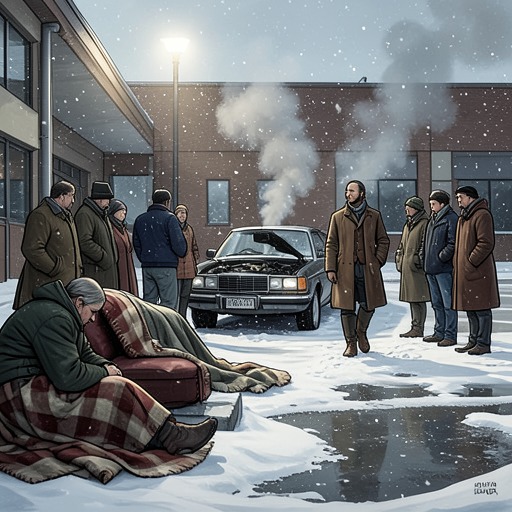
Snowed-in isolation
Lost and FoundSnowed-in isolation is the reunion’s sudden change from a scheduled weekend into a potentially extended stay, as dangerous cold, heavy snow, and blocked routes threaten to cut the town off. The storm is more than a backdrop: it changes where Bethany and Ransom stay, makes proximity to the reunion’s organizers and classmates newly useful, and gives their performed relationship a setting in which they must sustain it well beyond a single event.
Forecast and Immediate Risk
The warning arrives as dinner is ending in the school cafeteria. The class president announces that an airport weather advisory may force changes to the reunion schedule and leave attendees trapped for an extra day or two. The National Weather Service forecast calls for heavy snow and extremely low temperatures through the weekend. For the group, the danger is logistical as well as meteorological: sufficiently low temperatures can make flying unsafe, the airport may be snowed in, and roads out of town may remain blocked even if local streets can be cleared.
The forecast is unsettled in its timing but stark in its implications. Snow is expected to start within hours, earlier than originally predicted, and attendees are advised to return to their hotels or houses before conditions worsen. The announcement draws groans and questions from the cafeteria; the prospect of a stay beyond the planned weekend is immediately shared by the whole gathering. Bethany, by contrast, initially feels less alarmed because she drove into town and could work from home if necessary. That relative confidence does not mean the storm leaves her plans untouched: the temperature is already dropping sharply as she and Ransom leave dinner.
Ransom offers Bethany his jacket when she shivers on the way to her car. The small gesture belongs to the storm’s practical pressure: the cold makes the danger tangible before the roads are actually impassable, and their departure becomes a decision about where to wait out the weather, not simply how to get home after dinner.
Relocation to the Clairmont Hotel
Bethany and Ransom choose the Clairmont Hotel rather than retreating to Bethany’s place. The choice combines practical convenience with the demands of their fake-couple arrangement. Bethany expects classmates to visit her if she stays at a hotel with other reunion attendees; sharing a room with Ransom would invite suspicion if it had two beds. At the same time, she decides that being close to classmates and the people organizing the revised program will help her keep track of what is happening. The Clairmont is also where the major Sunday dance is planned, making it a natural center of reunion activity.
Ransom recognizes the public advantage of staying there: their closeness can reinforce the impression that they are a convincing couple before the people most likely to gossip. Bethany accepts that logic, while also citing the cold as a reason not to keep travelling around town. She and Ransom commit to making the hotel their base, even though the choice means deliberately placing their performance under the eyes of classmates. The weather narrows their practical options; their decision turns that constraint into an opportunity to maintain the cover story.
The hotel room sharpens the consequences of moving in together. The front desk assigns them room 3140 and gives them two key cards. The room is spacious, with chairs, a small table, a dresser, and a large bed, but no couch or settee; there is only one bed for two people who barely know each other. Ransom offers to sleep on the floor. Their hotel stay is therefore not simply a convenient retreat from the storm: it puts the carefully managed appearance of intimacy beside the ordinary negotiations of shared space.
A Shared Base During the Extended Reunion
The Clairmont places Bethany and Ransom near the changing reunion schedule, while the weather complicates travel beyond it. Ransom offers to return to Bethany’s place to collect their belongings after they check in. He expects to have about half an hour alone during the trip, having found the prolonged performance tiring. Bethany, meanwhile, feels both excitement and worry at the thought of him gathering her things. Their reactions show how quickly the storm-driven arrangement moves their false relationship into domestic territory: even a practical errand carries emotional and performative weight.
The group’s activities continue within the limits imposed by the conditions. Some events are to be moved indoors, and the first event Ransom identifies after breakfast is a fun fair at the school. He signs them up for activities despite Bethany’s protests that she has never made a basket and does not want to learn hula. He sees participation as a way for her to show her former friends that she is successful and well-rounded, and for them to appear in love. The disrupted schedule thus does not suspend the reunion’s social performance; it gives the couple more occasions to enact it among classmates.
The storm does not make the town wholly impassable. Later, Bethany and Ransom drive to a restaurant a short distance from the hotel. Most streets in town remain navigable, but there is no practical way out, and Bethany’s parents’ house is inaccessible because of problems involving snowploughs or trucks. This distinction matters: snowed-in isolation is a boundary around the town, not a claim that everyone is confined to one building. The attendees can move locally while their routes home, the airport, and the option of returning to Bethany’s house remain out of reach.
Pressure, Intimacy, and Other Stakes
The extended stay keeps Bethany and Ransom together through more of the reunion than their original plan anticipated. At the hotel, he takes an active role in shaping their public appearances, from signing them up for the fun fair to encouraging Bethany to work the room at the dance. Their shared lodging and repeated participation make the fake relationship increasingly visible to classmates. The storm’s pressure is therefore social as well as logistical: it reduces the ease of leaving the setting in which their story must be sustained.
For Ransom, the reunion also coincides with a private investigation that has consequences beyond the couple’s public performance. At dinner away from the hotel, he reflects on information he obtained through the agency Bethany works with: his parents did adopt a child, and the identity of that child is kept separately from their dossiers because the child was a minor. Since the adoption took place about twenty years earlier and was closed, public records have not supplied the information he needs. He wants access to the child’s file and, if it still exists, the birth parents’ file. The storm does not itself reveal his identity or resolve the search, but the circumstances of the prolonged stay place this consequential objective alongside the reunion’s staged intimacy.
Clearance and the End of the Enclosure
The isolation proves temporary. During the dance in the Clairmont Hotel ballroom, a class officer announces that the roads out of town have been cleared and the airfield is operating again. The group will be able to leave on time the following day. The announcement reverses the original warning: an extra day or two had seemed possible, but the reunion now has a definite end within reach.
Bethany and Ransom cheer with the others, yet the news makes Bethany sadder. She has been showing off her ring and trying to prolong the dance, because its ending means returning to life apart from Ransom and the pleasure of their brief time together. The storm’s release from confinement does not restore a neutral status quo. By delaying departure, the snow has helped make a shared temporary life feel consequential; once travel becomes possible again, Bethany confronts the limit of that life. The isolation ends not with a dramatic escape but with cleared routes—and with the recognition that the couple’s reunion-bound performance may soon end as well.