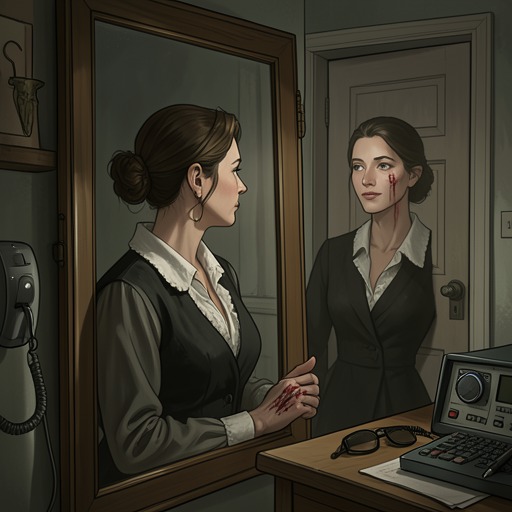
“Fantasy Emmi”
Love Virtually“Fantasy Emmi” names the imagined Emmi Rothner built through correspondence with Leo Leike, rather than an identity separate from her. The figure is created from words, omissions, and mutual projection; its freedom from physical encounter helps sustain the intimacy, but also makes it a source of tension in Emmi’s marriage and in the boundary between her correspondence and everyday life.
An Image Built from Correspondence
Leo acknowledges that he has written to Emmi every day while deleting the messages instead of sending them, because his interest in her has begun to exceed what he considers appropriate for their correspondence. He agrees with her stated expectation that they will probably never meet and regards that assumption as protection against turning their exchange into ordinary chat-room or lonely-hearts conversation. When he finally sends a message, he says it contains only a fraction of what he wanted to write. The withheld emails thus mark an early gap between his private attachment and the more limited relationship he allows into their inboxes.
Leo later describes their correspondence as the construction of virtual characters: they ask questions without answering them, refuse to reveal fundamental parts of their lives, and try to infer each other from what remains unsaid. They know that they live in the same city and have exchanged basic information about their work, but their electronic world lacks the usual coordinates of shared life: faces, ages, routines, and a distinction between day and night. In this vacuum, Emmi’s written presence can be elaborated without being tested against the details of an encounter.
The imagined figure is not merely a playful invention to Leo. He confesses that he is seriously interested in Emmi, while suspecting that his interest is nourished by the inbox itself and would fail if removed from it. He asks whether she wants him to continue writing, making the correspondence’s future depend on a direct answer even as he questions whether its imagined intimacy could survive outside the screen.
Projection and the Limits of the Image
When Leo returns from a conference in Bucharest, he finds four messages from Emmi, including one that opens with an insult. His reply rejects the idea that her being happily married has made him jealous or changed his aims: he says he never wanted to know what she looked like and is instead composing his own Emmi Rothner from her messages. The portrait, he insists, would remain much the same regardless of changes in her marital history. This is not knowledge of Emmi’s life so much as a deliberate decision to make her written presence sufficient.
Emmi describes the same arrangement from her side, calling herself a fantasy image to Leo and Leo a source of amusement and renewed flirtation for her. She understands the exchange as letting her experience the opening stages of an affair without having one in ordinary life, but warns that their correspondence has advanced into an affair that cannot happen. Her account exposes the contradiction within the fantasy: it can feel emotionally consequential precisely because it is kept apart from the acts and obligations that would make it an ordinary relationship.
Leo later calls Emmi the heroine of his email novel and says he is grateful that their attempts at a physical meeting have failed. He can keep seeing her as he wants to see her, without discovering that the person in reality differs from the ideal figure in his messages. He describes that imagined Emmi as perfect and untouched by others. The missed meetings therefore do more than postpone a decision: they preserve the conditions under which his image can remain complete.
The Other World and Everyday Life
Emmi’s messages give the imagined relationship a defined place outside her household. In one late-night email she lists the people and objects around her: Bernhard is working, Fiona is staying with a friend, Jonas is asleep, and Wurlitzer is eating dog food. She imagines the furniture, piano, bookcase, CD player, wine rack, and bed reacting to her correspondence and to the possibility that Leo might enter the family’s world. The piano, in particular, is connected to Bernhard: he taught Emmi to play, and the instrument is bound to their shared history. The inventory makes the household’s ordinary attachments visible just as Emmi insists that Leo cannot become part of them.
Emmi calls her marriage dependable and harmonious. She says she and Bernhard respect and treasure each other, share music, theater, and friends, and depend on the life they have built together. She also describes her place in the family: Fiona is like a younger sister, while Emmi has become a kind of mother to Jonas after his mother died when he was three. Her defense of this life is not an abstract excuse. It specifies the relationships and shared history that the correspondence risks unsettling, even while she insists that Leo and the household must remain separate.
That separation becomes harder to maintain after Bernhard discovers the emails. In his account, he has noticed Emmi’s distraction and distance, then found a folder containing the correspondence printed page by page in a secret drawer. He later reads the messages in one night during a hiking trip and is taken to hospital after he cannot get out of bed. His account recasts the “other world” as a real pressure on the marriage: the relationship may be made of words and an imagined person, but the consequences reach into the family’s everyday life.
A Name That Breaks the Boundary
The tension between imagined and domestic identities becomes decisive when Emmi cancels a planned meeting with Leo at the last minute. She explains that Bernhard, who usually calls her Emma, adds the name Emmi to his usual farewell when she tells him she is meeting a friend. That single change exposes to her that he may see through the explanation and the emotional life she has kept apart from him. She had expected to leave as one version of herself and return to the other; hearing her name in Bernhard’s voice makes the division feel unstable.
Emmi interprets the name as touching the identity she associates with Leo: the self she feels he has recognized through their letters. Her imagined response to Bernhard insists that Leo has found and drawn out that self, despite never having seen her. She says she could prove the connection through the correspondence. The exchange shows how an identity created in writing can feel more personally revealing than a long-established marriage, without making the fantasy equivalent to a shared life.
Significance
“Fantasy Emmi” is sustained by the form of the novel’s email exchange. Each correspondent writes from a partial, interested perspective; unanswered questions and withheld facts leave space for projection, while later messages revise what an earlier email seemed to mean. Leo’s idealized portrait, Emmi’s account of an affair without an affair, Bernhard’s discovery of the printed messages, and Emmi’s reaction to the altered name all show different consequences of that incompleteness.
The imagined Emmi is therefore both refuge and risk. She allows Leo to preserve a version of Emmi that cannot be disproved by ordinary contact, while allowing Emmi to experience a self she feels is recognized in the correspondence. But the very qualities that protect the image—distance, omission, and postponed meeting—also prevent it from becoming a mutually tested relationship. When the private letters enter Bernhard’s awareness and Emmi hears her name differently at home, the boundary between the imagined figure and domestic life can no longer be treated as secure.