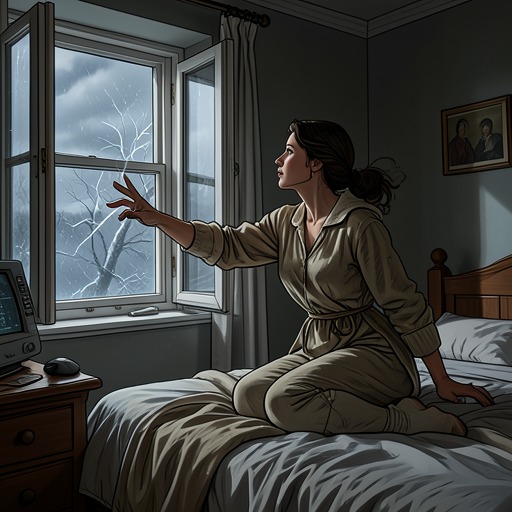
“Second voice”
Love VirtuallyThe “Second voice” is Leo Leike’s name for the dialogue Emmi Rothner’s emails awaken within him, and for the intimacy he fears losing if their connection leaves the screen. More than a flattering metaphor, it describes how correspondence changes his experience of solitude: Emmi becomes an inward presence, at once companion, interlocutor, and source of questions he might otherwise not ask himself.
The phrase and its meaning
Leo explains that Emmi is like a second voice inside him, accompanying him through the day and turning his inner monologue into dialogue. He values not just her charm but her ability to question, insist, parody, and engage him in conflict. The voice is therefore not a simple echo of his own thoughts. Its distinctness matters: Emmi’s responses enrich his emotional life precisely because they challenge him.
The metaphor names a relationship formed through language rather than shared physical presence. Their emails give Leo a companion in his thoughts, but the same medium also keeps that companion separate from the demands and disclosures of an in-person encounter. The voice feels intimate while remaining mediated; its nearness depends on distance.
From email to emotional dependence
The correspondence’s importance is apparent in the way each writer registers silence. Emmi tells Leo that when he does not write for three days, she begins to wonder why and feels that something is missing. She asks him to rectify the absence. Her words describe a growing reliance on his messages, not merely an interest in occasional conversation.
Leo, in turn, asks directly whether she wants him to keep writing and requests a clear answer. When Emmi later says she thinks they should stop because she is becoming addicted to him and spends her day waiting for emails, Leo responds with questions about whether she wants to know him in person. Their exchange makes the “Second voice” part of a reciprocal attachment: both the comfort of contact and the strain of waiting are built into the correspondence.
Solitude, grief, and the refused meeting
Leo says that exchanging a few seemingly irrelevant words with Emmi about his mother’s death did him a world of good. The second voice returned, asking the questions he had been missing and finding answers with him, breaching and overcoming his loneliness. The intimacy’s force thus becomes especially clear in a moment of grief: ordinary words can draw him out of isolation without requiring either person to explain everything face to face.
That relief brings a desire for greater closeness. Leo admits that he wanted Emmi beside him and that, had she been free that evening, they would have met. Yet he imagines the meeting as a possible ending to the magic: family burdens might be unloaded at once, puzzles solved, and conversation exhausted, leaving disenchantment in place of illusion. He wonders how they would look at one another and what they would write afterward. His questions do not establish that a meeting would inevitably destroy the connection; they show that he cannot be sure the voice would survive the change in circumstances.
Preserving the voice
Leo tells Emmi that he is afraid of losing the Emmi voice and wants to keep and treat it with care; he says he cannot live without it. The declaration makes the metaphor an expression of both attachment and apprehension. He wants closeness, but fears that translating a relationship sustained by messages into immediate personal contact could deprive it of the conditions that made it powerful.
The phrase consequently gathers the correspondence’s central tension into one image: Emmi is emotionally present to Leo while remaining physically unknown to him. Her voice gives his inward life a second speaker, but its survival seems tied to the distance that permits him to imagine what a meeting might resolve or ruin. The correspondence’s pauses sharpen that dependence: after Emmi leaves him waiting for two days, Leo asks not to be left suspended, even if her answer is rejection. The second voice is precious partly because it can fall silent.