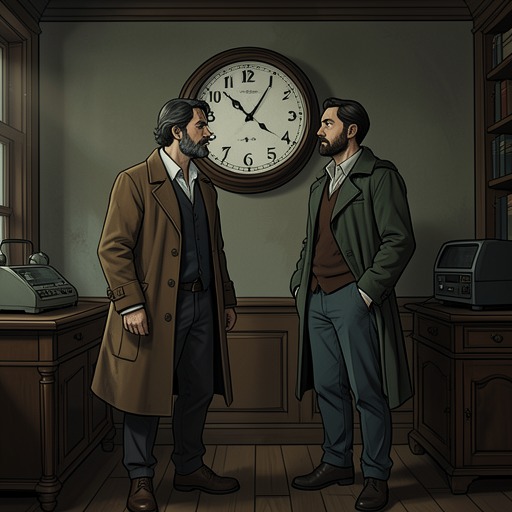
“the other world”
Love Virtually“the other world” is the private emotional realm Emmi and Leo create through their correspondence. It offers intimacy outside Emmi’s family life, but its very distance from that life is also its limit: it can intensify longing and reshape a marriage without providing the face-to-face relationship its participants imagine.
An intimacy made through correspondence
Leo describes the pair as communicating in a vacuum: they have exchanged basic information about their work and know they live in the same city, yet they lack shared surroundings, ages, faces, and any common sense of time. Their computer screens are the only space they inhabit together. For Leo, this absence of ordinary context does not make the connection unreal; he admits that he is seriously interested in Emmi while suspecting that the interest is sustained by his inbox and might fail if brought into a meeting.
The exchange therefore has its own rhythm and conditions. Emmi tells Leo that three days without a message make her wonder what has happened and leave her feeling that something is missing. Leo, in turn, asks whether she wants him to keep writing and later protests when she leaves him without a reply for two days. The other world is built not only from what they disclose but from the repeated expectation of an answer: silence becomes an absence within a relationship that has no shared physical setting to fall back on.
A refuge from ordinary life
The correspondence becomes a daily emotional presence for both. Emmi says that a message from Leo can make her day begin well, while a day without one feels bleak; she recognizes that she is becoming addicted to him and considers ending the exchange. Leo calls her a second voice inside him, one that turns his inner monologue into dialogue and breaks through his loneliness. When he has shared a few seemingly insignificant words about his mother’s death, he says her presence has done him good. The connection’s emotional force is real, even as it remains mediated by writing.
The phrase also takes on a more specific meaning in Emmi’s family life. In imagining what she might tell her husband before meeting Leo, Leo describes himself as protection against the north wind: the person Emmi writes to at night rather than turning to her husband. He imagines the correspondence as a place where the two of them discuss their private selves and the life they might have if Emmi did not have her husband and children. This imagined explanation makes the other world a parallel emotional life, not simply a pastime kept separate from the marriage.
The boundary between screen and presence
When Leo and Emmi contemplate moving beyond email, the change of medium threatens the world they have made. After exchanging voices becomes a possibility, Leo asks whether they will go through with it; later he urges Emmi to come to him, while also acknowledging that she is married. His messages reveal how strongly he wants to move from written and spoken contact toward physical proximity, but that desire does not erase the boundary between their private correspondence and Emmi’s commitments.
Leo’s account of a possible meeting explains why he has also resisted crossing that boundary. He imagines that meeting would strip away the secrets and puzzles that sustain their connection, replacing the magic of distance with the demands of immediacy. He fears losing Emmi as a second voice if the imagined figure on the screen becomes a person encountered in ordinary life. In this sense, the other world offers closeness while postponing the encounter that could test what that closeness means.
Exposure and an ending by disconnection
The private realm is not consequence-free. Bernhard tells Leo that since Leo entered Emmi’s life, she has seemed absent and distant, spending hours in her room at the computer and smiling in a way Bernhard no longer feels is meant for him. He discovers her printed email correspondence in a secret drawer and reads it during a hiking trip. The other world, which had seemed to exist beyond the family’s view, becomes materially present in a folder of printed messages and an immediate source of marital pain.
Leo eventually decides to move to Boston for at least two years and end the email contact. He says Emmi cannot remain the first and last thought of his day and sees their written relationship as emotionally confusing rather than a path toward a shared life. His farewell frames their intimacy as a backward route: exciting, but leading nowhere. Later, when Emmi tries to write to him, an automatic delivery notice reports that the address has changed and incoming messages will be deleted. The other world ends not with a face-to-face resolution but with a failed delivery, exposing how completely its continued existence depended on the channel through which it was made.
Meaning of the phrase
The other world is both refuge and enclosure. It gives Emmi and Leo a language for loneliness, desire, and an imagined alternative to ordinary life, yet it keeps them apart from the physical knowledge that a meeting would bring. Its asynchronous messages allow intimacy to grow through anticipation and carefully chosen words; the possibility of voice or presence unsettles that arrangement, while the changed email address finally makes its fragility concrete. The phrase thus describes a relationship that can profoundly alter lives without ever becoming a stable shared world.