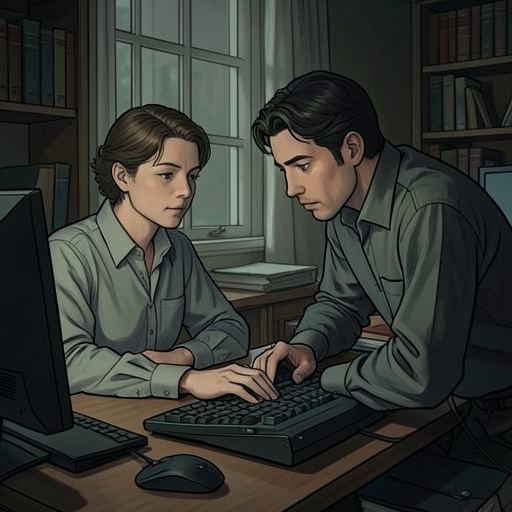
Emmi and Leo’s email correspondence
Love VirtuallyEmmi and Leo’s email correspondence is the relationship’s primary setting and its central complication: messages let Emmi Rothner and Leo Leike become unusually candid with each other, but the intimacy they build depends on distance, incompleteness, and the screen. What begins as contact with a stranger grows into an attachment that shapes their days and challenges the boundaries of Emmi’s married life, even as both recognize that a meeting could alter or destroy what the correspondence has made possible.
An intimacy built from absence
The letters make their own form of closeness out of what is missing. Leo observes that the pair know almost nothing about each other: they have disclosed their lines of work and that they live in the same city, but not the fundamentals of their daily lives. Without faces, ages, or a shared physical setting, each tries to assemble a picture from the other’s words while withholding enough to keep that picture unresolved. The exchange is deliberately curious and evasive; unanswered questions and the effort to read between the lines are not merely obstacles but part of its attraction.
Leo names the contradiction directly. He is seriously interested in Emmi, yet suspects that his interest is nourished by his inbox and would not survive an encounter. His confession turns the email relationship into both an acknowledged attachment and an experiment whose conditions the participants fear changing. When he asks whether she wants him to continue writing, the question makes the correspondence itself the matter under negotiation: preserving it requires a response, but a clear answer might force them to define what they have.
The medium also gives small intervals unusual weight. Emmi tells Leo that three days without a message make her wonder what has happened and feel that something is missing. Later, she describes opening her inbox to find a message from him as the beginning of a good day, and the previous day’s silence as a bad one. The rhythm of sending, waiting, and replying becomes part of the relationship’s emotional substance; an empty inbox is no longer neutral when she has begun to organize her expectations around his presence.
From flirtation to dependence
Emmi initially describes the exchange as a way to refresh her flirting and experience the opening stages of an affair without undertaking one in real life. She also calls it a fantasy: Leo knows her through a handful of letters and can build a harmonious image from them, while their connection lacks the ordinary conditions of a shared life. The description recognizes the correspondence’s limits, but also its power. Because the affair can remain at the level of words, Emmi can approach its excitement while imagining that its consequences are contained.
That containment becomes harder to maintain. After a day without a message, Emmi says she is beginning to feel addicted to Leo and proposes that they stop. Her fear is not only that he may refuse to meet her, but that he wants the correspondence without knowing the actual person behind it. Leo’s response begins with an understanding acknowledgment and a set of questions, including whether she wants to know him in person. The exchange converts a general wish to end things into a direct test of what each expects from the other.
The intensity is especially consequential for Emmi because she experiences email as a place where she can be more spontaneous than in ordinary life. She explains that everyday roles and compromises require her to regulate what she feels and says, whereas with Leo she can write without calculating what is permissible to disclose. His patience and continued attention help her feel accepted even when she admits to jealousy, distrust, and self-doubt. In her account, the correspondence does not simply entertain her; it gives her access to a version of herself she believes is harder to express elsewhere.
The screen’s border and the marriage at home
Leo likewise describes Emmi’s messages as a second voice within him, turning his inner monologue into dialogue and accompanying him through the day. When he writes about his mother’s death, he says that sharing the subject with Emmi relieves his loneliness and makes him want her beside him. Yet he imagines that an in-person meeting would bring their secrets and puzzles to an end, leaving him to unload his family burdens and both of them disenchanted. His resistance to meeting is therefore bound to his fear of losing the voice the emails have created, not simply to a lack of interest in Emmi.
The correspondence remains outside Emmi’s household, but it is not untouched by that household. In one late-night message from her study, she imagines the furniture and objects around her reproaching her for becoming preoccupied with Leo. The piano recalls that Bernhard was her piano teacher and connects the household’s music with their marriage; the bookcase and bed register the disturbance of her attention and imagination. Emmi calls the domestic world impenetrable and insists that she and Leo must stay outside it if she is not to lose him. She also describes her marriage to Bernhard as loving and respectful, supported by shared music, theatre, friends, and family life. That account makes the boundary real: her correspondence with Leo develops alongside a life she says she values, rather than in the absence of one.
The gap between written intimacy and private life is also a recurring source of unease. After a period of silence, Leo complains that Emmi has left him waiting and asks her to answer rather than leave him suspended. Such appeals echo Emmi’s earlier complaint about the absence of his messages, reversing who waits and who must restore the exchange. The emails sustain connection through response, but also expose each writer to the other’s silence; neither can fully control the meaning of a delay.
Voice, proximity, and the final interruption
The relationship begins to test the limits of writing when the pair turn toward voice. A message framed as a shared midnight moment has Leo propose a drink and a kiss, while asking Emmi to reply at once and tell him what she is drinking. Later, under the subject “Our voices,” the question of whether they will go through with the exchange signals a change in the terms of contact: written language has allowed them to imagine one another, but a voice brings a more immediate form of presence.
The movement toward physical proximity becomes explicit in Leo’s late-night invitation to Emmi. He offers to pay for a taxi to Hochleitnergasse 17, flat 15, or to come to her instead. He promises that the visit would not involve sex and imagines meeting her without turning on the lights, while asking what counts as cheating when the steps under consideration range from an email to a voice, a smell, or a kiss. The message does not resolve the boundary between fantasy and action; it shows how the correspondence has brought that boundary to the point of decision.
The available ending preserves that uncertainty by replacing a personal reply with a system message. After an unsent message in which Emmi says she cannot come over, identifies her feelings for Leo, and recognizes that Bernhard has sensed them, a delivery notice reports that the recipient’s email address has changed and that incoming mail will be deleted automatically. The relationship’s principal channel is abruptly made unusable. The evidence establishes the interruption of correspondence, not what follows beyond it: the exchange that had made absence emotionally charged ends, at this point, in an impersonal statement that messages can no longer arrive.