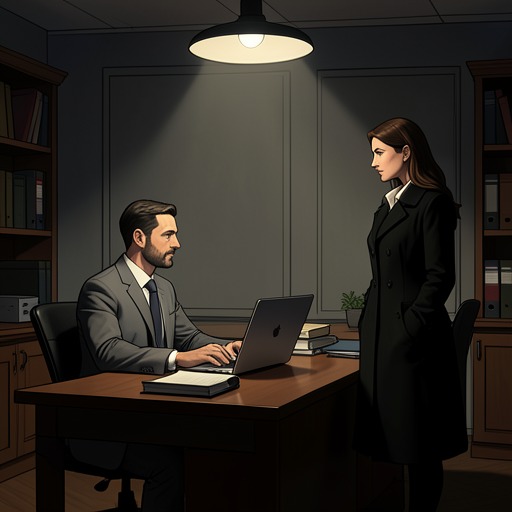
Emmi and Leo’s online romance
Love VirtuallyEmmi and Leo’s online romance is an intimacy made in language and sustained by distance: email gives each a vivid place in the other’s inner life, while postponing the ordinary encounter that might alter or end their imagined connection. Their relationship moves from written companionship toward voice and the possibility of physical presence, but its decisive pattern is a repeated approach to that boundary and retreat from it. Leo eventually leaves for Boston and stops their correspondence; when contact resumes, he urges Emmi to preserve what they had as a private experience that reached the brink of meeting but did not cross it.
Intimacy in the written exchange
Leo describes Emmi not as an interchangeable correspondent but as a second voice within him, turning his inner monologue into dialogue. He credits her with questioning and challenging him, and with enriching his emotional life. Their correspondence is therefore more than a means of exchanging information: it becomes an internal relationship, a continuing presence accompanying him through the day. The force of that presence is especially clear after Leo has spoken with Emmi about his mother’s death. Even a few seemingly incidental words, he says, help to breach his loneliness and bring a pressing desire to have her beside him.
That emotional closeness does not make their lives mutually available. Leo insists that Emmi should not become his conscience or claim authority over his private life, including his sexual choices; in turn, he says he does not seek details about her marriage to Bernhard. He acknowledges that he sometimes has erotic thoughts about Emmi but says he keeps them to himself. The boundary is part of the relationship’s design: the messages can approach intimate subjects while each person’s separate life remains outside the other’s control.
The promise and danger of meeting
After the exchange about his mother, Leo imagines what an in-person meeting might have done. He believes that, had Emmi been free that evening, they would have met, and that the encounter could have stripped away their secrets and puzzles. He pictures himself unloading his family burdens until both were overwhelmed, followed by talk that would leave them disenchanted. His uncertainty is not simply whether they would like one another; he wonders how they would look at each other, what they would see, and whether they could continue writing afterward. The imagined meeting threatens the ambiguity that makes their correspondence powerful.
Their intimacy nevertheless moves beyond text. One midnight message stages an imagined shared drink: Leo names a specific wine, Sauvignon Visconti from Colli Orientali del Friuli, 2003, and asks what Emmi is drinking; she replies that she has white wine. Later, the subject line “Our voices” marks a new threshold. Leo asks whether they are going to go through with it, and subsequent messages turn voice into a more immediate form of contact, carrying an invitation to meet at his home. He proposes an encounter without needing to see Emmi, while acknowledging that she is married to Bernhard. The invitation shows how the relationship’s carefully maintained distance can begin to give way when words and voices make the imagined person feel present.
Marriage, conflict, and the near encounter
Emmi’s marriage is not incidental to the romance’s limits. In a heated message, Leo accuses her of avoiding a meeting because she considers Bernhard the obstacle: email lets her have Leo to herself in a virtual world where she can shift between intimacy and distance. The accusation is Leo’s interpretation, not an established account of Emmi’s motives, but it identifies the central conflict as he sees it. Their private connection can coexist with her family life while remaining untested by the choices that physical involvement would demand.
Bernhard’s discovery of the correspondence makes that conflict concrete. After finding and reading the printed emails, he writes privately to Leo, asks him to meet Emmi, and says he believes she wants physical as well as mental intimacy. He frames a single encounter as a possible culmination that might also bring the correspondence to an end and return Emmi to family life. His appeal reveals the stakes of the relationship beyond the two correspondents: the hidden intimacy has become entangled with Emmi and Bernhard’s marriage and family. Yet Bernhard also asks Leo to keep the letter secret, leaving Leo with knowledge obtained through a breach of Emmi’s trust.
Withdrawal, return, and the meaning of the non-encounter
Leo eventually decides to move to Boston for at least two years, where he will lead a university project group. The move is accompanied by a decision to stop emailing Emmi. He says he must get her out of his thoughts, because she has become the first and last thought of his day despite being committed to a family life he believes she values. He also questions whether the written relationship, rather than enriching her life, has created confusion. For himself, he wants to meet a woman in a conventional sequence—seeing and hearing her before the possibility of touch—and calls the reverse progression of his relationship with Emmi exciting but directionless.
The attempt to end the relationship does not erase its emotional hold. After the failed first-and-last meeting, Emmi writes that she had been unable to send a message canceling her visit, that she thinks she loves Leo, and that Bernhard has sensed something. The address change then produces an automatic notice that Leo’s account can no longer receive mail and that incoming messages will be deleted. The impersonal delivery failure gives their separation a hard technical edge: where their correspondence had made Leo continually available in Emmi’s inner life, the changed address makes communication impossible.
When Leo later replies, he says Emmi can never be a burden because she is part of him, carried across continents and emotional landscapes as a fantasy and an ideal. At the same time, he reports that his physical life has moved on: he has met someone in Boston, and they are considering a future together. Looking back, he calls the failed meeting the night he cruelly broke off their virtual relationship. He says that they had taken their experience to the brink without going further, and that the long silence was needed to protect its uniqueness. His closing appeal is to cherish what they had rather than risk ruining it. The romance ends not with an accomplished meeting but with a claim about the value of the encounter that never fully occurred: distance preserved the relationship’s imaginative intensity, while also preventing it from becoming a shared life.