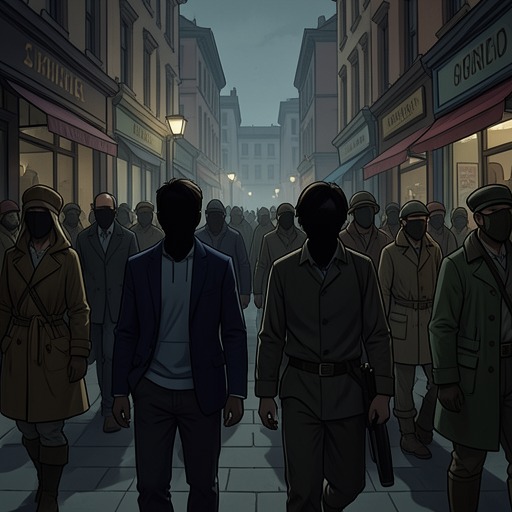
Leo’s fear of meeting Emmi
Love VirtuallyLeo’s fear of meeting Emmi is not simply hesitation about an unfamiliar encounter: he believes that meeting could undo the intimacy their emails have made possible. He wants to see her, and at times presses urgently for that closeness, but also imagines the encounter as a backward journey from their imagined relationship toward disillusionment. The tension between pursuit and retreat shapes their correspondence and turns a prospective meeting into a test of whether their connection can survive contact with ordinary, embodied life.
The correspondence as intimacy
Leo describes Emmi as a “second voice” accompanying him through the day, turning his inner monologue into dialogue. When he writes about his mother’s death, even a few seemingly incidental exchanges help him feel less alone. The letters have become more than entertainment or flirtation: he says he cannot live without this voice and fears losing it. His attachment to Emmi is therefore bound to the medium through which he knows her. Their written intimacy lets him experience conversation, challenge, and emotional companionship without the exposure of meeting face-to-face.
That dependence gives the prospect of meeting its particular danger. Leo imagines that, in person, the secrets and puzzles sustained by their correspondence would disappear. He fears that an encounter would replace the imaginative exchange with talk about family burdens, leaving no magic or illusion. His questions about how they would look at one another, what they would see, and whether they would still write afterward are not answered; their force lies in showing how much of the relationship’s future he considers vulnerable to a single meeting.
The imagined cost of recognition
When Emmi suggests meeting, Leo contrasts her with Mia, with whom he says there were no prior expectations. He and Emmi, by contrast, would begin at the finish line and have only a backward path ahead. In his forecast, each would hide behind the person already assembled from the other’s words: Emmi behind the Emmi he knows, and Leo behind the Leo she knows. He expects both to feel disappointed, not because either has done anything wrong, but because the imagined figures cannot be transferred intact into an actual encounter.
Leo elaborates that fear through an image of a long-anticipated meal: the meeting would be like eating something they had looked forward to for a year and allowed to simmer for months, only to find it disappointing. Afterward, he imagines, they would possess a demythologized and disenchanted picture of one another and would no longer know what to write. Even a later chance encounter in a café or on a bus might become a scene of avoidance, leaving two strangers with a shared pseudo-history. This anticipated aftermath makes the meeting feel irreversible: it could not simply be tried and then set aside, because it would alter the terms of every email that followed.
Pursuit, withdrawal, and an ending
Leo’s fear does not keep him from seeking closeness. In one late-night message, he stages an imagined encounter between them and urges Emmi to come to his home, presenting the invitation as a chance to share a drink and be near one another. The appeal to voices, scent, touch, and darkness shows how far his desire reaches beyond written exchange, even as he tries to place limits around what the encounter would mean. His invitation and his warnings are not separate positions: both expose the struggle to approach Emmi without surrendering the protected world their correspondence has built.
Later, Leo says that since Boston he has made his emails deliberately impersonal. He is trying not to invest more emotion in their story or build it up further before its collapse. He nonetheless wants one meeting, believing it would do them good and give their story the ending it deserves before he leaves for America. His resolve is therefore instrumental as well as emotional: he hopes that a face-to-face encounter can bring closure, while his earlier fear insists that the same encounter may destroy the relationship that needs an ending. He explicitly rules out not meeting as a possibility, but that declaration does not make the underlying anxiety disappear.
Fear made explicit
As the arranged meeting approaches, Leo finally names the vulnerability beneath his predictions about mutual disappointment: he is scared that what he has meant to Emmi will evaporate when she sees him. He suspects that his words on a screen read better than his face looks when it speaks them, and fears that she may be shocked by the person behind the correspondence and by the feelings she has invested in him. His concern is not only that Emmi might fail to match his image of her; he fears that he himself will fail to match hers.
This admission complicates his earlier insistence that the meeting is necessary. The encounter is at once a desired end to their story and a possible exposure of the gap between written identity and physical presence. Leo’s fear thus gives the correspondence its central contradiction: the emails bring him close to Emmi while allowing him to avoid the very recognition that might confirm or undo that closeness. The evidence leaves the meeting’s outcome unresolved, but makes clear that his insistence on seeing her coexists with a fear of being seen.