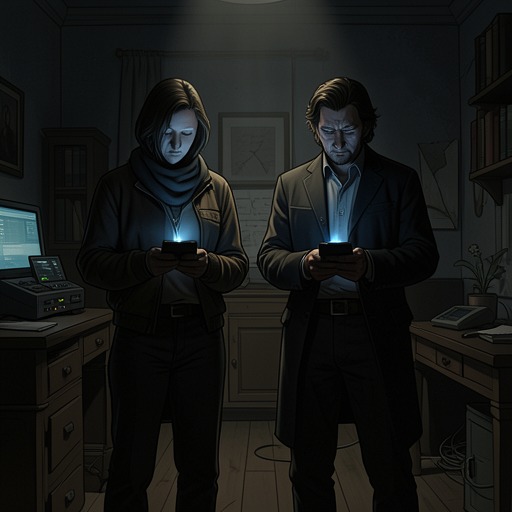
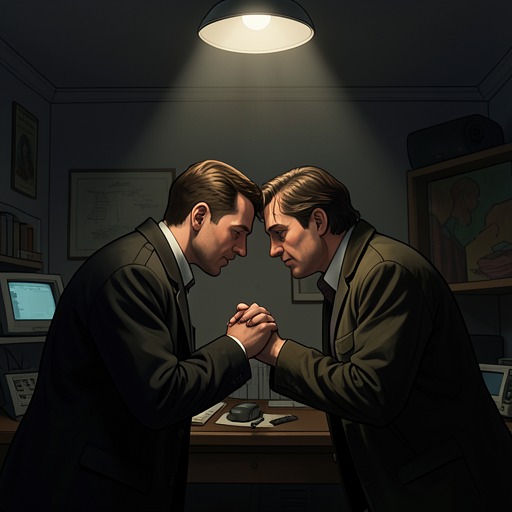
Leo’s late-night invitation to Emmi
Love VirtuallyLeo’s late-night invitation to Emmi is a turning point in their email correspondence: a written intimacy that had been protected by distance suddenly becomes an urgent proposal to meet in person. Leo asks Emmi to come to his home, casting the encounter as closeness without the ordinary demands of recognition or commitment. Emmi refuses the fantasy as uncomplicated, insisting that what happens after intimacy matters as much as the imagined moment itself. The invitation therefore reveals both the force of Leo’s longing and the risk that the relationship’s carefully maintained separation may no longer hold.
From the “second voice” to a wish for proximity
Before the invitation, Leo has described Emmi as a “second voice inside me,” a presence that turns his inner monologue into dialogue and helps him feel less alone. He says that exchanging a few words with her about his mother’s death had done him good. The conversation awakens a wish to have Emmi beside him, but Leo also imagines the meeting as a possible loss: face-to-face, he fears, they might disclose their secrets, talk through their family burdens, and discover that the magic of their correspondence cannot survive ordinary immediacy. His hesitation is not indifference. He says he cannot live without the voice their writing has created, and fears that meeting could cost him that voice.
That conflict sharpens at midnight. Leo addresses Emmi as if she were visiting him, proposes a shared drink, and asks whether he may embrace and kiss her. He names the wine he is drinking, Sauvignon Visconti from Colli Orientali del Friuli, 2003, while prompting her to reply with what she is drinking. The email form lets him stage an encounter in real time without actually bringing them into the same room: he can imagine her presence, solicit an answer, and sustain the scene through writing. The intimate tone is immediate, but the physical meeting remains only an invitation.
A drunken invitation and its entanglements
Eight minutes later, Leo says that he has been drinking and waiting for Emmi at midnight, and asks her to come over. He proposes darkness so they would not have to see one another, and says he wants to feel close to her. In the same message he turns to Marlene, describing their relationship as a draining attachment rather than love and saying that she will not let him go while he cannot hold on to her. The invitation is thus bound up with a second emotional conflict: Leo wants Emmi near him while trying to make sense of his separation from Marlene.
His later message expands the appeal into a chain of imagined possibilities. He suggests another drink, blindfolds, and looking through old carnival photographs; he recalls his mother’s fondness for Marlene, his own sense of having been overlooked as a child, and the pain of being betrayed. He also acknowledges that Emmi is married to Bernhard and warns her not to betray her husband. These details complicate the invitation rather than resolve it. Leo longs for Emmi, but his messages also show that he understands the vulnerability and consequences attached to infidelity. His repeated declarations of affection do not erase the divided loyalties he has just described.
The next morning, the request becomes more concrete: Leo asks Emmi to come over at ten and offers to pay for a taxi because he lives on the edge of town. A minute later, he urges her to be brave and trust him. The practical details and renewed insistence make the invitation more than a passing image, while preserving its essential uncertainty: Emmi must decide whether the intimacy of their messages should cross into a meeting.
Emmi refuses the imagined script
Emmi answers by questioning the urgency and identifying what she believes is driving it. She suspects Leo is still feeling the effects of the previous night and seeks intimacy to forget Marlene. She describes the familiar romantic-film scenario he appears to be offering: a first meeting arranged in semidarkness, an encounter that seems to resolve desire, and then a fade-out that avoids the question of what follows. Her response shifts attention from the anticipated scene to its aftermath. For Emmi, the unaddressed consequences—not the promise of a secret encounter—are the decisive part.
She also recognizes the blindfold as a device that would let them approach one another without seeing each other, preserving the anonymity and imaginative freedom of their correspondence. She can see why the proposition might appear to leave their other lives untouched, but rejects that premise. She calls the arrangement a male fantasy and tells Leo he can forget it with her. Her refusal is firm without being contemptuous: she later apologizes for her sharpness, thanks him for the offer, and says she likes his spontaneity and the kisses he has sent in writing. The exchange preserves their affectionate language while establishing that affection does not amount to consent to the encounter he has imagined.
Leo responds by admitting that he had not explained his real motive for wanting to see her so urgently. Emmi treats the drunken proposal as flattering and daring, but her amusement does not reverse her decision. Their emails can sustain flirtation, acknowledge desire, and test boundaries; they cannot make a meeting consequence-free simply by imagining darkness or refusing to look at one another.
The invitation returns as the medium changes
The question of meeting resurfaces when Leo and Emmi discuss exchanging voices. In a later appeal, Leo again asks her to come to his home, this time imagining that a drink, a hug, or a kiss might remain harmless and insisting that he does not need to see what she looks like. He offers his address, Hochleitnergasse 17, flat 15, and asks whether she wants him to come to her instead. His language makes the distinction between written intimacy and physical presence increasingly difficult to maintain: after having heard Emmi’s voice, he says he wants further closeness, even as he tries to define limits around what that closeness would mean.
This recurrence shows that the earlier refusal has not extinguished Leo’s desire to meet, and that the issue is no longer confined to one drunken night. The proposed meeting keeps returning as the point where their intimate correspondence might acquire consequences in their everyday lives. Later, Emmi writes that she cannot come over because everything feels like too much, recognizes that she may love Leo, and senses that Bernhard has noticed something. Her message is followed by an automatic notice that Leo’s email address has changed and will no longer receive incoming mail. The invitation’s history therefore ends not with the meeting Leo sought, but with a deeper admission from Emmi and an abrupt interruption of the channel through which they had negotiated their closeness.
The cost of imagined intimacy
The episode depends on the contrast between an invitation that can be elaborated endlessly in email and a meeting that would make each person answerable to the other’s presence and existing relationships. Leo’s messages turn the home visit into a scene that can be revised through words; Emmi’s reply restores the missing question of what comes after. Her refusal does not deny the mutual attraction, but distinguishes desire from a decision to act on it.
The later return of the invitation after their voices enter the correspondence deepens that tension. Text had offered Leo an inner companion without requiring an actual encounter; voice makes the absent person more immediate, and he again seeks physical proximity. Yet the final sequence keeps the outcome unresolved in a different way: Emmi’s growing recognition of love coincides with the failure of her message to reach Leo. The invitation thus marks both an attempted crossing from virtual intimacy into shared space and the limits of a relationship whose access depends on communication that can suddenly disappear.