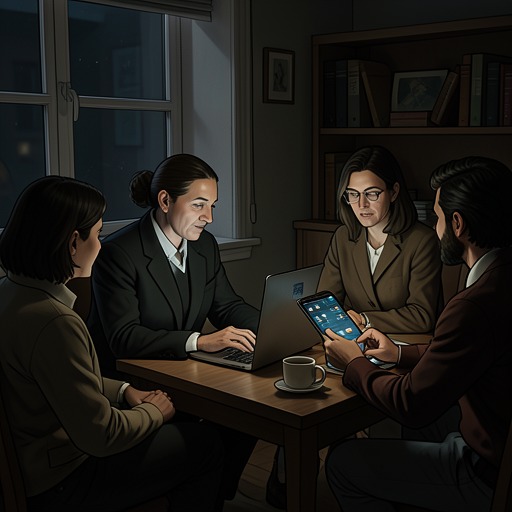
Printed email correspondence folder
Love VirtuallyThe Printed email correspondence folder is the preserved, physical record of Emmi Rothner and Leo Leike’s correspondence—and the object that exposes it to Emmi’s husband, Bernhard Rothner. Stored in a secret drawer, it makes private messages portable and readable beyond the computer screen. Once Bernhard finds and reads it, the correspondence can no longer remain confined to Emmi and Leo’s separate “other world”: the folder brings that world into the marriage and family, with consequences severe enough to send Bernhard to the hospital.
Discovery and Contents
Bernhard discovers the folder while snooping in Emmi’s room. It is hidden in a secret drawer and holds the full correspondence with Leo, printed page by page. The messages that had reached Emmi through a screen have become a thick, orderly stack of documents—something that can be held, copied, and read in sequence.
The folder gives Bernhard access to the relationship as Emmi and Leo recorded it for each other. It exposes not a single isolated message but the accumulation of their exchange: its increasing intimacy, the delays and appeals that shaped its rhythm, and the discussion of whether they should move beyond email. In that sense, the archive preserves the relationship’s development while also removing the privacy that had allowed it to develop at a distance.
From Private Record to Family Crisis
After finding the folder, Bernhard copies the documents with a trembling hand. For several weeks he manages to put them out of his mind, but the discovery continues to affect the marriage. During a vacation in Portugal, a child is ill, the older child falls in love with a sports instructor, and Bernhard and Emmi do not speak to each other for two weeks, while each tries to maintain the appearance that everything is fine.
On a later hiking trip, Bernhard takes the folder with him and reads through all the emails in one night. He describes the experience as his greatest emotional torment since the death of his first wife. After finishing, he cannot get out of bed; his daughter calls emergency services, and he is taken to the hospital. The folder’s significance lies in this chain of actions: discovery leads to copying, postponement, then an exhaustive reading that makes the correspondence’s effect on the family impossible to ignore.
The Object and the Relationship
The folder changes the status of the emails. In the exchange itself, Emmi tells Leo that if he does not write for three days, she begins to wonder why and feels that something is missing. Leo, in turn, asks plainly whether she wants him to keep writing. Their correspondence depends on messages arriving across a screen, where absence, anticipation, and intimacy are experienced through the inbox. The printed archive gathers those separate moments into a single sequence that Bernhard can inspect.
The letters also show why the record unsettles the boundary Emmi tries to maintain between correspondence and home life. She describes her household—Bernhard still working, a child asleep, and familiar objects seeming to object to Leo’s presence—and insists that Leo and she must remain outside the world she shares with her husband. The folder makes that outside exchange materially present inside the home: a secret kept among pages in Emmi’s room, then carried away and read by Bernhard.
Narrative Significance
The folder makes the novel’s epistolary form consequential within the story. Emails can feel immediate to their writers while remaining invisible to those around them; printing them converts that private sequence into an object that can be hidden, discovered, copied, and read in retrospect. The shift from screen to paper does not resolve the distance between Emmi and Leo. Instead, it gives a third person access to the record and exposes how the relationship has altered Emmi’s attention and Bernhard’s sense of their marriage.
The folder is therefore more than a container for the correspondence. It is the material hinge between the intimacy Emmi and Leo create through writing and the domestic life from which Emmi says that intimacy must remain separate. Its discovery turns a relationship sustained by messages into a crisis with consequences beyond its two correspondents.