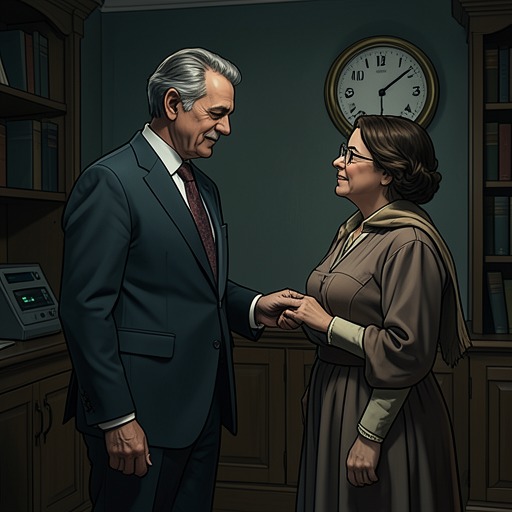
América Vicuña
Love in the Time of CholeraAmérica Vicuña is a fourteen-year-old student placed in the care of Florentino Ariza, who is both her guardian and a recognized blood relative. Their secret relationship begins under his authority and ends in her death after she fails her final examinations. Her story exposes the imbalance hidden beneath Florentino’s language of love: while he treats their arrangement as a refuge in old age, she depends on him and is left to face its consequences largely alone.
Identity and Circumstances
América arrives from the fishing village of Puerto Padre on a government scholarship to attend secondary school. Her family entrusts her to Florentino, who has the authority to take her out of boarding school. She is a child when he begins cultivating her confidence through ordinary outings, including Saturdays at the circus and Sundays in the park for ice cream. His attention and her dependence are not equal conditions: he is an old man entrusted with her care, while she is a schoolgirl whose family has sent her away to study.
Florentino recognizes that she is still a child, yet imagines the woman she will become and guides her toward a secret relationship. The narrative describes her response as immediate happiness, and says the relationship motivates her studies: she remains at the head of her class partly to retain the privilege of weekend outings. This apparent contentment does not remove the underlying disparity. The meetings take place within a relationship of guardianship, and Florentino’s own description of himself as a venerable guide cannot make that authority neutral.
Her Relationship with Florentino
América becomes the last of Florentino’s established lovers after he assumes complete responsibility for the R.C.C. His earlier pattern of casual affairs gives way to a routine of visiting existing partners, but the narration distinguishes América from those women: she has qualities that, in his words, make him mad with love. He says he likes and comes to love her for herself, rather than treating her as a replacement for Fermina Daza. Even so, the relationship remains secret and rests on his control of the conditions that permit it.
Their meetings are organized around her school schedule. Florentino is the only person authorized to take her out, and he collects her in the R.C.C.’s six-cylinder Hudson for Sunday afternoons. The two behave with a familiarity the narration compares to that of a long-married couple, but this apparent domestic ease sits beside the fact that he is her guardian and she is still a student. Florentino recognizes the risk of pregnancy and takes precautions; the detail underscores his awareness of one consequence of the relationship without showing comparable foresight about its emotional or educational costs.
When Juvenal Urbino dies on Pentecost Sunday, Florentino has planned to spend the day with América until she must return to school shortly before the Angelus. The funeral bells remind him of his obligation to attend Jeremiah de Saint-Amour’s funeral, and he dresses in haste. Before leaving, he plaits the braid he had loosened and ties the bow on her school shoes. Their routine is interrupted not by a decision to end the affair but by the claims of another death, a juxtaposition that foreshadows the mortality Florentino associates with their age difference.
Neglect and Decline
Years later, Florentino’s health and mobility have deteriorated. Leona Cassiani cares for him during the week, while América takes over on Saturdays and Sundays. He has promised to send her to Alabama for further study at the river company’s expense, partly to quiet his conscience and avoid difficult explanations. That promised future does not resolve the present: his illness has changed the relationship, and América suffers through sleepless nights at school and weekends without him.
Her academic decline makes that change measurable. The school informs Florentino officially that she has fallen from first place in her class to last and has nearly failed her final examinations. He does not tell her parents, although he remains responsible for her as guardian, and he does not raise the problem with América because he fears she will implicate him in her failure. Instead, he leaves matters untouched, increasingly deferring problems in the hope that death will settle them. His failure is not simply that he cannot restore the old routine; he avoids acting when the evidence of her distress reaches him directly.
Those around Florentino observe his transformation. The women who now care for him interpret his lack of desire differently: Leona sees it as a prelude to death, while América suspects an explanation she cannot understand. The narration says Florentino alone knows the cause, but the passage does not make that cause América’s to decipher. His physical dependence reverses the earlier pattern in which he arranged their meetings and their future; she is now among those attending to his needs, even as he withholds the knowledge and decisions that might affect her life.
Death and Its Aftermath
During the voyage home with Fermina Daza, Florentino receives an urgent telegram from Leona, delivered by the purser at Zambrano. Its brief report says that América died the previous day for unknown reasons. A later telegraphic conversation supplies the circumstances: in the grip of mortal depression after failing her final examinations, she drank laudanum stolen from the school infirmary. Her family is traveling from Puerto Padre, and her funeral is to take place that afternoon.
Florentino suspects that the account is incomplete, but América leaves no explanatory note that would permit anyone to be blamed for her decision. The absence of a note does not settle what he cannot know; instead, it leaves him with suspicion and guilt without a clear account of her final state of mind. He tries to remain alive by refusing himself the anguish of the memory, mentally erasing it. In the years that remain to him, however, the grief returns without warning, like the pang of an old scar.
On the voyage home, Fermina says that returning will be like dying. Her words recall a thought that has troubled Florentino since the journey began. In the same passage, grief for América overwhelms him: he locks himself in the bathroom and cries until he has shed his last tear. Only then does he admit to himself how much he loved her. The recognition arrives after her death, when it can neither repair his neglect nor give her a voice in the story of what happened.
Narrative Significance
América’s arc turns Florentino’s old-age romance into a reckoning with responsibility. He can describe affection, shared routine, and the future he promised her, yet when her grades fall and she nearly fails, he chooses avoidance. Her death follows that failure, although the narrative does not claim that the examination result alone explains her suicide or present Florentino as the sole cause. It does establish that her depression is connected to the failure, and that the guardian who receives warning signs does not intervene.
Her story also complicates Florentino’s retrospective understanding of his loves. He initially treats the relationship as a sheltered pleasure of old age and believes himself to love América for herself; after her death, he tries to erase the memory, only to have grief return. His final admission of love is therefore both a recognition and an irreparable delay. América remains a person with a school life, a family in Puerto Padre, academic ambitions, and a future once imagined in Alabama—not merely an episode in Florentino’s long history of desire.