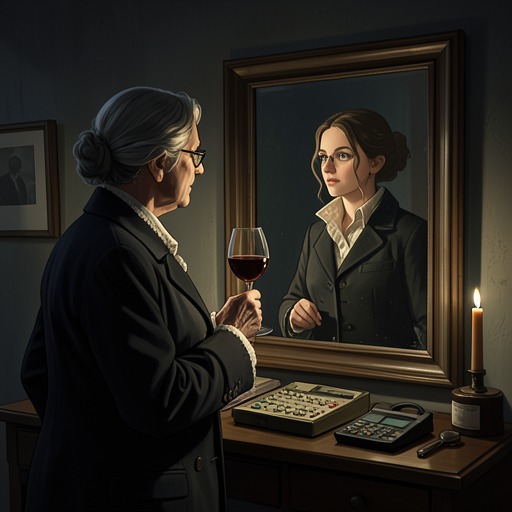
Arcade of the Scribes
Love in the Time of CholeraThe Arcade of the Scribes is a commercial passage where people seek help putting their needs into writing and where small wares promise solutions to private troubles. Florentino Ariza makes it the setting for an unlikely literary vocation: he can write convincingly only about love, and by lending that gift to strangers he makes the memory of Fermina Daza productive without ever displacing her. The Arcade is at once a place of service, commerce, and fantasy, where letters can change lives even when their author cannot change his own.
A workplace shaped by longing
After work at the River Company of the Caribbean, Florentino goes to the Arcade, removes his frock coat, puts on cuffs to protect his sleeves, and unbuttons his vest so he can think. He stays late encouraging the hopeless with letters of extravagant devotion. His method is also his limitation: he does not need to ask clients what they want, because he reads their eyes and writes from the one subject that fills his own mind, Fermina Daza. His attempts to prepare other kinds of documents fail. A woman seeking help with a child, a war veteran pursuing a pension, or a person wanting to complain of a robbery receives no satisfactory document from him; the only persuasive prose he can produce is a love letter.
Demand soon requires an appointment system. The Arcade’s ordinary requests and Florentino’s specialized talent do not quite fit together: people arrive with practical problems, but his gift translates need into romantic declaration. He writes without charge, yet his work is not emotionally neutral. Each anonymous message is composed through the imaginative filter of his continuing attachment to Fermina, so the Arcade becomes a public outlet for a love that remains private and unresolved.
A correspondence written by one hand
Florentino’s most cherished episode begins with a timid young girl who asks him to answer a letter that has overwhelmed her. He recognizes it as one he himself wrote the previous afternoon for her suitor. Rather than expose the arrangement, he composes a reply in a different style, suited to the girl’s age and feelings, and imitates a handwriting that seems to belong to her. He can invent a distinct hand for each occasion, and he imagines Fermina’s answer to him if she had loved him as helplessly as the girl loves her suitor.
Two days later, Florentino writes the boy’s response in the same hand, style, and emotional register he had already assigned to him. In effect, he conducts a feverish correspondence with himself, distributing the parts of a courtship between two clients who do not know that a single scribe is sustaining both voices. Before a month passes, the young people separately thank him for the proposal he placed in the boy’s letter and the devoted acceptance he supplied in the girl’s: they intend to marry.
The authorship remains undiscovered until after the couple has their first child and happens to compare their histories. They then visit the Arcade together to ask Florentino to become the child’s godfather. The episode gives practical consequence to his imagined skill: his fabricated exchange has helped bring about a marriage, and the couple’s later request turns his work into a lasting personal bond. The Arcade’s letters are not merely rehearsals of feeling; in this case, they help create the future their writers describe.
The book that remained in the attic
That success encourages Florentino to write a much larger work. He uses time he scarcely has to assemble a Lovers’ Companion, more poetic and extensive than the inexpensive manuals sold in doorways and already memorized by much of the city. He organizes imaginable situations in which he and Fermina might find themselves and supplies multiple letter models and alternatives for each. The result runs to roughly a thousand letters in three volumes, as comprehensive in scale as the Covarrubias Dictionary.
No printer in the city is willing to risk publishing it. The manuscript ends up in an attic among other papers from the past, while Tránsito Ariza refuses to open the earthenware jars and spend a lifetime’s savings on what she regards as a mad publishing venture. The book’s delay is more than a failed commercial beginning: it is a courtship imagined in exhaustive detail but never realized with its intended recipient. Years later, when Florentino can afford to publish it himself, he finds that love letters have gone out of fashion. The Arcade has given his private longing a public form, but neither his manuscript nor the market can preserve that form indefinitely.
A marketplace of remedies and recollection
The Arcade also appears as a place where Florentino seeks products beyond the page. In his long campaign against baldness, he tries advertised cures, complementary treatments, herbs sold in the public market, and magical specifics and Oriental potions available in the Arcade. After six years and 172 advertised remedies, these efforts leave him with an inflamed, foul-smelling scalp condition rather than restored hair. The episode makes the passage part of a broader economy of hope: like the letters, its wares promise an answer to distress, but their promises may fail or deceive.
Much later, while his weekly visits to the widowed Fermina have become routine, Florentino finds in the Arcade a postcard of Fermina and her cousin Hildebranda Sánchez, photographed by a Belgian photographer more than half a century earlier. He has bought it for fifteen centavos at a postcard sale and gives it to Fermina, who cannot understand how it came to be there. To him its appearance is a miracle of love. In the same period he brings a white rose from his garden to their tea table, carefully removing its thorns because its meaning might be misread by a recent widow. These visits take place at Fermina’s home, but the postcard’s recovery in the Arcade links their tentative present to a shared past preserved as a cheap, chance-found image.
Narrative significance
Across these episodes, the Arcade connects writing with both invention and material exchange. Florentino can create persuasive voices for strangers, imitate their handwriting, and even guide a couple toward marriage, yet the most elaborate correspondence he composes—the imagined one between himself and Fermina—remains a manuscript rather than a lived exchange. The contrast gives the place its particular charge: in its stalls and passageways, feeling can be drafted, bought, and carried away, but a letter’s apparent intimacy does not guarantee that its author will attain the love it describes.
The Arcade also gathers different kinds of time. A new courtship takes shape in the letters Florentino writes for the young couple; a vast archive of hypothetical courtships lies forgotten in an attic; and a postcard bought for a few centavos unexpectedly brings Fermina’s distant youth into her later life. The place therefore serves the novel not simply as a background for Florentino’s occupation, but as a recurring point of contact between memory, commerce, and the written forms through which people try to make love possible.