Dogs
Love in the Time of CholeraDogs are both cherished companions and unsettling presences in the lives of Juvenal Urbino and Fermina Daza. Their recurring place in the household reveals the couple’s opposing views of animals, while the dog who remains beside Jeremiah de Saint-Amour at his death turns loyalty into a quiet act of companionship and an enduring part of the funeral arrangements.
Dogs and Domestic Life
Fermina Daza’s affection for animals repeatedly brings them into a household that her husband would rather keep free of them. Early in their marriage, she filled the house with pets, including three Dalmatians named for Roman emperors. Their conflicts and breeding added to the already crowded animal life of the home. Juvenal Urbino, by contrast, disliked animals, and dressed that dislike in scientific and philosophical arguments. He regarded dogs as servile rather than loyal, a judgment that sits in deliberate contrast to the attachment represented by Jeremiah de Saint-Amour’s dog.
The couple’s difference is not simply a debate about household order. Fermina treats animals as beings worthy of affection and makes room for them even when their presence strains domestic comfort. Juvenal’s objections turn animals into categories of danger or nuisance. Dogs therefore become a recurring measure of how each spouse understands the boundary between human life and the nonhuman creatures admitted into their home.
Rabies and the Loss of the Household Animals
That domestic disagreement becomes more consequential after a German mastiff contracts rabies. In the resulting attack, the mastiff kills the other animals it encounters. A gardener from a neighboring house intervenes and kills the dog; because no one can determine which animals may have been bitten or contaminated, Juvenal orders the surviving animals killed and their bodies burned in an isolated field. He also asks Hospital of Misericordia to disinfect the house thoroughly.
The episode forces Fermina to concede, for the first time, that Juvenal was right about a domestic matter. For a long while she says nothing more in favor of animals and instead hangs framed illustrations from Linnaeus’s Natural History in the drawing room. The incident thus changes the actual contents of the house as well as the terms of the couple’s argument: the animals Fermina had gathered are gone, and her husband’s caution has been confirmed by a crisis rather than by abstract reasoning. The giant tortoise, forgotten by everyone during the aftermath, is the sole animal to escape.
The Parrot and the Return of an Animal
The later theft of the family’s silver prompts Juvenal to secure the house, but it does not make him accept a guard dog. He installs locks and bars, stores valuables in a strongbox, and begins sleeping with a revolver beneath his pillow, yet refuses to purchase a dog even if the thieves were to take everything. He declares, "Nothing that does not speak will come into this house," intending to end Fermina’s renewed argument for a dog.
Fermina turns that remark to her advantage. Months after the robbery, she buys a royal Paramaribo parrot from the ships arriving from Curaçao. The bird knows sailors’ blasphemies and speaks them in a human-sounding voice, so it meets the letter of Juvenal’s rule while restoring an animal to the home. The parrot is not a dog, but the episode makes the household’s animal policy depend on speech: the distinction Juvenal had intended as a prohibition becomes the opening Fermina uses to bring a creature back.
Jeremiah de Saint-Amour’s Dog
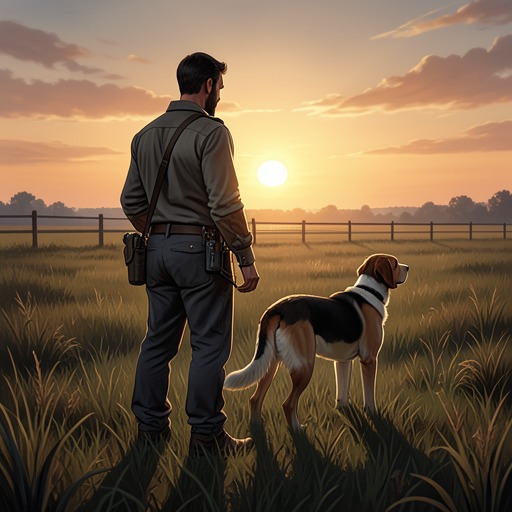
A different kind of bond appears at Jeremiah de Saint-Amour’s death. When Juvenal enters the darkened room, he finds Jeremiah dead beside his developing equipment, with crutches nearby and a black Great Dane with a white chest tied to the cot. The dog’s presence belongs to Jeremiah’s final arrangements: he had decided in advance to die at seventy, and he intended his dog to remain with him.
Jeremiah’s lover explains that she had wanted to take the dog away. Jeremiah stopped her, caressed the animal, and said, "I’m sorry, but Mister Woodrow Wilson is coming with me." He asked her to tie the dog to the cot while he wrote his letter. She used a false knot so the animal could free himself, hoping to preserve the dog’s company without binding him. Juvenal later tells her that the dog did not escape; she answers that perhaps he did not want to. Her response makes the dog’s remaining beside his dead master an act of attachment, not merely the consequence of a knot.
Jeremiah had asked to be remembered with a rose, and his lover brought one from the patio at dawn. At his burial, the dog was placed beside him as he had requested, in the part of the cemetery reserved for suicides. The animal’s presence connects the intimate scene of the death to its public aftermath: the dog accompanies Jeremiah from his room to the grave, while the story’s contrasting views of animal loyalty remain unresolved. Juvenal may call dogs servile, but Jeremiah’s final wish and the lover’s interpretation leave room for a more personal bond than that judgment allows.