Euclides
Love in the Time of CholeraEuclides is a boy swimmer whom Florentino Ariza recruits to search for the treasure of the sunken galleon San José. About twelve years old, quick, clever, and accomplished in the water, he can dive and navigate where Florentino cannot. His skill turns Florentino’s romantic scheme into a real expedition, but the boy’s sudden disappearance ends the search and leaves Florentino with only the friendship he has formed at the lighthouse.
Identity and Abilities
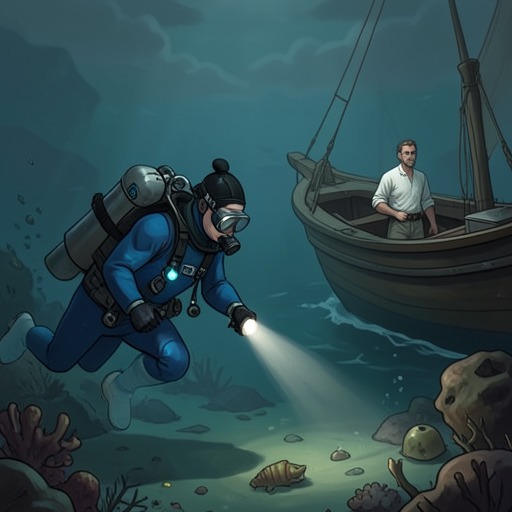
Euclides earns his living helping fishermen and diving for coins tossed into the water by curious onlookers. He is one of the boys whose skill at swimming out to meet ocean liners has attracted accounts from tourists in the United States and Europe. His body is described as eel-like, able to slip through a bull’s-eye; weather has tanned his skin so deeply that his original color is impossible to imagine, while his large yellow eyes stand out with particular brightness.
For Florentino, these abilities answer a practical question that had not occurred to him before: whether anyone could reach the wreck and bring up its treasure. Euclides says he can dive twenty meters without air, sail a fishing canoe alone in a storm using instinct rather than instruments, locate a point far out at sea, and navigate by the stars. He also claims he knows how to frighten sharks away with magic tricks. His confidence is so complete that he agrees to everything Florentino asks, even promising to keep their purpose secret under interrogation.
The Search for the Galleon
Florentino’s plan begins as a private fantasy linked to his letters to Fermina Daza. Watching fishermen bring up sleeping fish after using mullein, he imagines that the boys who dive for coins might recover the legendary treasure. He hires Euclides without disclosing the full purpose of the undertaking. The boy helps reckon the practical expenses: canoe and paddle rental, fishing equipment to disguise their incursions, food, fresh water, an oil lamp, candles, and a hunter’s horn for emergencies.
They set out at dawn from the fishermen’s port. Their contrasting appearances make an unlikely pair: Euclides is nearly naked in his usual loincloth, while Florentino wears a frock coat, dark hat, patent-leather boots, and a poet’s bow, carrying a book for the crossing. Florentino soon recognizes that Euclides is not merely a gifted diver but an exceptionally knowledgeable navigator. The boy can identify the histories of rusting wrecks, the ages of buoys, the origins of debris, and even the links of the chain the Spaniards used to close the bay. His broad knowledge raises Florentino’s suspicion that he might guess the expedition’s real aim, but Euclides initially has no idea they are looking for a galleon.
Florentino’s own research has led him to a presumed wreck site, reached after they sail out through Boca Chica and into the calm waters of the Sotavento Archipelago. There, he asks Euclides to dive twenty meters and retrieve whatever he can find. Euclides disappears among the coral and returns with striking ease, then continues exploring farther north. After several dives, he objects that he cannot find an unspecified target if Florentino will not tell him what it is. Florentino keeps the secret; when Euclides invites him to dive as well, Florentino admits that he has never learned to swim and prefers to look at the sea through a window.
A Discovery and a Vanishing
Three Sundays pass without progress. At last Florentino reveals the secret, and Euclides changes the search route, taking them along the old galleon channel more than twenty nautical leagues east of Florentino’s chosen location. Less than two months later, Euclides dives for a long time in the rain while the canoe drifts away. Because Florentino cannot row it back to him, the boy must swim for nearly half an hour to catch up. When he climbs aboard, he produces two pieces of women’s jewelry from his mouth.
Euclides describes a vast field of wrecks resting among the coral at a depth of eighteen meters. Some ships, he says, still have their sails intact, and their preservation seems to have held them in the time and light of the moment they sank. He identifies the San José by its name in gold letters on the stern, though he says English artillery has damaged it more than the other vessels. In his account, an enormous octopus occupies the ship’s dining room, its tentacles reaching through the cannon openings; the commander’s body remains inside the forecastle, and the treasure in the hold lies beyond the limit of his breath. As proof, he presents an emerald earring and a salt-corroded medal of the Virgin.
Florentino sends Fermina a letter about the treasure. She already knows the galleon story from Lorenzo Daza, who once spent time and money trying to enlist German divers. Members of the Academy of History had persuaded Lorenzo that the wreck tale might have been invented to conceal a viceroy’s theft of Crown treasure. Fermina believes the ship lies beyond human reach at two hundred meters, rather than the twenty meters Florentino claims, but she is accustomed to his poetic excesses and treats the adventure as one of his most successful. As his later letters grow more fantastic, she confides to Hildebranda Sánchez that she fears her infatuated sweetheart has lost his mind.
Failure and Lasting Consequences
Euclides continues to surface with supposed evidence, and the plan grows from a search for scattered jewelry into a proposed major salvage enterprise involving fifty ships and their cargoes. Florentino eventually asks his mother for help financing it. She tests the metal settings and holds the gems to the light, recognizing that they are glass and that someone is exploiting her son’s innocence. Euclides kneels and swears that he has done nothing wrong, but he does not return the following Sunday and is never seen by Florentino again. The narrative leaves the truth of his claims and his disappearance unresolved; the boy’s performance, Florentino’s credulity, and the apparent evidence never settle into a confirmed discovery of the treasure.
The failed expedition leaves Florentino with no recovered galleon treasure. Its remaining consequence is the lighthouse. During one stormy night at sea, he and Euclides take refuge there in the boy’s canoe; afterward Florentino returns in the afternoons to talk with the lighthouse keeper. That friendship survives changes in the world, while the lost search becomes an episode in Florentino’s life rather than the grand enterprise he had imagined.
Narrative Role
Euclides briefly gives Florentino’s yearning a material shape: a love-struck fantasy becomes a project with a route, a crew, equipment, and purported artifacts. Yet the boy’s practical competence coexists with an account so wondrous that Florentino’s hopes outrun his ability to verify it. The emerald earring and medal look like evidence, but the glass gems expose the vulnerability beneath the scheme. Euclides therefore occupies an uncertain place between capable ally and apparent deceiver, without the narrative providing a final explanation of which he is. His disappearance closes the adventure abruptly, redirecting Florentino from the promised treasure to the lighthouse and the enduring companionship found there.