Fermina Daza
Love in the Time of CholeraFermina Daza’s life is defined less by a single choice than by the long consequences of choosing: she rejects Florentino Ariza as a young woman, marries Juvenal Urbino, and only after her husband’s death discovers that old love and old grief can return together. Proud, observant, and unwilling to let others dictate what love may mean at any age, she moves through the novel from a girl under paternal authority to a widow who insists on the right to begin again.
Identity and Background
Fermina is thirteen when Florentino first sees her in the Park of the Evangels house, where she is taking a reading lesson with Escolástica, the unmarried aunt who has raised her. The girl looks up as he passes the sewing-room window. That casual glance begins a love story whose consequences outlast the first romance by more than half a century. Her mother is dead, and her father, Lorenzo Daza, exercises an iron authority over the household; the aunt’s care offers Fermina a measure of intimacy and shelter within it.
Her schooling takes place at the Academy of the Presentation of the Blessed Virgin, an institution that prepares young women to become diligent and submissive wives. Its rules are not merely abstract discipline: writing a love letter is grounds for expulsion. When the school discovers Fermina’s correspondence with Florentino, she admits that she wrote the letter but refuses to identify her sweetheart, first to the school and then before its tribunal. Lorenzo searches her room and finds the hidden packets of letters. He blames Escolástica for the relationship and sends his sister away, while Fermina is sent by schooner to San Juan de la Ciénaga. Once beyond her father’s authority, Fermina searches the Caribbean provinces for her aunt, but does not find her for almost thirty years.
First Love and the Choice to Marry
Fermina’s early relationship with Florentino is conducted through letters and secrecy. She and her correspondent become engaged in private, but the arrangement cannot protect them from family authority or the social institutions surrounding her. The discovery of the letters makes their private attachment legible to her father, who responds by separating them and removing the aunt he believes enabled it. Fermina’s refusal to expose Florentino at school shows both her resolve and the limits of that resolve: she can keep his identity from the tribunal, but cannot prevent Lorenzo from taking control of her life.
Her later rejection of Florentino is decisive. The novel establishes that she turned him away after a long and troubled affair, and that he continued to remember her for fifty-one years, nine months, and four days. She does not share his account of their youthful love as an enduring destiny. Much later, when she recalls those days, the places themselves have altered: the park’s almond trees are gone, its old statue has been replaced, and her former house has fallen into ruin. Memory cannot restore the original setting or make the young Florentino easy to recognize in the old man who appears before her.
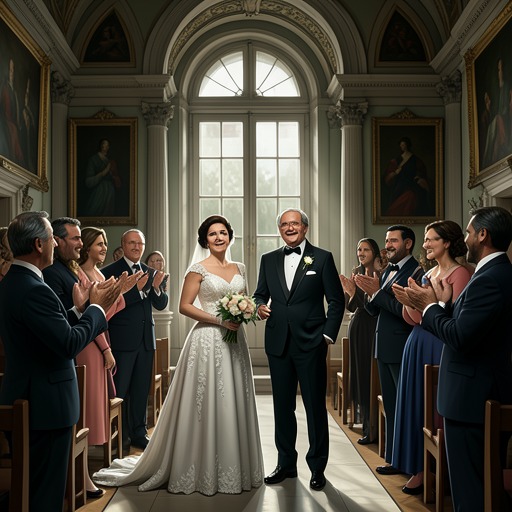
Fermina marries Juvenal Urbino in a ceremony of exceptional public splendor. She reaches the main altar of the Cathedral on her father’s arm, at eleven in the morning on the day of the Holy Trinity, with three bishops officiating. Anonymous letters and death threats return when the banns are announced, but she pays little attention to them; her fear is concentrated instead on the approaching loss of her virginity. The marriage’s public inevitability gradually quiets opposition. Women who had resisted the match eventually arrive at the Park of the Evangels with recipes and engagement gifts, and the wedding becomes a social triumph, sponsored by Rafael Núñez. At the same hour, Florentino lies delirious with fever on a boat, suffering over the marriage that closes their first courtship.
Marriage, Perception, and Domestic Life
Fermina’s marriage to Juvenal is a long practice of attention as well as a social bond. She becomes familiar with her husband’s needs and routines, choosing his clothes for the weather and occasion and laying them out the night before. Over time she helps him dress, at first out of love and, during roughly the last five years of his life, because he can no longer manage without her help. The change is presented without ceremony: care begins as affection and becomes part of the daily structure of their life together.
She is also sharply unlike her husband in her response to animals. At seventy-two she remains an ardent admirer of tropical flowers and domestic creatures, and early in the marriage she brings many animals into the house despite Juvenal’s dislike of them. The household includes three Dalmatians named for Roman emperors, cats of several breeds, caged Guatemalan birds, curlews and herons, and a young stag that enters through the windows to eat the anthuriums. An Amazonian monkey chained to the patio mango tree is eventually removed because of its sexual behavior, not because Fermina lacks compassion for it. She also once keeps six perfumed crows bought from smugglers’ ships from Curaçao, but their incessant wingbeats and funeral-wreath odor make them intolerable to the household. These episodes show her domestic world as exuberant and unruly, set against Juvenal’s habit of disguising his aversion to animals with scientific and philosophical arguments.
Fermina’s perceptiveness extends beyond the household. Her sense of smell, which helps her find a missing child and navigate the prejudices of the city’s upper social circles, is described as an almost uncanny instrument of judgment. One Sunday, while preparing Juvenal’s clothes for Mass, she smells his jacket, vest, shirt, trousers, underwear, socks, and handkerchief. The articles carry a human odor that had not been present during their years together, and she recognizes that she has been in bed with another man. The discovery gives her sensory instinct a painful role in the marriage: the faculty that once helped her move through society now detects her husband’s infidelity.
Widowhood and the Return of Memory
Juvenal’s death first meets Fermina as a demand for another beginning. Finding the old man dying in the mud, she hopes his open eyes mean there is time to tell him how much she loved him and to repair what they had done badly in their life together. Death gives her no such interval. Her grief turns into rage against the world and herself, and that anger helps her hold herself together as she receives condolences during the wake and watches her husband’s coffin leave the house. Before the coffin is closed, she removes her wedding ring and places it on his finger, covering his hand with hers in the familiar gesture with which she had restrained him when he digressed in public.
Once she is alone, grief becomes physical and domestic. Her husband’s slippers, pajamas, scent, and absence in the dressing-table mirror make the rooms newly painful. She sleeps on her usual side of the bed and wakes to the space where his body had been. In that first night without him, she dreams and sobs that she will never again be able to sleep in the same way. When morning comes, she recognizes a further, unsettling fact: while asleep she had thought more about Florentino than about her dead husband. The realization does not erase her mourning; it shows that the old, rejected love has become part of the mind through which she experiences loss.
For a time, Fermina regards Florentino’s renewed declaration during the wake as an intrusion, even as a possible beginning of revenge. She has long believed that her rejection left hatred in him that could only grow, and she cannot reconcile the vulnerable boy of memory with the old man who has chosen the moment of her bereavement to speak again. The harder she tries to forget him, however, the more insistently he occupies her thoughts. Nostalgia leads her back to the park where they once met, only for her to find that the trees, statue, and surrounding city have changed. The passage from anger toward recollection is not a simple return to romance: it is a struggle to understand a past that neither memory nor the transformed city can restore intact.
Old Age, Family Conflict, and Renewed Agency
Fermina’s old age does not diminish her independence. At seventy-two she wears a loose silk dress belted at the hip, a long, uneven-looped pearl necklace, and high-heeled satin shoes for a solemn occasion. Her hair is steel-blue and bobbed at an angle; her hands remain resilient and free of age spots. The narration emphasizes that she feels well in a body no longer constrained by iron corsets, bound waists, and bustles. The contrast between age and vitality is central to her characterization: she is not portrayed as a remnant of her younger self, but as a woman whose bearing and judgment persist through bodily change.
Her cousin Hildebranda Sánchez helps bring the past into the present. The two women meet often after Fermina returns from Flores de María, sharing long conversations and memories of the time they first met. On one visit Hildebranda brings a nearly invisible copy of a photograph of them dressed as old-fashioned ladies, taken when Juvenal was young. They can still recognize the young and beautiful women through the photograph’s fading image. Hildebranda’s memories repeatedly include Florentino, whose fate she associates with her own; Fermina, by contrast, has heard rumors about him without treating them as a reason to revise her view of him.
The most visible late assertion of Fermina’s authority comes in a dispute with her daughter, Ofelia Urbino. Ofelia condemns Fermina’s friendship with Florentino as an improper, damaging relationship between two old people and insists that he should be driven from the house. Fermina listens without interrupting; when Ofelia finishes, she feels herself come back to life. She orders her daughter to leave immediately and bars her from returning for as long as Fermina lives. The confrontation turns the social taboo against love in old age into a test of household power. Fermina does not accept the premise that age makes affection obscene, and she will not let a daughter’s respectability police her private life.
Narrative Role
Fermina is the point at which the novel’s contrasting ideas of love become most sharply visible. Florentino treats their youthful attachment as a lifelong vow; Fermina’s rejection establishes that his persistence cannot substitute for her consent. Her marriage to Juvenal, in turn, is neither a mere obstacle to the first romance nor a disposable interval: its rituals, routines, betrayals, and care make up a substantial shared life. After Juvenal’s death, Fermina’s mourning does not cancel that marriage, while her renewed attention to Florentino does not simply return her to the girl she once was.
Her story also exposes how social rules regulate women’s choices at different ages. As a schoolgirl, she can be expelled for writing a love letter; as a bride, she confronts expectations about virginity and public respectability; as a widow, she faces the insistence that an old woman’s love is shameful. Across these stages she refuses to let other people’s judgments become the final account of her feelings. Her authority is not an escape from grief, history, or the consequences of choice. It is the capacity, preserved into old age, to decide how those forces will shape the life still available to her.