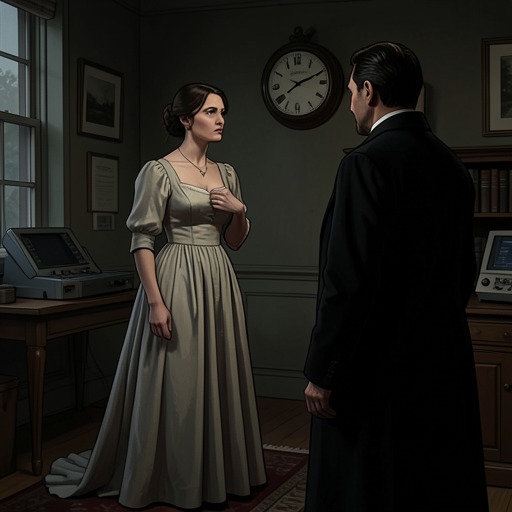
Fermina and Florentino's reunion at Juvenal's memorial Mass
Love in the Time of CholeraAt the first-anniversary memorial Mass for Juvenal Urbino, Fermina Daza and Florentino Ariza meet again in public after a year of letters that Fermina has read, first hidden and later saved. The reunion turns an uninvited appearance into an acknowledgment: Fermina thanks Florentino for coming, revealing that his words have steadied her and altered how she sees him. The Mass is at once a social ceremony for the dead and the setting for a living relationship to begin changing.
An uninvited presence
The family has sent invitations to the Mass at the Cathedral, but Florentino has received no reply. That silence drives his decision to attend without an invitation. He arrives early, choosing a place from which Fermina cannot pass without seeing him. The ceremony’s seating makes the social order visible: the first rows belong to families who own their pews for life, their names engraved on copper plates, while Florentino ends up among the poor relations when the central nave is already crowded.
His purpose is personal, but the occasion is ostentatious rather than intimate. Fermina enters on her son’s arm, dressed in a severe, long-sleeved black velvet dress buttoned to her shoes and a narrow scarf of Castilian lace instead of the veiled hat worn by many widows. Florentino watches her cross the church and has to steady himself against a pew until his dizziness passes. Though they are only seven paces apart, he feels they inhabit different times: his longing makes physical nearness seem like a gulf.
A meeting made by ceremony
Fermina stands through almost the whole service in the family pew before the main altar, composed and elegant. When the ceremony ends, however, she rejects the usual custom of remaining seated to receive condolences and instead moves through the crowd to thank the guests individually. The departure from convention suits her independent manner and brings her, in time, to the section where Florentino is sitting.
She looks around to check that she has not missed anyone she knows. When she sees Florentino, she leaves her companions, approaches him without hesitation, and holds out her hand. Her smile is sweet, and her words are simple: “Thank you for coming.” The encounter is not a declaration of love or a promise of a future together. Its importance lies in recognition: Fermina sees him, receives his presence without rebuking him, and acknowledges a connection that her silence had left uncertain.
The letters behind the encounter
Fermina’s greeting is explained by the correspondence Florentino has been sending since Juvenal’s death. She received the first letter at breakfast with her daughter. The typewritten page caught her attention; then she recognized the initial on its signature and blushed. She concealed it in her apron pocket, calling it another government condolence letter even though her daughter pointed out that all the official messages had already arrived. Fermina planned to burn it, but curiosity made her read it first. She shut herself in her bedroom, read it three times, and found that its measured salutation and opening announced a change from the insolence she had expected.
The letter reflects on life, love, old age, and death—subjects Fermina has privately tried and failed to grasp. Florentino gives them a clarity that she recognizes as unlike the feverish declarations of his youth and the somber conduct she has associated with him. She is struck by the possibility that this unfamiliar, lucid Florentino is writing to her now. In her memory, Aunt Escolástica had once thought his words inspired by the Holy Spirit; the letters revive that astonishment in a new form.
Fermina initially reads and burns the letters, despite a growing interest and a sense of guilt at destroying them. Once they begin arriving numbered, she finds a reason to keep them. Their regularity—one every three or four days throughout the year—turns the problem of how to dispose of them into the problem of how to return them without making the gesture seem like a renewed rejection. Her pride prevents her from explaining herself in a letter, and time passes without her finding another way.
Widowhood and a changed reading of the past
The first year has also changed Fermina’s relation to her marriage. Her memory of Juvenal becomes purified, no longer an obstacle to daily acts or private thoughts but a watchful presence that guides without controlling her. She can imagine him as flesh and blood when she needs him, while no longer having to bear his patriarchal demands or his insistence on love expressed through ritual kisses and tender words. Widowhood does not erase the marriage; it allows her to understand its tenderness and its limits together.
She recalls telling Juvenal that she was unhappy. His answer—that stability mattered more to a good marriage than happiness—had once seemed a miserable threat. In widowhood she understands it differently, as the principle that had helped sustain many happy hours between them. That reinterpretation matters to the reunion: Fermina is not simply replacing her dead husband with Florentino, but learning to live with the marriage as memory while considering the meaning of the letters arriving from the past.
The Mass therefore marks a restrained but decisive shift. Florentino’s attendance brings him physically into Fermina’s sight; the letters have already brought his reflective voice into her private life. Her thanks recognizes both forms of presence. She has found in the correspondence serious reasons to go on living, and she regards it as a noble effort to erase the past rather than an attempt to repeat his intrusion at Juvenal’s vigil. The reunion leaves their future unstated, but it changes the terms of their contact: where there had been silence and a feared rebuff, there is now gratitude, interest, and the possibility of continued conversation.