First balloon mail flight
Love in the Time of CholeraThe First balloon mail flight, organized for the celebration of the new century, is both a public spectacle and a revealing journey across the province. Conceived through Juvenal Urbino’s initiative, it carries what is presented as the first airmail to San Juan de la Ciénaga. From the balloon, its passengers see a region whose celebratory account of modern progress sits uneasily beside abandoned history, environmental damage, and evidence of deaths concealed as cholera.
Purpose and Participants
The flight forms part of an innovative program of public ceremonies for the new century. Half the city gathers at Arsenal Beach to watch a large taffeta balloon in the colors of the flag ascend. The balloon is carrying a letter from the Governor of the Province to the municipal officials of San Juan de la Ciénaga, a town roughly thirty leagues to the northeast as the crow flies. The letter is intended to document the journey as the first transport of mail through the air.
Juvenal Urbino is the driving force behind the undertaking. He and Fermina Daza, who had experienced flight at the World’s Fair in Paris, are the first passengers to climb into the wicker basket; the pilot and six distinguished guests follow. A journalist asks Juvenal for his final words in case the expedition ends in disaster. His response turns the ceremony into a pointed comparison between the wider world and the city’s own reluctance to leave the past behind: he considers the nineteenth century to be passing everywhere except there. The remark draws abuse, but it gives the flight a meaning beyond technical novelty.
The Aerial Journey
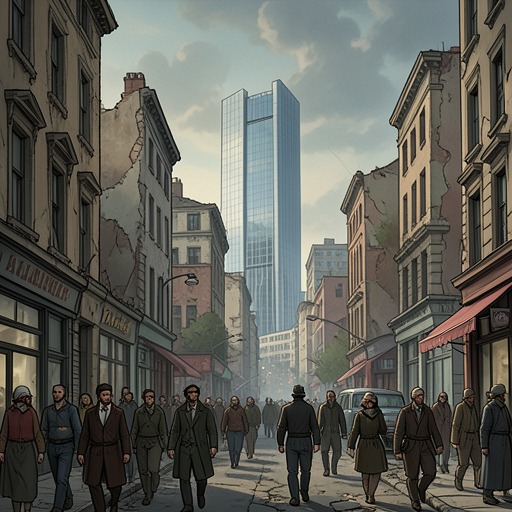
The crowd sings the national anthem as the balloon rises. The trip proves less dangerous than some spectators expect: under calm, favorable wind, the passengers fly low, passing the spurs of snow-covered mountains and the Great Swamp before reaching their destination. From above, they see Cartagena de Indias, still walled but largely abandoned after cholera panic. Its bramble-covered streets, overgrown fortifications, palaces, and monuments make the old city’s grandeur appear inseparable from its decay.
The route also passes the lake dwellings of the Trojas in Cataca. Children plunge from houses, roofs, and canoes into the water, while Fermina throws them bundles of clothing, bottles of cough syrup, and food from the balloon’s basket. The journey then crosses banana plantations. Their scale and silence prompt Fermina to remember walking there as a very young child with her mother and other women. The view is not simply a scenic panorama: it joins an aerial present to a personal memory reaching back beyond what Fermina’s father believed she could recall.
Cholera and the Evidence Below
The flight’s apparent elevation does not provide an escape from the region’s crisis. Looking through a spyglass, the pilot sees what appear to be bodies in the cultivated fields. Juvenal observes ox carts, railway boundaries, and damaged irrigation ditches, and also sees human remains. When someone attributes the deaths to cholera ravaging the villages of the Great Swamp, Juvenal notes that the bodies appear to have been killed by blows to the back of the neck. His observation exposes the inadequacy of the official explanation: the deaths are being folded into an epidemic narrative even though the evidence from the air points to deliberate killing.
The balloon lands safely on a broad, hot beach. Local officials, schoolchildren waving flags, beauty queens, and a brass band welcome the party. Fermina hopes to see her birthplace and compare it with her earliest memories, but plague precautions prevent her from going there. Juvenal delivers the Governor’s letter, the expedition’s central official document; it is subsequently misplaced among other papers and never seen again. The contrast is sharp: the flight is meant to establish an enduring record of technological firsts, yet its proof disappears, while the journey’s less formal observations reveal conditions the ceremony does not acknowledge.
Return and Significance
The pilot cannot make the balloon rise again. The party travels by mule to the dock at Pueblo Viejo, where the swamp meets the sea. Fermina recognizes the place as one she remembers passing through with her mother in a cart drawn by oxen. Her father had repeatedly insisted that the journey she described happened at least five years before she was born. The stop therefore links the expedition’s forward-looking technology to a dispute over memory: the official record goes missing, but Fermina’s recollection persists despite another person’s certainty that it cannot be true.
Three days after setting out, the expedition returns to its port of origin after a stormy night and receives a heroes’ welcome. Florentino Ariza is again lost in the crowd, watching Fermina from the margins of a public event. He recognizes traces of fear on her face, but later that afternoon sees her ride in a cycling exhibition sponsored by Juvenal. Her skill and independence in the exhibition complicate the spectators’ earlier doubts about a woman’s place in the balloon. For Florentino, such fleeting public appearances become markers of time: he registers its passage less through changes in himself than through the changes he perceives in Fermina. The flight thus remains at once a civic spectacle, an imperfect claim to modernity, and an episode whose most consequential revelations concern the region beneath the balloon and the memories carried by its passengers.