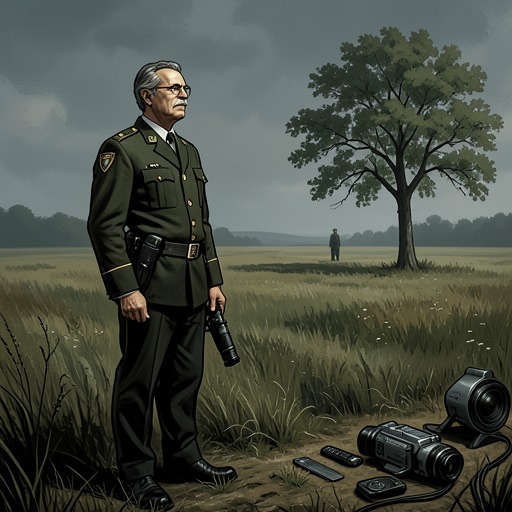
Park of the Evangels
Love in the Time of CholeraThe Park of the Evangels is the small urban park where Florentino Ariza first sees Fermina Daza and then waits to watch her pass. Repeated walks beneath its almond trees transform a public place into a theater of secret attention: Florentino watches from a hidden bench, while Fermina and Aunt Escolástica gradually recognize him and make his presence part of their shared private life.
Setting and First Encounter
Florentino’s first sight of Fermina comes indirectly, after he delivers a telegram to Lorenzo Daza at a partly ruined house on the Park of the Evangels. The house is undergoing extensive renovation, and its emptied, work-filled passageways lead to an interior world Florentino does not yet understand. On his way out, he sees Fermina in the sewing room with Aunt Escolástica, who holds open a book as the girl gives her a reading lesson. The glimpse connects the park’s public setting to the household beyond it, but Fermina does not yet know who the young messenger is.
The school route soon makes the park a place of deliberate waiting. From seven in the morning, Florentino takes the most secluded bench he can find and pretends to read verse in the shade of the almond trees. Fermina passes in her blue-striped uniform, her schoolbooks held against her chest and a thick braid reaching to her waist. Because her father’s strict rules keep her beside her aunt, Florentino has no easy way to approach. He sees them pass four times each day and again on Sundays after High Mass; for a time, seeing her is all he can hope for.
Watching and Recognition
The routine is initially one-sided. Florentino idealizes the girl from a distance, assigning her imagined virtues and sentiments, and spends his hours in the park turning a brief sight into an all-consuming attachment. The gap between his inward intensity and the outward regularity of Fermina’s passing gives the place its charged atmosphere: he is present, but the two have not yet spoken.
Fermina eventually recognizes the quiet figure beneath the trees. Her father’s account of the telegram explains why Florentino had come to the house and that he works with the telegraph, an invention that holds a particular fascination for her. Recognition alone does not make her curious about love; at first, his frail appearance chiefly inspires pity, as though he were ill. Aunt Escolástica, however, understands the repeated sightings as courtship. She points him out to Fermina and treats his patient watchfulness as a diversion they can share.
A Shared Secret
Aunt Escolástica’s complicity changes the park from a place of solitary observation into part of a small, confidential world between the two women. As they walk through the park, both look quickly for Florentino and suppress their laughter when one spots him first. He, meanwhile, sees the pair cross with the rigid, aloof composure that makes his pursuit seem so difficult. The same repeated passage thus carries different meanings: for him, it is a vigil; for the aunt and niece, an intimate joke and a developing possibility.
The aunt prepares Fermina for the prospect of forbidden courtship by teaching her sign language, a way to communicate without attracting notice. Fermina’s amusement and curiosity deepen gradually rather than all at once. She comes to long for the letter Florentino has not yet dared to deliver, and the park’s recurring encounters become the visible edge of a relationship still conducted largely through glances and anticipation.
The Vacation Season and Approach
During a three-month school vacation, Fermina appears each afternoon beneath the almond trees at the house’s doorway, giving Aunt Escolástica another reading lesson. Florentino first assumes the arrangement is accidental, perhaps a consequence of the repairs, but then understands that he can see Fermina at the same time every day. He cannot tell whether she notices him or rejects him; he reads her apparent indifference as a radiance that sustains his hope.
Toward the end of January, Aunt Escolástica leaves Fermina alone at the doorway beneath falling yellow leaves. Florentino takes the opening as an arranged opportunity, crosses the street, and stops before her. He asks only that she accept a letter. The park and the adjoining doorway have brought his long, silent pursuit to its first direct appeal, while the response to that appeal belongs to the next turn in their courtship.
Narrative Significance
The Park of the Evangels matters less as a landmark than as a pattern of repeated access and distance. Its ordinary paths allow Florentino to see Fermina again and again without being able to reach her; the strict escort that blocks an approach also creates the ritual through which the aunt and niece notice him. Almond-tree shade, a hidden bench, and the daily walk become the modest material conditions of a private romance.
The setting also gives the courtship a gradual, spatial form. First comes the accidental glimpse linked to the telegram, then the repeated watch from a distance, then mutual recognition, complicity, and finally the crossing of the street. Florentino’s first request for a letter is a small physical movement through the park, but it marks a decisive change from longing observed at a distance to love openly addressed.