San Jose Ship
Love in the Time of CholeraThe San José galleon is the treasure-laden flagship lost with its commander and crew during an English attack on the Terra Firma fleet in 1708. In the novel, its wreck lies at the intersection of documented imperial history and maritime legend: Florentino Ariza pursues it as a concealed salvage target, while the objects brought up from the seabed seem to verify a vision of ships preserved intact in their own lost time. The galleon’s material riches make it a prize; its distance beneath the water makes it an image of the past that can be approached but not wholly recovered.
Historical Identity and Cargo
The San José was the flagship of the Terra Firma fleet, one vessel in a convoy of twelve supply ships of varying sizes. It had arrived after May 1708 from the celebrated fair at Portobello in Panama, carrying part of its cargo already aboard: three hundred trunks of silver from Peru and Veracruz, and 110 trunks of pearls gathered and counted on Contadora Island. During the month the fleet remained in port, popular festivities marked the interval before the rest of the treasure was loaded. That additional cargo included 116 trunks of emeralds from Muzo and Somondoco and thirty million gold coins, wealth intended to rescue the Kingdom of Spain from poverty.
The convoy sailed with a heavily armed French squadron, but the escort could not protect it from the English squadron commanded by Charles Wager, waiting at the entrance to the bay in the Sotavento Archipelago. The San José was among the first ships to sink. Its commander went down with the vessel, standing upright on the quarterdeck, and the flagship alone carried most of the fleet’s cargo. The account leaves the broader wreckage uncertain: no reliable record establishes how many other ships were lost or how many escaped the English guns. Against that uncertainty, the San José’s fate is presented as certain and especially consequential because the ship held the largest share of the treasure.
A Wreck Sought in Secret
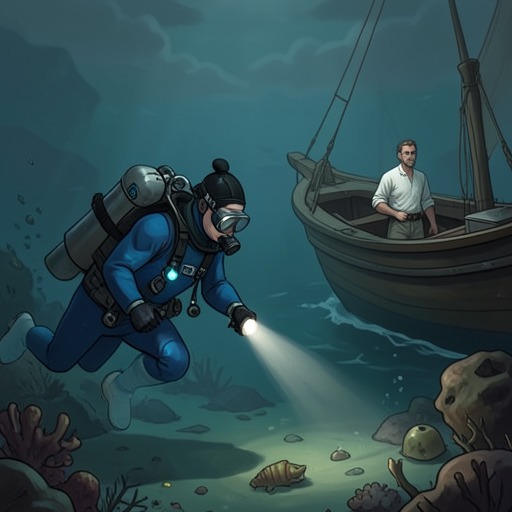
After hearing about the treasure at a transient hotel, Florentino Ariza studied the habits of galleons and consulted old navigation charts. He believed he had worked out the wreck’s location and hired Euclides, a capable navigator and diver, for repeated Sunday expeditions. At first Florentino concealed the purpose of the search. The pair explored waters reached by sailing out between the two fortresses of Boca Chica and into the calm interior of the archipelago, where Florentino directed Euclides to dive while remaining aboard himself. Although Euclides could descend to the seabed, Florentino had never learned to swim and maintained that the sea was made to be viewed through a window.
The first search plan failed because Florentino had chosen the wrong site. After three Sundays without success, he disclosed his secret to Euclides, who changed their course to follow the galleons’ old channel more than twenty nautical leagues east of the original location. Less than two months later, Euclides stayed underwater so long that the canoe drifted away; unable to row it back, Florentino watched him swim almost half an hour to reach it. When Euclides climbed aboard, he produced two pieces of women’s jewelry from his mouth. Their recovery turned a speculative search into evidence that the seabed contained a field of old wrecks—and made Florentino wish to learn to dive deeply enough to see it himself.
The Ship Beneath the Coral
Euclides described the wreckage as an immense underwater landscape, not a single isolated ship. At a depth of only eighteen meters, he said, old sailing vessels lay among coral reefs across an area too vast to survey. Several caravels still had their sails intact. The wrecks seemed to have sunk with their own space and time, remaining illuminated by the same eleven-o’clock sun that shone when they went down on Saturday, June 9. The image makes the seabed less a place where history has simply ended than a world in which its moment of ending appears to persist.
The San José was the easiest vessel to identify: its name remained visible in gold letters on the stern. Yet it was also the ship most damaged by English artillery. Euclides reported an octopus inside, more than three centuries old, its tentacles reaching through the cannon openings and its body grown so large in the dining room that freeing it would require destroying the ship. He also described the commander’s body, dressed for battle and floating sideways inside the forecastle. He had not reached the treasure in the hold because he lacked sufficient air. The two recovered pieces—a salt-corroded emerald earring and a medal of the Virgin—were the limited, tangible proof of a discovery whose most astonishing contents remained underwater.
Legend, Letter, and the Limits of Recovery
The wreck’s exact depth and accessibility become part of its contested identity. In a letter sent to Fermina Daza in Fonseca shortly before her return, Florentino first mentioned the treasure and the expedition. She already knew the galleon’s story from Lorenzo Daza, who had spent time and money trying to persuade a company of German divers to salvage the treasure. Members of the Academy of History eventually dissuaded him, arguing that the tale of the wrecked galleon had been invented by a brigand of a viceroy to conceal the theft of the Crown’s wealth. For Fermina, the ship lay beyond human reach at a depth of two hundred meters, not the twenty Florentino claimed. The recovered jewelry and Euclides’s account thus give the legend a physical foothold without settling every doubt surrounding it.
Florentino’s subsequent letters offered increasingly fantastic details, delivered with the same seriousness as his promises of love. Fermina, accustomed to his poetic exaggerations, initially treated the adventure as one of his most successful inventions; as the letters continued, she confessed to Hildebranda Sánchez that she feared her dazzled sweetheart had lost his mind. The San José therefore operates on two levels: it is a real historical wreck, approached through charts, diving, and recovered objects, and a story Florentino reshapes for an intimate reader. Its treasure remains inaccessible even as its name, cargo, and imagined interior become vividly present. The contrast between the small objects brought to the surface and the enormous hold left unexplored gives the quest its enduring force: discovery is real, but recovery remains incomplete.