Solitude and the need for love
Love in the Time of CholeraSolitude and the need for love are linked through two contrasting lives: Fermina Daza’s enforced isolation in her father’s house and Florentino Ariza’s search for intimacy in a succession of secret relationships. For Fermina, confinement makes time itself an adversary; for Florentino, loneliness becomes both a quality others perceive and the condition under which he pursues love.
Fermina’s confinement
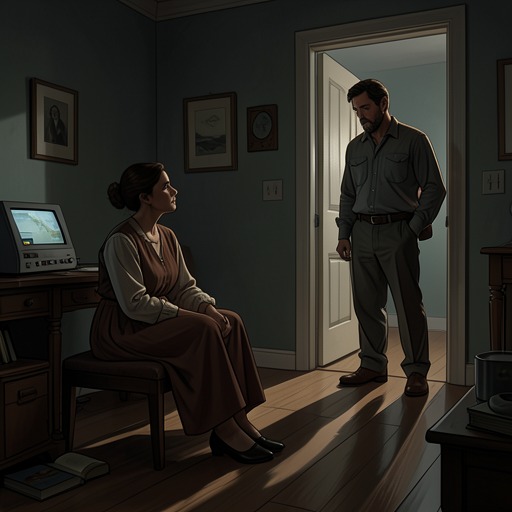
After Fermina’s expulsion from the Academy of the Presentation of the Blessed Virgin and the departure of Aunt Escolástica, her days narrow to the household. Hildebranda Sánchez sees her cousin as an old maid of twenty, secluded in a private life that is unlike the busy, sprawling family homes Hildebranda knows. Fermina wakes at six and spends the day waiting through a steady procession of people at the door: sellers, beggars, charity workers, tradesmen, and fortune-tellers. Their visits punctuate the hours without giving her a life beyond them.
Gala Placidia takes over many of the household duties previously associated with Aunt Escolástica, caring for the linens, preserving the wardrobe of Fermina’s dead mother, and managing the front door. Fermina, meanwhile, retains authority over domestic decisions: she chooses meals and purchases and determines what should be done, though the house offers little that needs deciding. After washing the birdcages, feeding the birds, and tending the flowers, she is left at a loss. Painting lessons make the passage of time more tolerable, but they remain another way to fill it; after her expulsion she sometimes sleeps through the afternoon and does not wake until the following day.
Her separation from Lorenzo Daza is quiet but consequential. Their relationship has lacked affection since Aunt Escolástica was expelled, and they have settled into a way of living that avoids disturbing one another. He gives Fermina spending money, accepts requests for unexpected expenses without demanding an account, and keeps his business and port offices outside her knowledge. One night he comes home in a state that frightens her and announces that they are ruined. He never repeats the claim, and nothing confirms it, but the unexplained warning leaves Fermina feeling alone in the world.
A social world closed to her
Fermina’s isolation is not simply the absence of company; it is the loss of a place in the social world. Her former schoolmates belong to a sphere closed to her after the disgrace of her expulsion. Her neighbors knew her only as a girl in the Academy’s uniform, while her father’s world consists of traders, stevedores, war refugees, and solitary men. The other girls who attend painting classes with her offer only temporary companionship: their affection ends when each lesson does.
Hildebranda tries to break this enclosure by proposing a Carnival dance with musicians, fireworks, and gunpowder displays. The idea fails because there is no one to invite. The failure makes plain that Fermina’s seclusion has already deprived her of the ordinary network through which a social gathering could be formed. Hildebranda’s recognition of this emptiness is the beginning of a practical intervention, not merely an expression of sympathy.
Hildebranda draws Fermina outward
After painting class, Hildebranda takes Fermina into the city. Fermina shows her the route she once traveled with Aunt Escolástica, the bench where Florentino Ariza used to wait while pretending to read, and the narrow streets he followed her along. She also points out places where their letters were hidden and the former prison of the Holy Office, later restored as the Academy she came to hate. The walk allows her to share a past that her present household cannot contain.
The cousins climb the hill above the paupers’ cemetery, where Florentino used to play the violin according to the direction of the winds so Fermina could hear him in bed. From there they look across the historic city: its broken roofs, decaying walls, ruined fortifications, islands in the bay, and poor settlements around the swamps, with the Caribbean beyond. The outing gives Fermina’s private memories a shared setting. Hildebranda cannot undo the social exclusions that have shaped her cousin’s life, but she can bring her into the city and listen as Fermina maps her former intimacy onto its streets.
Florentino’s response to loneliness
Florentino’s first bedroom relationship, with the Widow Nazaret, does not become the lasting union his mother hoped for. Instead, it opens into a wider pattern of affairs. The Widow’s tenderness answers something in his loneliness, while their connection eventually fades as she broadens her own horizons and he seeks consolation elsewhere. Their gradual forgetting of one another shows that intimacy can relieve solitude without necessarily ending it.
Florentino develops a cautious method for approaching women. He has an eye for recognizing a woman who is waiting for him, but he avoids risking a refusal, which he finds deeply humiliating. The women, in turn, read him as a solitary man in need of love. His apparent helplessness invites them to give affection without requiring promises or expecting a return beyond the reassurance of having helped him. The pattern rests on an asymmetry: their kindness offers comfort, while he continues to carry the pain associated with Fermina.
He records these secret relationships in a coded book titled Women, beginning with the Widow Nazaret. By the time Fermina is free of her marriage, the record has grown to about twenty-five notebooks and 622 long-term liaisons, separate from numerous brief encounters he does not record. The scale of the archive turns his response to loneliness into a sustained, highly organized practice. Yet the record does not prove that he has escaped his original attachment. After six months with the Widow, he believes he has survived the torment of Fermina’s loss, and for a time speaks as though he has achieved freedom.
Love as need and interruption
That confidence breaks when Florentino unexpectedly sees Fermina leaving High Mass with her husband, surrounded by the attention of her new social world. The women who once treated her as an upstart now welcome her, and she moves among them with ease. Her changed appearance and bearing make her momentarily difficult for Florentino to recognize; when he sees that she is six months pregnant, the distance between their lives becomes unmistakable. He sees her and her husband as an assured couple and responds not with anger or jealousy but with contempt for himself, feeling poor, ugly, and unworthy.
The episode exposes the limit of Florentino’s serial consolations. He has treated other relationships as evidence that he can recover from Fermina, but seeing her established life revives the sense of loss. At the same time, the novel does not present Fermina’s isolation and Florentino’s longing as interchangeable: she is cut off by expulsion, social boundaries, and the narrow routines of her home, while he repeatedly seeks out relationships and records them. Their distinct circumstances converge in the recognition that love is bound up with the need to be seen, accompanied, and admitted into a world that solitude has closed.