Sotavento Archipelago
Love in the Time of CholeraThe Sotavento Archipelago is the remote maritime setting of Florentino Ariza’s search for the sunken San José and its treasure. Reached by way of the old galleon routes, its reefs and sheltered waters become a world beneath the ordinary one: a place where a boy diver can descend among ships preserved in coral and time, while the man who hires him remains unable even to swim. The expedition gives Florentino a practical adventure to describe in his letters to Fermina Daza, but the archipelago’s elusive wrecks also let his romantic imagination speak in the guise of discovery.
Geography and Historical Setting
The archipelago lies along the route Florentino reconstructs from old navigation charts. Ships leave the bay between the two fortresses of Boca Chica and, after four hours of sailing, enter the archipelago’s calm interior waters. At its far end, two hours from the largest island, lies the area he initially believes to contain the San José. Florentino’s proposed search point is sixteen nautical miles northwest of the largest island; after the first attempts fail, Euclides redirects their search along the old galleon channel, more than twenty nautical leagues east of that location.
The water above the reefs appears unusually clear and still. The men can pass over manta rays and squid, and the account describes lobsters resting among the coral so plainly that they can be picked up by hand. Those placid conditions contrast with the violent history that brought the wrecks there. In May 1708, the San José, flagship of the Terra Firma fleet, sailed with a convoy and a heavily armed French squadron, only to meet the English squadron under Commander Charles Wager at the archipelago’s entrance to the bay. The San José sank among other vessels, carrying most of the fleet’s cargo.
The Expedition in the Coral Waters
Florentino’s plan begins with a letter-writing purpose as much as a nautical one: he resolves to tell Fermina that he will salvage the treasure for her. Watching fishermen bring sleeping fish to the surface with mullein gives him the idea of recruiting boys who dive for coins tossed into the water. He chooses Euclides, a swimmer of about twelve, after testing his claims about diving, navigation, sailing, and keeping a secret. Euclides agrees to work for the fishermen’s usual pay, with five additional reales on Sundays, and calculates the practical costs of canoe and equipment rental. Their supplies include food, fresh water in a demijohn, an oil lamp, tallow candles, and a hunter’s horn for emergencies.
The first three Sundays lead nowhere. Florentino has withheld the reason for the search, so Euclides cannot know what object to look for. Florentino refuses the boy’s invitation to dive with him: he has never learned to swim and says the sea was made to be viewed through a window. When the weather turns cold and dark falls abruptly, the pair steer back toward port by the lighthouse. A French ocean liner passes close by the canoe as they return, a reminder that the archipelago remains both a working sea route and the setting of their hidden venture.
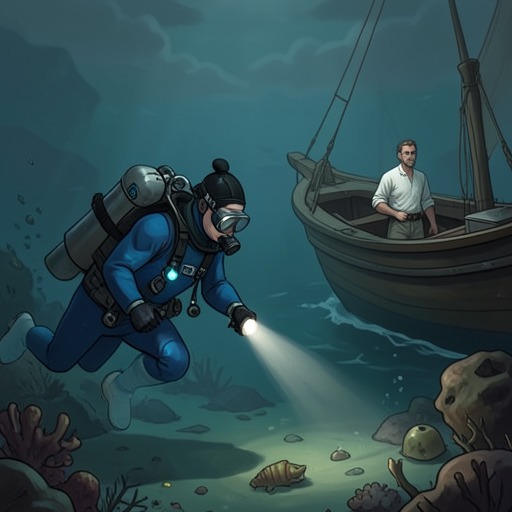
Once Florentino finally reveals the secret, Euclides changes the search area. Less than two months later, during a rainy outing, he spends so long underwater that the canoe drifts away; unable to row it back to him, Florentino watches as Euclides swims nearly half an hour to reach it. The boy climbs aboard with two pieces of women’s jewelry in his mouth. His discovery does not yet recover the treasure, but it transforms the archipelago from a conjectural search site into a field of tangible wreckage and gives Florentino a new desire: to learn to swim and dive so that he can see the depths himself.
The San José and Its Cargo
Florentino’s hunt rests on a history of the wrecks that he has pieced together from accounts of galleons. The San José was the flagship of a fleet of at least twelve supply ships. It had arrived after May 1708 from the fair at Portobello, Panama, with three hundred trunks of silver from Peru and Veracruz and one hundred ten trunks of pearls from Contadora. During its long stay, further cargo was brought aboard for the Spanish Crown: one hundred sixteen trunks of emeralds from Muzo and Somondoco and thirty million gold coins.
The fleet sailed in convoy with French protection, but the English squadron’s accurate cannon fire overcame it at the archipelago’s entrance. The San José was among the first vessels to sink, with its crew and commander; it alone carried most of the convoy’s cargo. The number of other ships lost or escaped is uncertain, and the historical account thus offers no complete map of the wreck field. That uncertainty underpins the expedition: Florentino thinks the navigation charts have enabled him to identify a precise site, but Euclides’s finds reveal a much wider landscape of sunken vessels than his original calculations allowed.
Euclides’s Account and the Uncertain Wrecks
Euclides describes numerous old sailing ships lying among the reefs at a depth of only eighteen meters, spread across an area too extensive to see to its end. He claims that several caravels still have their sails intact and that the wrecks seem to retain the space and time in which they sank, illuminated by the eleven-o’clock sun of Saturday, June 9. The San José is identifiable by its name in gold letters on the poop, though it is also the ship most badly damaged by English artillery.
In Euclides’s account, the wreck is at once archaeological site and uncanny tableau. An octopus more than three centuries old has grown so large inside the dining room that freeing it would require destroying the ship; the commander’s body remains dressed for battle, floating sideways in the forecastle. Euclides says he did not reach the treasure-filled hold because he lacked enough air. The emerald earring and Virgin medal he produces, their chain corroded by salt, give his story physical tokens, but they do not establish that he saw the hold or recovered any treasure. The expedition’s central promise therefore remains suspended between proof and elaboration.
Letters and the Archipelago’s Narrative Role
Florentino first mentions the galleon to Fermina in a letter sent to Fonseca shortly before her return. She already knows the legend from Lorenzo Daza, who once spent time and money trying to recruit German divers to recover the treasure. Historians had persuaded Lorenzo that the wreck story might have been invented by a viceroy to conceal theft from the Crown; Fermina also believes the ship lies at two hundred meters, beyond human reach, rather than the twenty meters Florentino claims. She nevertheless welcomes his adventure as one of his more successful poetic inventions. As later letters accumulate further fantastic details, she confesses to Hildebranda Sánchez that she fears her dazzled sweetheart may have lost his mind.
The archipelago consequently holds together two competing scales of truth. Its sea lanes, reefs, artifacts, and recorded battle connect it to documented maritime history; its apparently time-preserved wrecks arrive through the exuberant report of a boy who says yes to every test and speaks with conviction. Florentino’s expedition does not resolve that tension by bringing the treasure ashore. Instead, the archipelago becomes the setting for a search that can be narrated to Fermina as both a concrete undertaking and an extravagant act of love.