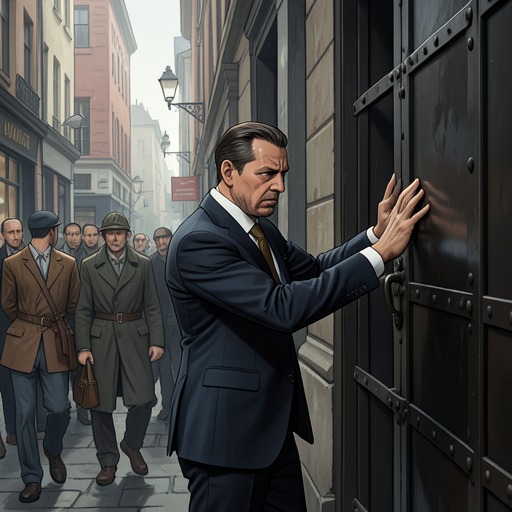
Street of Windows
Love in the Time of CholeraStreet of Windows is Florentino Ariza’s home, a discreet refuge whose many windows give its street a name and evoke the possibility of watching eyes behind curtains. Across separate moments in his life, the address holds the secrecy of his family origins, the private order he builds around his unfulfilled love for Fermina Daza, and the solitude through which he remembers her.
Identity and Setting
The street is associated first with the concealed circumstances of Florentino Ariza’s birth. His father, Pius V Loayza, had once slept there during the beginning of his relationship with Tránsito Ariza, but apparently stopped visiting after their son was born. Florentino had no direct memory of his father on the street. His baptismal record identified him only as the natural son of Tránsito, herself an unmarried daughter; Pius V’s name was absent, although he secretly provided for the boy until his death.
The street’s domestic setting also embodies a contradiction: it offers privacy despite its conspicuous windows. Florentino’s house is described as discreetly located, even though the architecture might suggest many hidden observers. That tension suits a life in which concealment is not incidental but a condition of intimacy.
Family Secrecy and Separation
As a boy, Florentino waited across from the River Company of the Caribbean offices on Fridays. His father would enter without acknowledging him, then leave hours later and discreetly give him money for the week. They did not speak; Florentino was frightened of him, and his father made no effort to bridge the distance. On one occasion, after a longer-than-usual wait, Pius V gave him the coins and ordered him not to return. The street’s association with his father thus leads not to recognition or reconciliation but to a final act of rejection.
The concealed paternity shaped Florentino’s prospects beyond the home. His social status prevented him from entering the seminary, while being the only son of an unmarried woman exempted him from military service during a particularly bloody period of the wars. The address belongs to a private family history whose consequences extended into public life, even as the father’s support remained hidden from view.
A House Reserved for Fermina Daza
After Tránsito Ariza’s death, Florentino was left alone in the house. He regarded it as a refuge suited to his way of loving, but its emotional meaning was defined by an absence: it had been made to please Fermina Daza, and no one else. He preferred to forgo many opportunities during his most fruitful years rather than bring other loves into it. The house therefore became less a shared home than a space maintained for the possibility of one particular beloved.
His changing position in the River Company of the Caribbean gave him practical forms of privacy elsewhere, including permission, with the watchmen’s cooperation, to use company offices at night, on Sundays, and on holidays. The Street of Windows remained distinct from those temporary accommodations: it was the home he protected from other relationships because he had reserved its meaning for Fermina. His professional advancement could open secret spaces, but it did not displace the emotional claim attached to his own house.
Return, Solitude, and Memory
Much later, during a night of distress, Florentino returned to the Street of Windows and visited Prudencia Pitre, a woman he had known since the previous century. He carried two bottles of port and a jar of pickles, uncertain whether she still lived in her old house, whether she was alone, or even whether she was alive. She recognized the scratching signal he had used when they were younger and opened the door without asking questions. The visit shows the street as a point of return to old connections when he is in need of human company.
After leaving Prudencia, Florentino awoke in his mother’s preserved bedroom. He sometimes slept there when solitude troubled him, and the large mirror from Don Sancho's Inn hung opposite the bed. In its depths he saw Fermina Daza reflected. The room, the mirror, and the house turn memory into part of the present: even in waking, his perception of the beloved remains attached to the familiar interior.
The street consequently gathers several forms of concealment into one place: a father’s hidden support and eventual repudiation, Florentino’s guarded devotion to Fermina, and his later retreat into a home full of remembered associations. Its windows make privacy feel exposed, while the house’s inward spaces preserve what cannot be openly shared. It is both a setting for isolation and the material refuge through which Florentino sustains a love that has never become a shared domestic life.